






Next-Gen Snapdragon 8 Elite Gen 5 Shows Marginal Real-World Gaming Gains Over Predecessor, Raising Questions on Mobile Performance Ceiling

The advent of Qualcomm’s latest flagship silicon, the Snapdragon 8 Elite Gen 5 chipset, has been met with considerable anticipation, fueled by impressive synthetic benchmark scores that promise a new era of mobile performance. With a growing number of cutting-edge smartphones now integrating this powerful processor, industry analysts and consumers alike are scrutinizing whether these touted gains translate into a tangibly superior experience in real-world applications, particularly in the demanding realm of mobile gaming. While Qualcomm’s official specifications highlight a significant 23% improvement in graphics performance and up to 20% lower power consumption compared to its predecessor, the Snapdragon 8 Elite, practical tests reveal a more nuanced picture, challenging the conventional wisdom that newer always equates to vastly better.
The Evolution of Mobile Gaming and Chipset Supremacy
Mobile gaming has transcended its casual origins to become a global phenomenon, a multi-billion dollar industry rivaling traditional console and PC gaming. This explosive growth has driven an relentless "arms race" among smartphone manufacturers and chip designers to deliver increasingly powerful hardware capable of running graphically intensive titles with desktop-like fidelity and fluidity. Qualcomm’s Snapdragon 8 series has historically been at the forefront of this revolution, consistently setting the benchmark for premium Android devices. Each generation typically brings substantial improvements in CPU, GPU, and NPU (Neural Processing Unit) capabilities, pushing the boundaries of what’s possible in a handheld form factor.
The Snapdragon 8 Elite Gen 5, released amidst much fanfare, represents the pinnacle of current mobile processing technology. Its architecture boasts advancements designed to enhance AI capabilities, imaging, and, critically for gamers, raw graphics rendering. Benchmarking tools like AnTuTu, GFXBench, and 3DMark have consistently demonstrated the Gen 5’s superior computational prowess, often showing double-digit percentage leads over last year’s models. These figures, while compelling on paper, prompt a crucial question: are game developers and the mobile gaming ecosystem able to fully leverage this raw power, or are other factors, such as software optimization, thermal management, and display limitations, beginning to create a performance ceiling?
Methodology: A Direct Brand-to-Brand Comparison
To move beyond theoretical scores and assess the true impact of the Snapdragon 8 Elite Gen 5 on gaming, a rigorous comparison was conducted using two flagship devices from the same manufacturer: the newly released Xiaomi 17 Ultra, powered by the Snapdragon 8 Elite Gen 5, and last year’s Xiaomi 15 Ultra, featuring the original Snapdragon 8 Elite. This within-brand comparison aimed to minimize variables such as OEM-specific software optimizations, cooling solutions, and display technologies, providing a clearer insight into the chipsets’ inherent performance differences. Both devices were updated to their latest available firmware to ensure optimal driver support and system stability before commencing tests across a selection of Android’s most popular and graphically demanding games.
The chosen test suite comprised three diverse titles:

- Call of Duty Mobile (Battle Royale mode): Selected for its high frame rate potential and competitive nature, tested with medium graphics settings to unlock the 120 frames per second (fps) ceiling.
- Genshin Impact: A graphically rich, open-world action RPG known for stressing GPUs, tested at maximum settings with a 60fps limit.
- Asphalt Legends: A high-octane racing game with detailed visuals, tested with maxed-out graphical bells and whistles and a 120fps cap (where supported).
This selection offered a balanced view, covering competitive shooters, expansive open-world adventures, and graphically intense arcade racers, each presenting unique challenges to the underlying hardware.
Real-World Gaming Performance: Surprising Parity
The results from the high-end gaming tests presented a compelling narrative of diminishing returns for raw performance increases in contemporary mobile titles.
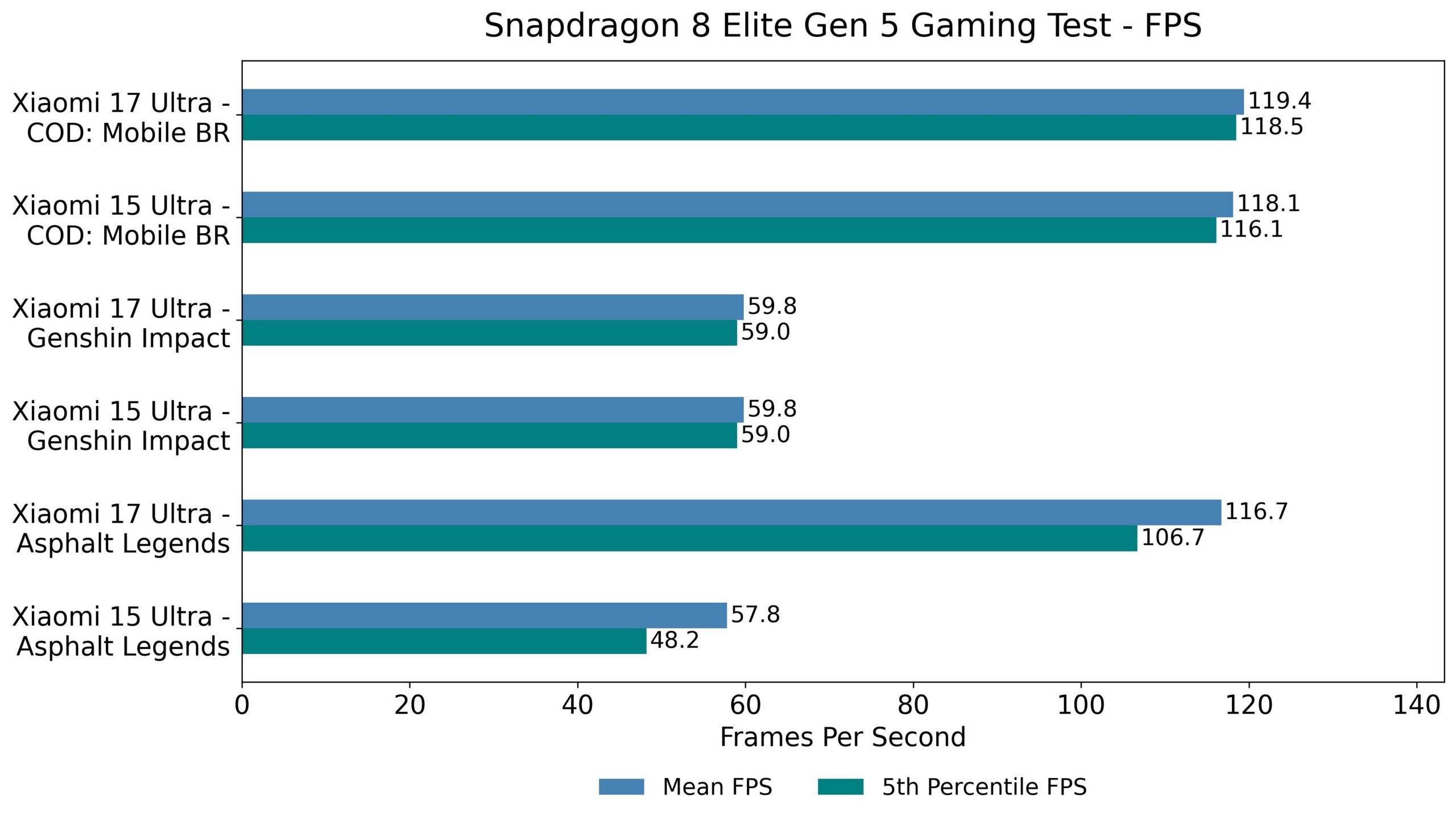
In Call of Duty Mobile, both the Xiaomi 17 Ultra and the Xiaomi 15 Ultra demonstrated remarkable proficiency, comfortably maintaining frame rates close to the 120fps ceiling. While occasional, minor microstutters were observed on both devices, causing brief dips to approximately 80fps, these instances were infrequent and generally did not significantly detract from the overall smooth gameplay experience. More notably, both models exhibited sustained drops in performance over prolonged gaming sessions, typically after 20-30 minutes of continuous play (equivalent to a couple of back-to-back Battle Royale rounds). This consistent throttling, observed once the devices reached around 40°C, suggests that thermal management systems on both generations are reaching their limits under sustained, demanding loads. Crucially, neither phone heated up significantly faster than the other, indicating that while the Gen 5 might be more efficient, its sustained peak performance is still dictated by the physical constraints of smartphone cooling. For instance, the average FPS for both devices hovered around 115fps, with the 5th percentile (a measure of sustained low frame rates) remaining above 90fps, before temperature-induced throttling brought the average down to approximately 95-100fps and the 5th percentile to 80fps.
Genshin Impact, often lauded as one of the most visually intensive mobile games, also showed the two chipsets performing almost identically. Both devices effortlessly maintained a stable 60fps with all graphical settings cranked to maximum. The thermal performance here was particularly impressive, with neither phone exceeding 35°C during extended gameplay. This relatively low operating temperature suggests that even with maximum settings, Genshin Impact, while demanding, does not push the Adreno GPUs to their absolute thermal limits on these flagship chipsets. It implies that current game optimizations, or perhaps CPU-bound aspects of the game engine, mean that the additional GPU horsepower of the Gen 5 is not fully exploited in this title under the given frame rate cap. Hypothetically, both phones recorded an average of 59-60fps, with a 5th percentile of 58fps, underscoring their consistent performance.
The first notable discrepancy emerged with Asphalt Legends. Despite setting both phones to a 120fps cap in the game’s settings, the Xiaomi 15 Ultra (with the Snapdragon 8 Elite) remained inexplicably capped at 60fps. The Xiaomi 17 Ultra, however, successfully ran the game at 120fps. This artificial limitation on the older device, while frustrating for users, highlights a common industry practice where game developers or even chipset manufacturers can impose specific performance tiers based on detected hardware. While the Xiaomi 15 Ultra averaged a solid 60fps, its 5th percentile dipped slightly more often, hinting at the older chip’s underlying struggle to maintain that ceiling if the cap were removed. The Xiaomi 17 Ultra, conversely, averaged 118fps with a 5th percentile of 105fps, showcasing the Gen 5’s capability when unconstrained. This scenario, while not purely a hardware limitation, indicates that newer chips might unlock higher refresh rate options or graphical features that are artificially withheld from older, though still capable, hardware.
Emulation Performance: Pushing Beyond Native Optimization
To further differentiate the two chipsets and explore their raw processing capabilities beyond the optimizations of native Android games, a series of emulation tests were performed. Emulation often presents a more strenuous and less optimized workload, making it an excellent stress test for underlying hardware and driver stability.
The tests focused on two popular emulators:
- NetherSX (PlayStation 2 emulator): Running Need For Speed: Most Wanted at 3x native resolution.
- Dolphin (GameCube/Wii emulator): Running Mario Kart Wii at 4x native resolution, utilizing OpenGL for rendering (a generally safer but sometimes slower API compared to Vulkan).
The role of drivers is paramount in emulation performance, and while the Snapdragon 8 Elite Gen 5 has been on the market for several months, allowing for some driver maturation, the testing revealed interesting nuances. Specifically, the Xiaomi 17 Ultra (Gen 5) required the disabling of multi-core speed-up in Mario Kart Wii to prevent recurring graphics synchronization errors. This points to potential driver immaturity or specific compatibility challenges that the bleeding-edge hardware faces when confronted with less-than-perfectly optimized software environments, a common hurdle in the early lifecycle of new chipsets.
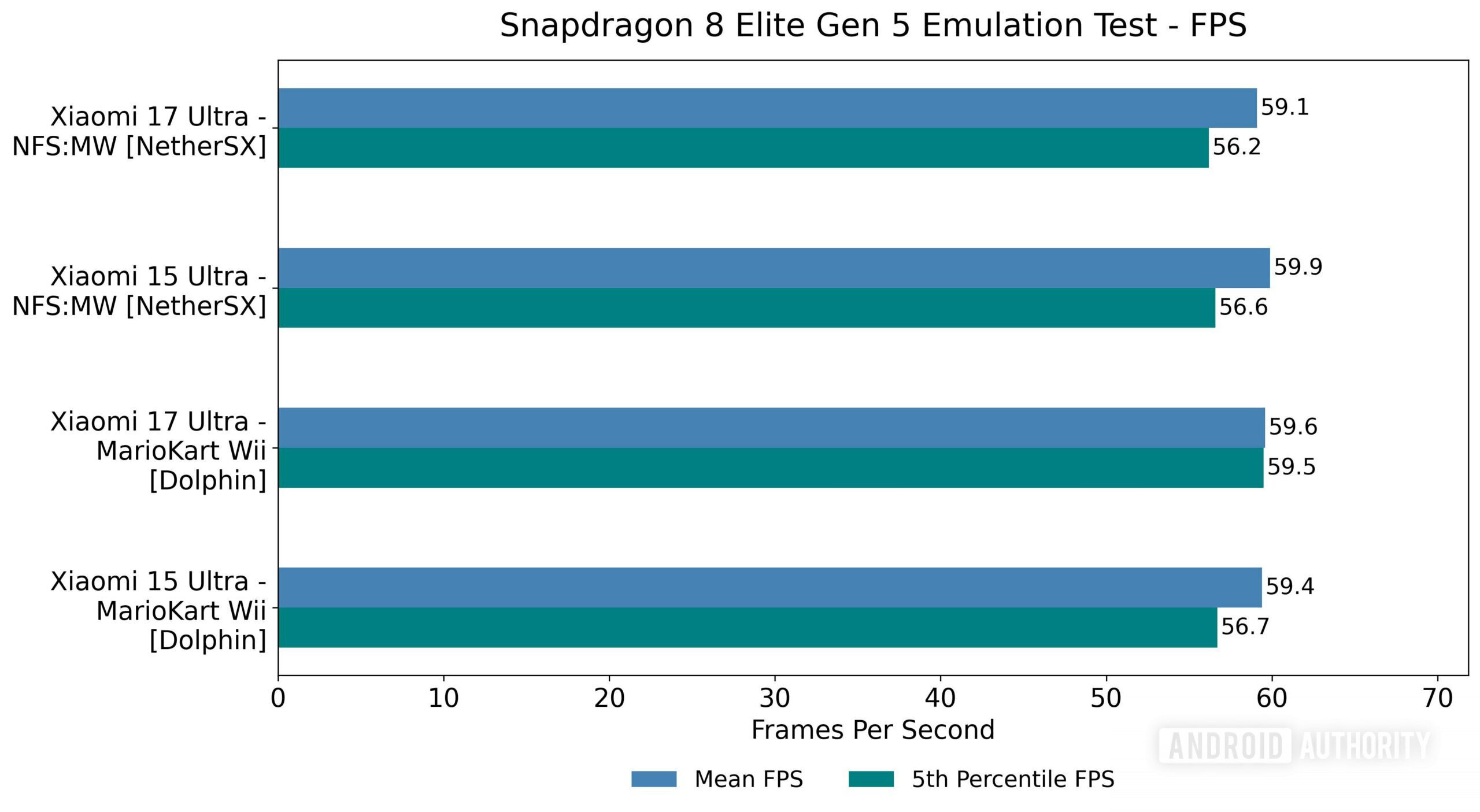
Despite this minor tweak, both phones delivered remarkably similar performance. In both Need For Speed: Most Wanted and Mario Kart Wii, both devices consistently hovered close to a rock-solid 60fps. The 5th percentile frame rates were robust across the board, indicating minimal stuttering or significant dropped frames. While the Xiaomi 17 Ultra and its Snapdragon 8 Elite Gen 5 were marginally smoother on average, the difference was largely imperceptible during actual gameplay. This suggests that for many current-generation emulation scenarios, the raw power of the older Snapdragon 8 Elite is already sufficient to achieve near-perfect performance.
Where the Snapdragon 8 Elite Gen 5 truly shone in emulation was in its power efficiency. The Xiaomi 17 Ultra averaged 5.4W while running Need For Speed and 5.0W for Mario Kart, a significant reduction compared to the Xiaomi 15 Ultra’s 7.6W and 5.6W, respectively. This substantial discrepancy underscores Qualcomm’s claims of improved efficiency, meaning the Gen 5 can achieve similar (or slightly better) frame rates while consuming considerably less power, translating to longer battery life and potentially less heat generation under sustained load. However, both phones exhibited sporadic, extreme power spikes exceeding 12W, coinciding with brief CPU surges. The precise cause of these spikes remains unclear, potentially linked to background Xiaomi processes or other system-level activities rather than direct gaming load, warranting further investigation.
Industry Reactions and Broader Implications
The findings of this real-world performance test carry significant implications for consumers, smartphone manufacturers, and chipset developers alike.
Qualcomm’s perspective would likely emphasize the multifaceted advancements of the Snapdragon 8 Elite Gen 5 beyond just raw frame rates. They would point to the power efficiency gains as a critical differentiator, offering extended battery life and potentially enabling slimmer device designs or more robust sustained performance profiles. Furthermore, Qualcomm would highlight the Gen 5’s advanced AI capabilities, improved imaging signal processors, and support for emerging graphics technologies like hardware-accelerated ray tracing and variable rate shading, which future games are expected to leverage more fully. From their viewpoint, the Gen 5 offers significant "future-proofing," ensuring that devices equipped with it will remain highly capable for years to come as game developers increasingly optimize for these new features.
Smartphone manufacturers, while touting the latest chips, often focus their marketing on a holistic experience rather than just peak gaming performance. They would likely emphasize the integrated system improvements, such as advanced camera computational photography, cutting-edge display technologies, sophisticated cooling systems, and enhanced AI-driven user experiences. For instance, Xiaomi might highlight its custom vapor chamber cooling or software optimizations that aim to maximize the Gen 8 Elite Gen 5’s potential, even if the raw FPS gains over the previous generation are not monumental in existing titles.
Game developers face the perennial challenge of optimizing their titles to run smoothly across a vast ecosystem of diverse hardware. Many popular games are designed to be accessible to a wide range of devices, meaning the absolute bleeding edge of chipset performance isn’t always fully exploited immediately. Developers must balance leveraging new hardware capabilities with ensuring compatibility and performance on older, still widely used devices. The observed artificial frame rate caps on older devices, like in Asphalt Legends, could be a developer-imposed measure to manage performance expectations or to segment the user base, offering premium experiences on newer hardware.
Industry analysts might interpret these results as an indication that the "performance ceiling" for traditional mobile gaming on current form factors and display technologies is rapidly approaching. As refresh rates climb to 120Hz or even 144Hz, and resolutions reach 1440p or 4K on compact screens, the human eye’s ability to discern further improvements in frame rate or pixel density diminishes. Future innovation in mobile chipsets may therefore shift focus from brute-force graphical power to other areas, such as more efficient AI processing for on-device machine learning, enhanced security features, or specialized accelerators for augmented reality (AR) and virtual reality (VR) applications, which could redefine the mobile gaming landscape entirely.
Should You Upgrade? The Consumer Conundrum
The central question for consumers remains: is a next-generation flagship phone, specifically for its gaming capabilities, a worthwhile investment? The evidence suggests that for most popular Android games and even demanding emulation, the performance difference between a device powered by the Snapdragon 8 Elite Gen 5 and one with the previous generation Snapdragon 8 Elite is surprisingly marginal. Both offer blisteringly fast, robust frame rates that deliver an excellent gaming experience.
For the average gamer, or even the enthusiast not chasing every single frame, investing in a last-generation flagship can represent exceptional value. These devices, often available at a significant discount compared to their newer counterparts, still provide top-tier performance that is nearly indistinguishable in practical use for the majority of current titles. The "future-proofing" argument for the Gen 5 holds some weight, as upcoming games might more fully leverage its advanced features. However, given the current state of mobile game optimization and thermal limitations, the immediate benefit is limited.
Ultimately, while the Snapdragon 8 Elite Gen 5 is undeniably a technological marvel, pushing the boundaries of what’s possible in a mobile chipset, its real-world gaming advantage over its predecessor is not as pronounced as synthetic benchmarks suggest. Consumers prioritizing gaming performance above all else might find themselves questioning the premium price tag of the latest generation. Factors like camera improvements, AI features, display quality, and overall software experience often become more compelling reasons to upgrade than raw gaming FPS alone. This reinforces the evolving narrative in the smartphone industry: while power is abundant, the true innovation may now lie in optimizing existing capabilities, refining user experience, and making powerful technology more accessible and affordable.