
Perplexity Unveils Hybrid Compute: A New Era of Secure and Efficient AI Processing for Apple Silicon Users

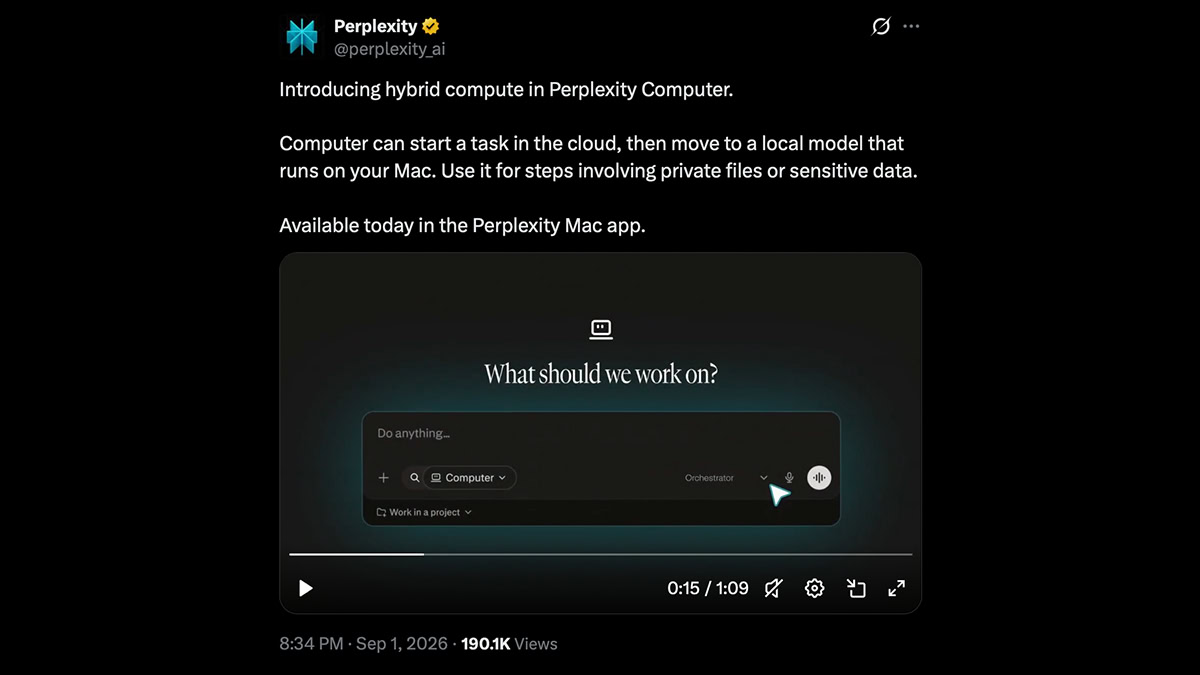
Perplexity, a burgeoning force in the artificial intelligence landscape, has continued its aggressive rollout of advanced agentic AI tools with the introduction of Hybrid Compute. This latest innovation follows closely on the heels of its earlier releases, Personal Computer in April and Portable Computer late last month, signaling a clear strategic direction towards empowering users with more versatile and secure AI capabilities. The company’s consistent momentum underscores a commitment to pushing the boundaries of what AI agents can achieve, not just in terms of computational power but also in addressing critical user concerns around data privacy and operational efficiency. Hybrid Compute, announced via a detailed post on the social media platform X, is positioned as a pivotal advancement that harmonizes the robust processing capabilities of cloud-based AI models with the inherent security and privacy benefits of local, on-device computation. This hybrid approach aims to offer a sophisticated middle ground, allowing users to leverage the strengths of both paradigms without compromising on sensitive data protection or the speed required for complex tasks.
The Evolution of Perplexity’s Agentic AI Ecosystem
Perplexity’s journey into agentic AI has been marked by rapid innovation and a clear vision for autonomous, goal-oriented AI systems. The concept of "agentic AI" refers to artificial intelligence systems designed not merely to respond to prompts but to understand, plan, execute, and monitor complex tasks, often involving multiple steps and interactions with various tools or data sources. This represents a significant leap beyond traditional conversational AI, moving towards systems that can act as intelligent assistants, capable of performing research, synthesizing information, and even managing workflows with minimal human intervention.
The introduction of Personal Computer in April laid the groundwork for Perplexity’s agentic ambitions. This tool aimed to provide users with a powerful AI agent that could assist with a wide range of personal and professional tasks, primarily leveraging cloud-based processing for its advanced reasoning capabilities. It offered a glimpse into a future where AI could take on more proactive roles in daily computing. Following this, the release of Portable Computer late last month further refined this vision by focusing on local, on-device AI processing. Portable Computer was designed for scenarios where internet connectivity might be limited or where privacy concerns necessitated that data never leave the user’s device. While offering enhanced data security, purely local processing often comes with limitations in terms of computational power and access to the vast knowledge bases available to cloud models.
This chronological progression highlights Perplexity’s iterative development strategy, addressing different facets of user needs and technological capabilities. Personal Computer showcased raw power and breadth, Portable Computer emphasized privacy and autonomy, and now Hybrid Compute seeks to reconcile these two seemingly disparate objectives. The rapid succession of these releases – Personal Computer in April, Portable Computer in late August, and Hybrid Compute in early September (referring to the typical news cycle of these announcements) – demonstrates an agile development cycle and a strategic response to evolving market demands for intelligent, secure, and adaptable AI solutions. This aggressive timeline positions Perplexity as a key innovator in the increasingly competitive field of AI agents, challenging established players and carving out a distinct niche through its focus on practical, user-centric deployments.
Understanding Hybrid Compute: A Fusion of Cloud and Local Processing
At its core, Hybrid Compute represents a sophisticated architectural design that intelligently distributes computational tasks between powerful cloud-based AI models and local models running directly on the user’s device. This ingenious division of labor is engineered to deliver the best of both worlds: the extensive computational resources and advanced reasoning abilities of large language models (LLMs) residing in the cloud, combined with the unparalleled data privacy and reduced latency offered by on-device processing. The mechanism is designed to be seamless for the user, yet robust in its execution.
When a user initiates a task within the Perplexity app that involves local files or attachments, Hybrid Compute first analyzes the nature of the data. If the system detects the presence of potentially personal or sensitive information within these files, it triggers a notification to the user. This proactive alert is a crucial privacy feature, giving the user explicit control over how their data is handled. At this juncture, the user is presented with a clear choice: they can opt to split the task, allowing the sensitive components of the data to be processed locally on their device, while the more complex, generalized reasoning or information retrieval aspects of the task are offloaded to the cloud. Alternatively, users retain the option to upload all data, including personal files, to the cloud for comprehensive processing by the more powerful remote models, if they deem the task requires it or if privacy concerns are less critical for that specific query.
This dynamic task allocation ensures that private files and proprietary data never leave the confines of the user’s machine when local processing is chosen. This is a significant differentiator in an era where data breaches and privacy concerns are paramount. For instance, if a user is analyzing a confidential business document or personal financial statements, Hybrid Compute can process the specifics of that document locally to extract relevant information or perform initial analysis, while simultaneously leveraging cloud-based LLMs to perform broader market research, competitive analysis, or synthesize general knowledge related to the task. The results from both local and cloud processes are then intelligently integrated to provide a comprehensive and secure output. This capability transforms the user’s interaction with AI, offering not just an intelligent assistant but a secure one, built on principles of data sovereignty and user control.
Technical Foundations: Models and Hardware
The effectiveness of Hybrid Compute is underpinned by the careful selection and integration of various AI models, both local and cloud-based, and its specific hardware requirements. For local processing, Perplexity has opted for models known for their efficiency and capability to run on consumer-grade hardware, particularly those optimized for neural processing units (NPUs) found in modern devices. Hybrid Compute supports Gemma 4 E4B, Qwen 3.6, and a Perplexity post-trained version of the Qwen 3.6 model.
Gemma, developed by Google, is a family of lightweight, open models built from the same research and technology used to create the Gemini models. Gemma 4 E4B, likely a more compact and efficient variant, is ideal for on-device inference due to its optimized architecture. Qwen, developed by Alibaba Cloud, is another powerful open-source large language model that has demonstrated strong performance across various benchmarks. Perplexity’s decision to include Qwen 3.6 and a fine-tuned version of it suggests a strategy to leverage robust, adaptable models that can be effectively compressed and run locally while still delivering high-quality results. These local models are crucial for handling sensitive data without transmitting it over the internet, and for performing tasks where immediate responses are preferred, even if the computational demands are slightly lower than those requiring expansive cloud resources.
On the cloud side, Perplexity taps into the immense power of leading-edge commercial LLMs, including Claude Opus 5 and GPT 5.6 Sol. Claude Opus 5, a flagship model from Anthropic, is renowned for its advanced reasoning capabilities, context window, and ability to handle complex prompts, making it suitable for intricate research, creative writing, and nuanced problem-solving. Similarly, GPT 5.6 Sol, a hypothetical or future iteration of OpenAI’s GPT series (as of current public knowledge, GPT-4 is the latest widely available, with GPT-5 anticipated), represents the pinnacle of cloud-based AI processing. These models boast billions or even trillions of parameters, allowing them to perform sophisticated analysis, generate highly coherent and contextually relevant text, and access vast amounts of information from the web. The strategic combination allows Hybrid Compute to delegate computationally intensive tasks that require extensive world knowledge or deep analytical prowess to these cloud giants, ensuring that users always have access to the most advanced AI capabilities for the appropriate parts of their queries.
The current availability exclusively on Apple Silicon Macs is a significant detail. Apple Silicon chips (M1, M2, M3 series) are known for their highly efficient architecture, integrated Neural Engine, and robust performance, making them ideal platforms for on-device AI inference. The Neural Engine accelerates machine learning tasks, enabling models like Gemma and Qwen to run smoothly and efficiently without excessively draining battery life or impacting overall system performance. This specific hardware requirement underscores the technical demands of running sophisticated AI models locally and highlights Perplexity’s focus on delivering a premium, optimized experience for users with capable hardware. As on-device AI capabilities improve across other platforms, it is logical to infer that Perplexity may extend Hybrid Compute to other operating systems and hardware configurations in the future, broadening its reach while maintaining performance standards.
Unpacking the Privacy and Security Advantages
In an increasingly data-driven world, the privacy and security of personal information have become paramount concerns for individuals and organizations alike. Cloud-based AI services, while powerful, inherently require users to entrust their data to third-party servers, raising questions about data residency, access, and potential vulnerabilities. Hybrid Compute directly addresses these anxieties by fundamentally redesigning how sensitive information is handled during AI interactions.
The core privacy advantage of Hybrid Compute lies in its ability to process private files and data locally on the user’s device. When the system detects personal data within a task’s input, it provides the user with the option to prevent this data from ever leaving their machine. This means that sensitive documents, proprietary business information, or private communications can be analyzed by an AI agent without being transmitted over the internet to Perplexity’s or its partners’ cloud servers. This on-device processing eliminates several common privacy risks, including the potential for data interception during transit, storage on remote servers that could be subject to external attacks, or inadvertent access by service providers. For professionals handling confidential client information, researchers working with proprietary data, or individuals simply concerned about their digital footprint, this feature offers a significant layer of assurance.
By keeping private data local, Hybrid Compute aligns with the principle of data sovereignty, giving users greater control over where their information resides and how it is processed. This contrasts sharply with purely cloud-centric AI solutions, where all input, regardless of its sensitivity, must be uploaded for processing. While cloud providers employ robust security measures, the very act of transmitting and storing data remotely introduces additional points of potential vulnerability. Perplexity’s approach, therefore, is not just about convenience but about establishing a higher standard of trust and security in AI interactions. The explicit user notification and choice mechanism further empowers users, making them active participants in their data’s journey rather than passive observers. This transparency builds user confidence and fosters a more secure environment for leveraging advanced AI capabilities in tasks involving sensitive information.
Economic Implications: Reducing AI Usage Costs
Beyond privacy, Hybrid Compute offers a compelling economic advantage by significantly reducing the operational costs associated with advanced AI usage, particularly for frequent or heavy users. The cost structure of most cloud-based AI services, especially those leveraging large language models, is typically based on a "token" system. Tokens are units of text (words, sub-words, or characters) that the AI model processes, and users are charged for both the input tokens (their prompts and data) and the output tokens (the AI’s response). For complex queries, extensive data analysis, or lengthy interactions, these token costs can quickly accumulate, making high-volume AI usage expensive.
Hybrid Compute cleverly sidesteps a portion of these costs by offloading the processing of specific data to local models. When users choose to split a task and process private files on their device, they will not incur token costs for that particular segment of the AI’s work. This means that if a significant part of a task involves analyzing a local document, only the more generalized, cloud-dependent reasoning or external information retrieval will generate token charges. For Perplexity Pro or Max subscribers, who are the initial target audience for Hybrid Compute, this can translate into substantial savings over time. These users often engage in more intensive and frequent AI tasks, making them particularly sensitive to cumulative token costs.
By providing a mechanism to reduce these costs, Perplexity enhances the value proposition of its premium subscriptions. It makes advanced AI more economically accessible for power users, encouraging deeper integration of AI into their workflows without the constant concern of escalating bills. This strategy also positions Perplexity competitively against other AI providers, some of whom solely rely on cloud processing and its associated token charges. By offering a cost-efficient alternative for specific types of tasks, Perplexity aims to attract and retain users who prioritize both performance and budgetary control. The ability to manage costs effectively can be a significant factor in the broader adoption of AI tools, moving them from niche applications to everyday utilities for a wider professional audience.
Market Positioning and Competitive Landscape
Perplexity’s introduction of Hybrid Compute places it squarely at the forefront of a burgeoning trend in the AI industry: the convergence of cloud and edge computing. This strategic move not only differentiates Perplexity from its competitors but also highlights a broader industry shift towards more distributed and intelligent AI architectures. The traditional paradigm of AI processing, heavily reliant on centralized cloud infrastructure, is gradually evolving to incorporate on-device capabilities, driven by advancements in hardware, demands for privacy, and the need for lower latency.
Major players like Google and Apple are also investing heavily in on-device AI. Google, for instance, has developed Gemini Nano, a compact version of its Gemini LLM designed to run efficiently on smartphones and other edge devices, enabling features like on-device summarization and smart replies without data leaving the device. Apple, with its powerful Neural Engine in Apple Silicon, is widely rumored to be integrating more on-device AI capabilities into its upcoming operating systems and applications, leveraging its hardware advantage for privacy-centric AI experiences. Against this backdrop, Perplexity’s Hybrid Compute can be seen as a sophisticated and mature implementation of this hybrid vision, specifically tailored for agentic AI tasks.
By offering a robust solution that intelligently balances cloud power with local privacy, Perplexity carves out a unique niche. Unlike some competitors that might offer purely cloud-based agents (e.g., advanced versions of ChatGPT, Anthropic’s Claude) or nascent on-device features, Perplexity provides a seamless, integrated experience that dynamically adapts to user needs and data sensitivity. This positions the company as a leader in delivering practical, enterprise-ready, and privacy-conscious AI agent solutions. The initial focus on Apple Silicon Macs further solidifies this premium positioning, targeting a demographic that often values performance, security, and cutting-edge technology.
The implications for the broader AI market are significant. Hybrid Compute demonstrates that the future of AI is unlikely to be a monolithic, cloud-only domain. Instead, a distributed, intelligent architecture that leverages the strengths of both centralized and decentralized processing will likely prevail. This approach empowers users with greater control, enhances security, and optimizes resource utilization, setting a new standard for how AI agents interact with user data and execute complex tasks. Perplexity’s continued innovation in this space suggests a future where AI is not just intelligent but also adaptable, secure, and deeply integrated into the fabric of personal and professional computing, paving the way for a more trustworthy and efficient AI ecosystem.
Broader Implications and Future Outlook
The launch of Hybrid Compute by Perplexity is more than just another product release; it represents a significant step towards a paradigm shift in how artificial intelligence is deployed and utilized. Its implications extend far beyond individual user benefits, touching upon fundamental aspects of AI architecture, data governance, and the future of human-computer interaction.
One of the most profound implications is the further decentralization of AI processing. While cloud computing has democratized access to immense computational power, the push towards hybrid models like Perplexity’s suggests a future where AI intelligence is distributed more intelligently across a network of devices. This decentralization can lead to more resilient systems, reduce reliance on single points of failure, and potentially open doors for entirely new applications where ultra-low latency or absolute data privacy is critical. This architectural shift could influence how developers design AI applications, encouraging the creation of modular systems that can adapt to varying computational environments and user privacy preferences.
Furthermore, Hybrid Compute champions the concept of "privacy by design" in AI, integrating data protection as a core feature rather than an afterthought. As regulations like GDPR and CCPA become more stringent, and public awareness of data privacy grows, AI solutions that offer demonstrable privacy safeguards will gain a significant competitive edge. Perplexity’s approach could become a blueprint for other AI companies seeking to build user trust and comply with evolving data protection standards. This could accelerate the development of privacy-preserving AI techniques, including federated learning and secure multi-party computation, which allow models to learn from decentralized data without exposing raw information.
The specific targeting of Apple Silicon Macs also highlights the critical role of hardware innovation in advancing AI capabilities. As chip manufacturers continue to integrate more powerful neural processing units (NPUs) into consumer devices, the line between what is possible on-device versus in the cloud will blur. This could lead to a virtuous cycle where more capable hardware enables more sophisticated local AI, which in turn drives demand for even more powerful and efficient edge devices. This trend has the potential to democratize access to advanced AI, making powerful intelligence available even in environments with limited or no internet connectivity.
Looking ahead, the success and evolution of Hybrid Compute could pave the way for an even more personalized and context-aware AI experience. Imagine AI agents that are deeply integrated with a user’s local data and habits, learning from their unique context while still being able to tap into global knowledge for broader insights. This could lead to AI that is not just an assistant but a truly symbiotic partner, understanding and anticipating needs with unprecedented accuracy and privacy. As Perplexity continues to innovate in the agentic AI space, Hybrid Compute stands as a testament to the company’s vision for a future where AI is both powerful and profoundly respectful of user autonomy and data security. The ongoing developments in this sphere promise to redefine the very nature of computing and intelligent assistance in the years to come.