Quantum Computing Emerges as the Next Frontier in the Global Artificial Intelligence Revolution

The pace of technological adoption in the twenty-first century has reached an unprecedented velocity, fundamentally altering the landscape of global finance and infrastructure development. While it took Facebook approximately 4.5 years to reach the milestone of 100 million active users, OpenAI’s ChatGPT achieved the same feat in a mere two months following its launch in late 2022. This rapid scaling of consumer-facing artificial intelligence (AI) has triggered a massive shift in capital allocation, with recent economic projections suggesting that AI infrastructure spending could average 3.2% of the United States’ Gross Domestic Product (GDP) between 2025 and 2032. To put this into historical perspective, the anticipated investment in AI exceeds the relative scale of the great railroad expansions of the 19th century and the Eisenhower-era Interstate Highway System buildout, both of which were foundational to American economic hegemony.
As the first phase of the AI revolution—centered on Large Language Models (LLMs) and generative graphics—matures, the industry is shifting its focus toward the underlying hardware and the next leap in computational theory: quantum computing. Analysts suggest that while the current market has been dominated by semiconductor giants and data center providers, the "missing link" for the next decade of growth lies in the transition from classical binary processing to quantum mechanical computation. This transition is expected to unlock value across diverse sectors, including pharmaceutical research, materials science, and complex cryptographic security.
The Economic Impact of the AI Infrastructure Buildout
The current surge in AI development is not merely a software trend but a massive industrial undertaking. The projected 3.2% of GDP earmarked for AI infrastructure represents a monumental commitment to hardware, including high-end GPUs, specialized memory chips, and the massive data centers required to house them. Nvidia Corporation (NVDA) has emerged as the primary beneficiary of this cycle. Since the public debut of ChatGPT in November 2022, Nvidia’s market capitalization has seen a meteoric rise, with its stock price soaring by more than 1,374%. This growth reflects a broader institutional realization that AI is the primary driver of modern productivity.
However, the hardware requirements for the next generation of AI are beginning to outpace the limits of traditional silicon-based architecture. Moore’s Law, which historically predicted the doubling of transistors on a microchip every two years, is facing physical limitations as components reach the atomic scale. This has led researchers and investors to look toward quantum computing as the necessary successor to ensure continued exponential growth in processing power. McKinsey & Company projects that the global economic value of quantum computing could reach $2.7 trillion by 2035, driven by the technology’s ability to solve problems that are currently intractable for even the most advanced supercomputers.
A Chronology of the AI and Quantum Convergence
The evolution of the current technological cycle can be traced through several key milestones that have shaped market sentiment and industrial policy:
- November 2022: The launch of ChatGPT marks the beginning of the public AI revolution, sparking a global arms race among tech giants like Google, Microsoft, and Meta.
- 2023-2024: Institutional capital flows heavily into "AI-first" companies and hardware providers. Nvidia becomes one of the most valuable companies in the world.
- Mid-2024: Market analysts begin identifying "bottlenecks" in AI training, specifically regarding energy consumption and the limits of classical data processing.
- Early 2025: Speculative interest shifts toward quantum computing firms. Companies like Rigetti Computing Inc. (RGTI) gain attention for providing cloud-based access to quantum processors (QPUs).
- Late 2025: Economic data confirms that AI infrastructure spending is tracking at record-high percentages of national GDPs, particularly in the U.S. and East Asia.
The integration of quantum computing into the AI stack represents a fundamental shift in how data is processed. Traditional computers use bits, which exist in a state of either 0 or 1. Quantum computers utilize qubits, which, through the principles of superposition and entanglement, can represent multiple states simultaneously. For AI, this means the ability to process massive datasets and run complex simulations with a fraction of the time and energy required by classical systems.
Case Study in Volatility: Rigetti Computing and the Quantum Market
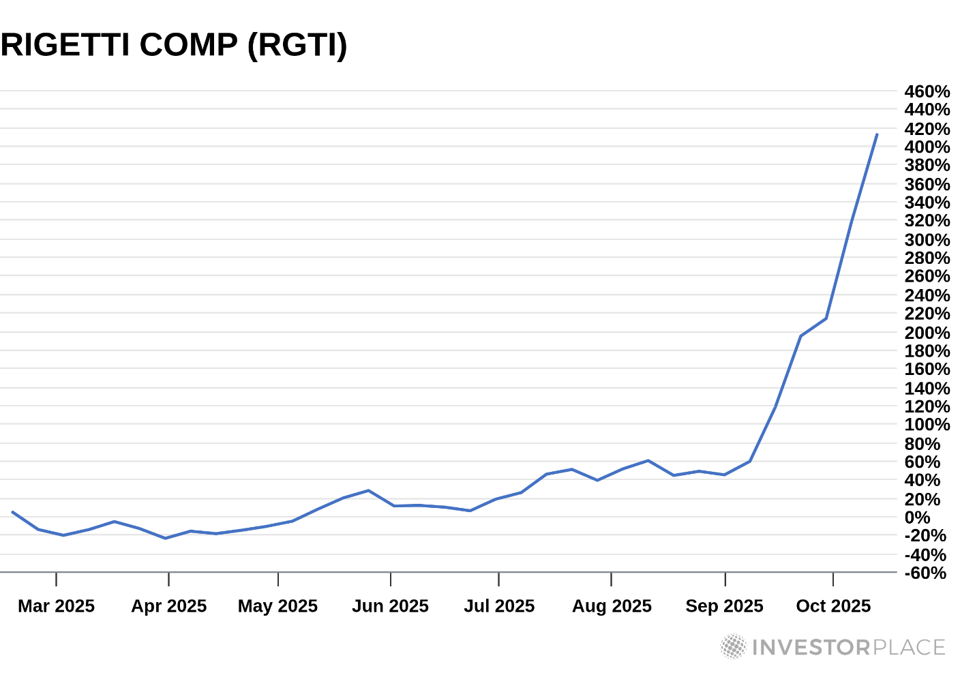
The transition to quantum computing has not been without significant market volatility, a characteristic common to emerging technological frontiers. Rigetti Computing Inc. serves as a primary example of the high-stakes environment in which quantum firms operate. In early 2025, the company was identified by market analysts as a key speculative play due to its hybrid classical-quantum approach. By mid-October 2025, Rigetti’s stock price had surged by over 400%, driven by breakthroughs in its cloud-based quantum processing services.
However, the inherent risks of the sector were highlighted when the stock experienced a sharp correction following its peak. This volatility underscores the "lottery ticket" nature of early-stage quantum investments. Unlike established semiconductor firms with robust balance sheets, many quantum companies are still in the pre-profitability stage, relying on venture capital and government grants to fund research and development.
Industry experts, including veteran floor traders and market makers, have noted that the movement in these stocks is often driven by "big money" institutional positioning rather than immediate fundamental earnings. Jonathan Rose, a former trader on the Chicago Mercantile Exchange with over 25 years of experience, observed that volatility in stocks like RGTI provides unique opportunities for tactical trading. Rose’s analysis of market-maker activity in December 2024 allowed his followers to capture a 233% gain in just four days, demonstrating that while long-term holding in quantum is risky, the short-term price action can be highly lucrative for those who understand volatility flows.
Comparative Analysis: From Microchips to Qubits
To understand the potential of quantum computing, it is necessary to compare it to previous technological paradigms. The 1980s were defined by the rise of the semiconductor, which enabled the personal computing revolution. The 1990s saw the birth of the commercial internet, while the 2000s and 2010s were dominated by cloud software and mobile connectivity.
Quantum computing is positioned to do for the 2030s what the microchip did for the 1980s. The primary difference lies in the complexity of the problems being addressed.
- Medicine: Quantum systems can simulate molecular interactions at the atomic level, potentially reducing the time required for drug discovery from years to weeks.
- Energy: The technology could lead to the development of new catalysts for carbon capture and more efficient battery chemistries.
- Materials Science: Designing superconductors that work at room temperature or creating stronger, lighter alloys for aerospace.
Financial analysts argue that the current AI boom is essentially the "software layer" of a much larger shift. Without the "quantum layer," AI development may eventually hit a ceiling where the energy costs of training larger models become economically unviable.
Strategic Market Positioning and Risk Management
As the market approaches what many believe is another major turning point, the strategies for capitalization are diversifying. Professional traders are increasingly moving away from a "buy and hold" mentality for speculative tech, opting instead for data-driven tactical entries. This involves monitoring institutional buying pressure and identifying where major players are positioning their capital before the broader retail market catches on.
The upcoming "$10k to $100k Challenge," hosted by Jonathan Rose on October 14, reflects a growing trend among retail investors to seek professional-grade trading methodologies to navigate this volatility. Such events focus on risk management—specifically, how to allocate capital into high-reward scenarios without "betting the farm." Rose, who generated over $6 million during the 2007–2008 financial crisis by understanding volatility, emphasizes that the goal is not just to find the next Nvidia, but to understand the timing of the market’s "surges."
Broader Implications for Global Competition
The race for quantum supremacy has also become a matter of national security and geopolitical strategy. The United States and China are currently the primary contenders in a global competition to stabilize qubits and scale quantum systems. The U.S. government’s CHIPS and Science Act, along with various Department of Defense initiatives, has allocated billions of dollars toward quantum research, recognizing that the first nation to achieve a fault-tolerant quantum computer will have a decisive advantage in cryptography and artificial intelligence.
For investors, this means that quantum computing is likely to receive sustained "top-down" support from government policy, similar to the support seen for green energy and domestic semiconductor manufacturing. This adds a layer of structural stability to an otherwise volatile sector.
Conclusion and Future Outlook
The AI Revolution is far from reaching its conclusion; rather, it is entering a more complex and capital-intensive phase. The projected 3.2% of U.S. GDP dedicated to AI infrastructure is a testament to the scale of this transformation. As classical computing approaches its physical limits, quantum computing stands ready to provide the necessary computational headroom for the next generation of technological breakthroughs.
While the risks associated with quantum stocks remain high, the potential for 400% gains in companies like Rigetti Computing suggests that the market is beginning to price in a quantum future. Whether through long-term fundamental investing in established giants like Nvidia or tactical, short-term trading in speculative quantum plays, the intersection of AI and quantum mechanics represents the most significant investment narrative of the current decade. As the industry looks toward the late 2020s, the focus will remain on those who can bridge the gap between today’s silicon chips and tomorrow’s quantum processors.