Galaxy S27 Series Chipset Strategy Unveiled: Snapdragon Dominance for Ultra, Regional Exynos for Base Models, and a Pro-Tier Split

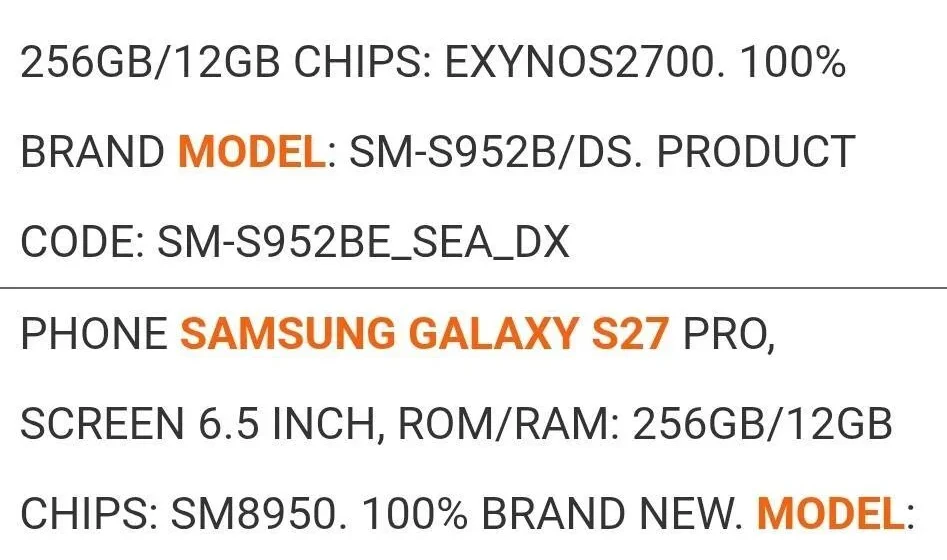
As the launch of Samsung’s highly anticipated Galaxy S27 series draws nearer, new insights into the chipset architecture across the four expected models have emerged, painting a complex picture of regional differentiation and strategic segmentation. Recent revelations from the import-export database platform NBD, brought to light by Notebookcheck, indicate a significant departure from previous generations for some variants, particularly for the rumored Galaxy S27 Pro. These listings, pertaining to international dual-SIM variants typically destined for European markets, suggest a multi-tiered approach to silicon, featuring Samsung’s own Exynos 2700 alongside Qualcomm’s next-generation Snapdragon offerings. This intricate strategy is poised to influence performance, pricing, and consumer choice across Samsung’s 2027 flagship lineup.
The Unveiling: Detailed Chipset Allocation Across the S27 Lineup
The NBD listings provide a detailed breakdown of the chipsets powering the forthcoming Galaxy S27 series. According to the data, the standard Galaxy S27 and its larger sibling, the Galaxy S27 Plus, are slated to feature the Exynos 2700 processor. This aligns with Samsung’s historical practice of deploying its in-house Exynos chips in the base and Plus variants of its flagship S-series phones in various international markets, while North American regions typically receive Snapdragon equivalents. This continuity suggests Samsung’s ongoing commitment to its Exynos division, even as it navigates the competitive landscape of mobile silicon.
However, the most premium model, the Galaxy S27 Ultra, is reportedly equipped with the top-tier Snapdragon 8 Elite Extreme Gen 6. This information provides reassurance to buyers, especially those outside the US, who might have been concerned by earlier rumors suggesting a potential return to an Exynos 2700 for the Ultra in certain regions. Since the Galaxy S22 Ultra, Samsung has largely standardized the use of Qualcomm’s Snapdragon chips across all regions for its Ultra-branded flagships, a strategic shift that followed considerable consumer feedback regarding performance disparities between Exynos and Snapdragon variants in prior generations. The Galaxy S21 Ultra marked the last instance where the Ultra model was offered with both Snapdragon and Exynos based on geographical location, with US buyers consistently receiving Snapdragon. This move towards Snapdragon exclusivity for the Ultra has, to a degree, solidified the perception of Snapdragon as the premium choice in Samsung’s ecosystem.
The most notable revelation from the NBD leak pertains to the rumored Galaxy S27 Pro. In a surprising turn, this model is listed to be powered by the Snapdragon 8 Elite Gen 6 – a distinct, slightly less powerful variant compared to the "Extreme" version reserved for the S27 Ultra. This differentiation within the high-end Snapdragon family marks a new level of segmentation within Samsung’s flagship portfolio, potentially influencing consumer upgrade paths and setting new expectations for the "Pro" moniker.
A Historical Perspective: Samsung’s Evolving Dual-Chip Strategy
Samsung’s decision to employ a dual-chip strategy – utilizing both its proprietary Exynos processors and Qualcomm’s Snapdragon chips – has been a hallmark of its Galaxy S series for over a decade. This approach is rooted in several strategic considerations. Primarily, it serves as a robust supply chain diversification measure, reducing Samsung’s reliance on a single vendor and mitigating potential risks associated with component shortages or pricing pressures. Secondly, it allows for regional optimization, where chipsets might be tailored to specific network bands, regulatory requirements, or market preferences. Lastly, the development of Exynos chips represents a significant investment in Samsung’s semiconductor division, fostering internal innovation and potentially offering cost advantages by leveraging in-house manufacturing capabilities.
However, this dual-chip strategy has historically been met with mixed reactions from consumers. For years, a perceived performance gap often existed between the Exynos and Snapdragon variants of the same phone, particularly in terms of raw CPU/GPU power, sustained performance under load, and battery efficiency. This "silicon lottery" often led to dissatisfaction among buyers in Exynos-designated regions, who felt they were receiving a demonstrably inferior product compared to their counterparts in Snapdragon markets. Online benchmarks, user reviews, and tech community discussions frequently highlighted these discrepancies, creating a persistent challenge for Samsung’s brand image.
The turning point for the Ultra series came with the Galaxy S22 Ultra. Following widespread criticism of the Exynos 2200 in the S22 series (though this specific chip wasn’t in the Ultra globally), Samsung made the strategic decision to equip the S22 Ultra, S23 Ultra, and S24 Ultra (and presumably subsequent Ultra models) exclusively with Snapdragon processors across almost all global markets. This move was widely interpreted as Samsung acknowledging and responding to consumer feedback, prioritizing a consistent, top-tier performance experience for its most expensive flagship. The S21 Ultra, released in 2021, stands as the last Ultra model to offer both Snapdragon and Exynos variants based on the region. The NBD leak for the S27 Ultra suggests this Snapdragon-only strategy for the top-tier model will continue, reaffirming Samsung’s commitment to delivering uncompromised performance for its most discerning customers.
Dissecting the Snapdragon 8 Elite Gen 6 vs. Extreme Gen 6
The differentiation between the Snapdragon 8 Elite Gen 6 for the S27 Pro and the Snapdragon 8 Elite Extreme Gen 6 for the S27 Ultra is a critical aspect of Samsung’s new segmentation strategy. While both chipsets are expected to be manufactured on an advanced 2nm process – a significant leap in semiconductor technology promising enhanced power efficiency and performance – the "Extreme" variant is engineered to deliver superior capabilities.
Industry analysts and leaked specifications suggest that the Snapdragon 8 Elite Extreme Gen 6 will boast incrementally better CPU, GPU, and Neural Processing Unit (NPU) performance compared to its standard Elite counterpart. These enhancements are crucial for demanding applications, intensive gaming, and advanced AI functionalities, positioning the Ultra as the unequivocal performance leader. A key distinction highlighted by the leaks is in video recording capabilities: the Extreme variant is expected to support smoother 8K video recording at 60 frames per second (fps), whereas the standard Elite version may be limited to 8K at 30fps. This particular feature disparity could be a significant draw for professional content creators and users who prioritize cutting-edge multimedia capabilities.

The implications of this internal Snapdragon differentiation are multi-faceted. Firstly, it allows Samsung to implement a more granular market segmentation within its premium tier. By providing a clear performance hierarchy, the company can guide power users and those seeking the absolute best specifications towards the S27 Ultra, while offering the S27 Pro as a slightly more accessible, yet still highly capable, premium option. Secondly, this tiered chipset strategy could directly influence pricing. A less powerful, albeit still high-end, chip in the S27 Pro could enable Samsung to lower its bill of materials, potentially translating into a more attractive price point for consumers compared to the Ultra. This could broaden the appeal of the "Pro" model without cannibalizing sales of the top-tier Ultra.
Furthermore, a less demanding chip in the S27 Pro could also be a strategic choice related to thermal management. Smaller phone form factors inherently offer less surface area for heat dissipation. By opting for a slightly less powerful (and thus, potentially cooler-running) chipset, Samsung might aim to mitigate potential overheating issues, ensuring a more consistent and comfortable user experience on the S27 Pro, which is likely to be physically smaller than the S27 Ultra. This pragmatic engineering decision could prioritize thermal stability over absolute peak performance in a device with tighter thermal constraints.
The Exynos 2700: Samsung’s Continued Investment and Challenges
The presence of the Exynos 2700 in the international variants of the Galaxy S27 and S27 Plus underscores Samsung’s unwavering commitment to its in-house semiconductor development. Despite past criticisms and the strategic shift towards Snapdragon for the Ultra models, the Exynos division remains a vital component of Samsung’s long-term technology strategy. Developing proprietary chips provides Samsung with greater control over its hardware ecosystem, allows for deeper integration between software and hardware, and potentially offers better cost control and supply security in the long run.
However, the Exynos 2700 enters a market where its predecessors have faced scrutiny. There has been considerable "chatter about Samsung switching to Exynos 2700 on the Ultra due to performance and alleged overheating issues with Qualcomm’s latest chipset." While Qualcomm swiftly responded to these concerns with public statements affirming the robust performance and thermal management of its upcoming chipsets, the rumors themselves reflect a lingering skepticism in the market regarding Exynos’s ability to compete at the very top tier. The NBD leak, by confirming Snapdragon for the S27 Ultra, should alleviate some of these concerns for European and other international buyers.
Yet, uncertainty persists for specific markets. Prominent leaker Ice Universe has suggested that South Korean buyers, Samsung’s home market, might still receive a Galaxy S27 Ultra powered by the Exynos 2700. If true, this would represent a significant divergence from the global Ultra strategy and potentially reintroduce the "silicon lottery" for the most premium model in a key market. Such a move would likely be driven by unique market dynamics, local supply chain considerations, or specific government incentives for domestic technology adoption. The performance of the Exynos 2700 will be under intense scrutiny, as it will need to demonstrate parity with its Snapdragon counterparts to regain consumer trust and validate Samsung’s continued investment.
Broader Implications for Consumers and the Market
The revealed chipset strategy for the Galaxy S27 series carries significant implications for various stakeholders. For consumers, particularly those outside the US, the regional disparity in chipsets for the base and Plus models means that the choice between Exynos and Snapdragon remains a relevant factor in their purchasing decisions. While the S27 Ultra appears to offer a globally consistent premium experience, buyers of the S27 and S27 Plus will need to consider the performance characteristics of the Exynos 2700, potentially leading to continued debates and comparisons.
The nuanced differentiation between the Snapdragon 8 Elite Gen 6 and Extreme Gen 6 for the Pro and Ultra models, respectively, provides clearer segmentation within Samsung’s high-end portfolio. This could allow Samsung to optimize pricing, making the Pro model more competitive while justifying the premium price tag of the Ultra with its absolute top-tier performance. However, it also means that "Pro" no longer signifies the absolute best-in-class performance within the flagship lineup, potentially shifting some consumer expectations.
From a competitive standpoint, Samsung’s strategy contrasts sharply with rivals like Apple, which employs a unified, proprietary chip strategy across its iPhone lineup, ensuring consistent performance globally. While Samsung’s dual-chip approach offers supply chain benefits, it creates complexities in marketing and consumer perception. The success of the Exynos 2700 will be crucial for Samsung’s long-term semiconductor ambitions and its ability to compete effectively against Qualcomm in the premium Android space. If the Exynos 2700 can genuinely close the performance gap, it could strengthen Samsung’s position. If not, the historical criticisms may resurface.
Beyond Chipsets: Other Leaked Specifications
Alongside the crucial chipset details, the NBD listings also provided glimpses into other core specifications for the Galaxy S27 series. All four models are expected to ship with a minimum of 12GB of RAM and 256GB of internal storage. This baseline configuration reinforces the premium positioning of the entire S27 lineup, ensuring robust multitasking capabilities and ample space for apps and media. It is also highly probable that the Galaxy S27 Pro and S27 Ultra will offer higher RAM and storage configurations, catering to power users and those who require more extensive resources. These foundational specifications, combined with the detailed chipset strategy, paint a comprehensive picture of Samsung’s ambition for its next-generation flagship series.
In conclusion, the emerging details surrounding the Samsung Galaxy S27 series chipset strategy reveal a carefully orchestrated plan for market segmentation and supply chain management. While the consistent deployment of Snapdragon 8 Elite Extreme Gen 6 in the S27 Ultra signals a continued commitment to uncompromised performance for its top-tier flagship, the reintroduction of a differentiated Snapdragon tier for the S27 Pro and the continued reliance on Exynos 2700 for the base and Plus models highlight Samsung’s complex balancing act. The success of this strategy will ultimately hinge on the real-world performance of the Exynos 2700 and the perceived value proposition of each distinct model within the highly competitive premium smartphone market. Final confirmation and a full understanding of Samsung’s vision will undoubtedly await the official unveiling of the Galaxy S27 series.