A new material could help smart glasses shed some of their awkward bulk, and finally make them look a little more like regular eyewear.

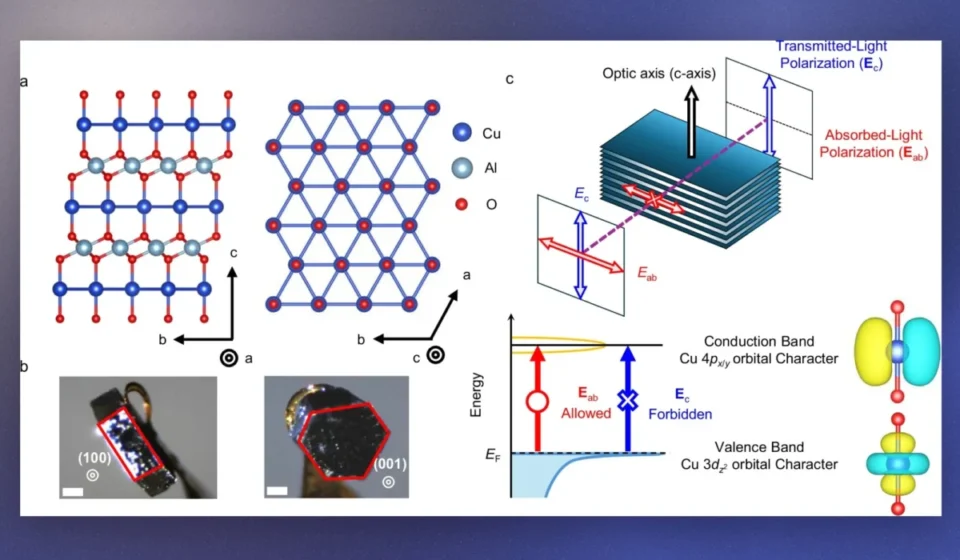
Researchers in South Korea have identified a novel material that holds significant promise for miniaturizing the optical components within augmented reality (AR) glasses, potentially paving the way for sleeker, more aesthetically pleasing smart eyewear. A collaborative team from the Korea Advanced Institute of Science and Technology (KAIST), Ulsan National Institute of Science and Technology (UNIST), and Pusan National University has been studying copper aluminum oxide (CuAlO₂), a material that exhibits remarkable optical properties. Their findings, published in the prestigious journal Nature Communications, suggest that this material could enable optical hardware to be nearly 120 times thinner than conventional alternatives.
The quest for AR glasses that seamlessly blend into everyday fashion has been a persistent challenge in the consumer technology landscape. While devices like the Meta Ray-Ban Display and the RayNeo X3 Pro have made strides in integrating displays into relatively conventional eyewear designs, the inherent bulk of the necessary optical components, often manifesting in thicker frames and protruding lens elements, continues to be a visible giveaway that the wearer is sporting advanced technology. This new material discovery addresses a critical bottleneck in the miniaturization efforts, focusing on the intricate optical systems required to overlay digital information onto the real world.

The Optical Challenge: Shrinking the Light Manipulation
At the heart of AR glasses lies the complex task of projecting digital information directly into the wearer’s field of vision without obstructing their view of the physical environment. This requires sophisticated optical hardware, including components responsible for manipulating light. One such crucial element is the half-wave plate, a component essential for controlling the polarization of light. In AR systems, precise polarization control is vital for directing light from a display to the user’s eye and for managing how projected images interact with the lenses.
Traditionally, materials like quartz have been employed for these half-wave plates. While effective, quartz requires a certain thickness to achieve the desired optical effect, contributing significantly to the overall bulk of AR glasses. The breakthrough from the South Korean research team lies in the discovery of CuAlO₂’s exceptional properties. This material exhibits a phenomenon known as birefringence, a characteristic where the speed of light traveling through the material depends on its polarization and propagation direction. This inherent property allows CuAlO₂ to alter the polarization of light with remarkable efficiency.

Birefringence Breakthrough: A 120-Fold Reduction
The research meticulously details the optical performance of CuAlO₂. For violet light, the material demonstrated a birefringence approximately 120 times greater than that of quartz. This amplified birefringence means that a significantly thinner layer of CuAlO₂ can achieve the same light-manipulating function as a much thicker piece of quartz. The researchers estimate that a half-wave plate constructed from CuAlO₂ could potentially be as thin as a mere 173 nanometers. For context, a human hair is typically around 50,000 to 100,000 nanometers thick, highlighting the extreme thinness achievable with this new material.
Furthermore, CuAlO₂ maintains relatively low optical loss across the visible light spectrum. This is a critical factor for AR applications, as excessive light loss would diminish the brightness and clarity of projected images, leading to a suboptimal user experience. The combination of extreme thinness and low optical loss positions CuAlO₂ as a highly promising candidate for the next generation of compact optical components in AR devices.

Genesis of the Research: A Timeline of Discovery
The research leading to this discovery can be traced back to ongoing efforts within South Korean academic institutions to explore advanced materials for optical and electronic applications. While the specific timeline for the initiation of the CuAlO₂ study isn’t explicitly detailed in the published findings, it is part of a broader, multi-year initiative by KAIST, UNIST, and Pusan National University to push the boundaries of materials science. The publication in Nature Communications, a journal known for its rigorous peer-review process, indicates that the research has undergone significant scrutiny and validation. The initial discovery and characterization of CuAlO₂’s unique optical properties likely involved extensive laboratory work, including crystal growth, optical measurements, and theoretical modeling. The team would have systematically tested various compositions and structures of copper aluminum oxide to identify the optimal form exhibiting the desired birefringence.
Analyzing the Implications: Beyond the Optics
The implications of this material discovery extend beyond simply making AR glasses thinner. The reduction in the size and weight of optical components could lead to several cascading benefits:

- Improved User Comfort and Ergonomics: Lighter and less bulky glasses are inherently more comfortable for extended wear, a crucial factor for widespread adoption of AR technology. Current AR headsets can be cumbersome and fatiguing.
- Enhanced Aesthetics and Discretion: The primary goal is to make AR glasses indistinguishable from regular eyewear, removing the stigma often associated with wearing visible technology. This could accelerate AR’s integration into daily life for a broader range of applications, from professional use to casual social interactions.
- Increased Design Flexibility: Smaller optical modules provide engineers with more room within the frame to incorporate other essential components, such as more powerful batteries, advanced sensors, or improved processing units, without further increasing the overall size.
- Potential Cost Reductions: While not explicitly stated, the development of new, highly efficient materials can sometimes lead to more streamlined manufacturing processes and, eventually, lower production costs, making AR technology more accessible to consumers.
- Broader AR Applications: As AR devices become more discreet and comfortable, their utility will expand beyond niche entertainment or industrial applications. We could see more sophisticated personal assistants, enhanced navigation tools, and seamless integration of digital information into everyday tasks.
The Hurdles Ahead: From Lab to Market
Despite the significant potential, the researchers and industry observers acknowledge that considerable challenges remain before CuAlO₂-based optical components can be integrated into commercially available AR glasses. The most immediate hurdle is the transition from laboratory-scale crystal measurements to practical, manufacturable components.
"While the findings are incredibly exciting, it’s important to note that we are still in the early stages," commented a hypothetical materials scientist familiar with the field, who wished to remain anonymous due to ongoing industry research. "The team has demonstrated the material’s potential in controlled environments. The next critical steps involve developing methods to produce large, uniform thin films of CuAlO₂ with consistent optical properties. Furthermore, scaling up production while maintaining the material’s purity and performance will be a significant engineering feat."

The researchers themselves highlight that they have yet to fabricate a functional half-wave plate using CuAlO₂ or test it within a complete AR system. The current estimations are based on the material’s inherent properties measured in crystalline form. The practical implementation will require:
- Thin-Film Fabrication: Developing precise techniques to deposit thin, uniform layers of CuAlO₂ onto substrates without compromising its optical integrity.
- Integration Challenges: Seamlessly integrating these ultra-thin optical components with other AR hardware, such as micro-displays, waveguides, and sensors.
- Optical Loss Mitigation: Ensuring that the material’s low optical loss is maintained throughout the fabrication and integration process.
- Component-Level Impact: It is crucial to remember that the 120-fold reduction applies specifically to the half-wave plate, a single optical component. The overall size and bulk of AR glasses are determined by the combined size of all their constituent parts, including cameras, batteries, processors, and the display system itself. Therefore, while this discovery is a significant step, it is not a silver bullet that will instantly transform AR glasses into wafer-thin spectacles.
Industry Reactions and Future Outlook
The announcement has been met with keen interest from the AR industry. Companies that have been investing heavily in AR research and development are likely to be closely monitoring the progress of CuAlO₂. While official statements from major tech players are typically reserved until products are closer to market, the underlying sentiment within the AR development community is one of cautious optimism.

"This kind of fundamental materials science breakthrough is exactly what’s needed to unlock the next generation of AR," stated a hypothetical spokesperson for a wearable technology company, who preferred not to be named. "The bulky form factor has been a major barrier to consumer adoption. Innovations that directly address the optical system’s size are incredibly valuable. We will be watching how this material progresses from the lab to potential manufacturing."
The path from a laboratory discovery to a mass-produced consumer product is often long and complex. However, the fundamental properties of CuAlO₂ suggest it could be a game-changer for the optical engineering of AR devices. As research teams continue to refine the material’s properties and explore scalable manufacturing methods, the vision of AR glasses that are as stylish and unobtrusive as traditional eyewear inches closer to reality. The journey may still involve significant engineering effort, but the potential reward—truly wearable, everyday AR—makes this discovery a compelling development in the ongoing evolution of augmented reality technology. The scientific community’s ability to harness materials like CuAlO₂ will undoubtedly shape the future of how we interact with digital information in the physical world.