Your hair will no longer be used only to look good, but will help with transferring brain signals as well

Researchers from Linköping University in Sweden and Ghent University in Belgium have unveiled a groundbreaking innovation that transforms human hair into functional bioelectronic electrodes, paving the way for less intrusive brain-signal monitoring. This novel technology, dubbed eHAIR, utilizes electrically conductive hair dyes to turn individual hair strands into versatile tools capable of reading brain activity. The findings were published in the esteemed scientific journal Science Advances, marking a significant leap forward in the field of neurotechnology.
The development addresses a persistent challenge in electroencephalography (EEG), a non-invasive method used to measure electrical activity in the brain. Traditional EEG setups often struggle with obtaining clean and stable signals due to the natural barrier presented by hair. This necessitates the use of conductive gels or pastes to lower the impedance between scalp sensors and the skin, thereby improving signal quality. While effective, these gels can be cumbersome, messy, time-consuming to apply, and prone to drying out during extended monitoring sessions, posing a significant inconvenience for patients and researchers alike.
The eHAIR system cleverly reorients the approach, no longer treating hair as an impediment but rather as an integral component of the sensing mechanism. By employing mixed ionic-electronic conductive polymer dyes, the researchers have developed a method to coat hair strands, which are essentially keratinized filaments anchored in the skin. This coating effectively transforms each hair into a flexible, low-impedance recording interface.
Mechanism of Action: Turning Hair into Electrodes
The core of the eHAIR technology lies in its specialized conductive polymer dye. When applied to hair, this dye permeates the keratin structure and imbues the strands with electrical conductivity. Unlike conventional conductive gels that create a temporary interface, the eHAIR dye permanently binds to the hair fibers. This direct integration allows the hair to function as an extension of the bioelectronic sensing system.

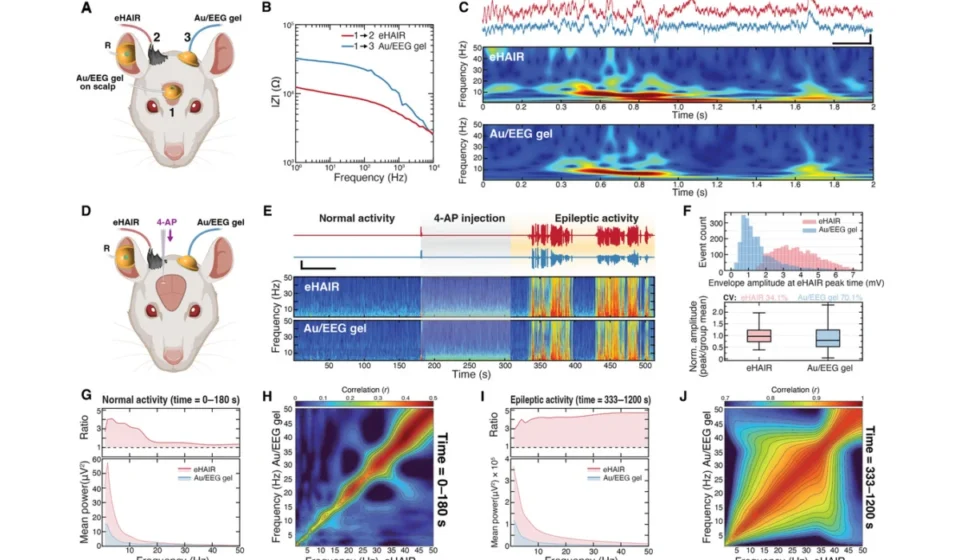
In laboratory testing, which included rigorous experiments on rats, the eHAIR system demonstrated remarkable efficacy. The treated hair served as a stable and mechanically flexible interface capable of supporting high-quality EEG recordings. Furthermore, it proved to be compatible with other electronic components, such as organic electrochemical transistors, without the need for traditional conductive gels. This stability and flexibility are crucial for applications requiring prolonged or dynamic brain monitoring. The ability to integrate electronic components directly with the hair suggests a future where wearable neurotechnology can be seamlessly incorporated into everyday life.
The Genesis of eHAIR: A Collaborative Effort
The research behind eHAIR is a testament to interdisciplinary collaboration. Linköping University, renowned for its pioneering work in organic electronics and bioelectronics, partnered with Ghent University, a leading institution in materials science and polymer chemistry. This synergy of expertise was essential in developing a conductive material that is both effective for signal transduction and safe for application to hair.
The development process likely involved extensive material science research to identify suitable conductive polymers that could be formulated into a dye. Key considerations would have included the dye’s ability to penetrate and adhere to hair keratin, its electrical conductivity properties, its long-term stability, and its biocompatibility. The transition from lab-bench material development to functional electrode application would have also involved significant engineering and testing to optimize the dyeing process and the integration of the treated hair with recording electronics.
Timeline and Early Development

While the precise timeline of the eHAIR project is not detailed in the initial report, the publication in Science Advances indicates a culmination of several years of dedicated research and development. The journey from conceptualization to successful demonstration in animal models would have involved stages of material synthesis, characterization, prototype development, and in-vivo testing. The transition to human application will require further rigorous validation, as outlined by the researchers.
The initial experiments on rats were crucial for establishing the proof of concept. By demonstrating that eHAIR could reliably capture brain signals in an animal model, the researchers provided strong evidence for its potential in human applications. The use of rats allowed for controlled experiments and the assessment of signal quality and electrode stability under various physiological conditions.
Broader Implications: Revolutionizing Neurotechnology
The implications of eHAIR extend far beyond the immediate improvements in EEG signal acquisition. The technology holds the potential to significantly reduce the intrusiveness and improve the accessibility of brain-monitoring devices.
-
Streamlined Clinical Procedures: For neurology clinics, sleep labs, and neurotechnology companies, eHAIR could revolutionize setup procedures. Eliminating the need for conductive gels would not only save time but also reduce the overall burden on patients, especially those undergoing routine or extended brain monitoring for conditions like epilepsy, sleep disorders, or neurological rehabilitation. The ease of application and removal could also lead to more frequent and consistent monitoring.

-
Enhanced Wearable Technology: The scalability of the eHAIR approach, where dyes bind directly to hair fibers, opens up exciting possibilities for future wearable neurotechnology. Imagine discreet, hair-based sensors that can continuously monitor brain activity for a variety of applications, from advanced brain-computer interfaces to personalized wellness and mental health tracking. This could lead to the development of "smart hair accessories" or even integrated hairstyles that function as sophisticated bioelectronic devices.
-
Improved Patient Comfort and Adherence: The messy and sometimes uncomfortable nature of traditional EEG can be a barrier to patient adherence, particularly for long-term monitoring. By transforming hair into an integral part of the sensing pathway, eHAIR offers a more comfortable and discreet solution, potentially leading to better patient compliance and more comprehensive data collection.
-
Potential for Remote Monitoring: The robustness and stability of eHAIR could facilitate more reliable remote brain monitoring. This could be invaluable for patients in rural areas, individuals with mobility issues, or for large-scale epidemiological studies where consistent and high-quality data is paramount.
Future Directions and Challenges
Despite the promising nature of eHAIR, the researchers acknowledge that the technology is still in its early stages. Several critical steps are required before it can be widely adopted for human use.

-
Long-Term Wash Durability: A key challenge will be ensuring the durability of the conductive dye after repeated washing. The integrity of the electrical connection must be maintained over time to ensure consistent performance. Research into improved dye formulations and application techniques will be crucial in this regard.
-
Scalability and Diversity of Hair Types: While the concept is scalable, extensive validation across diverse hair types, textures, and colors will be necessary. Different hair structures may interact with the dye differently, requiring adjustments to the formulation or application process to ensure optimal conductivity for all users.
-
Skin and Scalp Safety: Rigorous dermatological testing will be essential to confirm the safety of the eHAIR dyes for long-term contact with the scalp. Comprehensive studies on potential allergenic reactions or irritation are paramount.
-
Integration with Compact Recording Hardware: Seamless integration with compact, user-friendly recording hardware is the next frontier. This will involve developing miniaturized electronic components that can effectively interface with the hair electrodes and transmit the captured brain signals wirelessly.
-
Regulatory Approval: As with any medical technology, eHAIR will need to undergo stringent regulatory review and approval processes before it can be used in clinical settings or marketed to consumers. This will involve extensive clinical trials to demonstrate its safety and efficacy in human subjects.

Analysis: A Paradigm Shift in Bioelectronics
The eHAIR innovation represents a significant paradigm shift in the field of bioelectronics. Instead of attempting to overcome the biological interfaces with cumbersome technologies, researchers are increasingly exploring ways to leverage the body’s existing structures. This "bio-integration" approach, exemplified by eHAIR, promises to lead to more natural, comfortable, and effective wearable technologies.
The ability to turn a ubiquitous biological feature like hair into a functional electronic component is a testament to the ingenuity of materials science and bioengineering. It highlights a future where everyday objects and even our own bodies can be seamlessly integrated with advanced technology, blurring the lines between the biological and the digital.
The potential for eHAIR to democratize access to brain monitoring technologies is also noteworthy. By reducing the cost and complexity associated with traditional EEG, this innovation could empower individuals to take a more proactive role in understanding and managing their brain health.
While the path from laboratory breakthrough to widespread application is often long and arduous, the eHAIR system offers a compelling vision for the future of neurotechnology. By transforming a common human trait into a powerful sensing tool, this research opens up exciting new avenues for understanding and interacting with the human brain. The prospect of a future where our hair not only enhances our appearance but also contributes to our health and understanding of ourselves is closer than ever before. The continued development and validation of eHAIR will undoubtedly be a significant area to watch in the evolving landscape of wearable health technology.