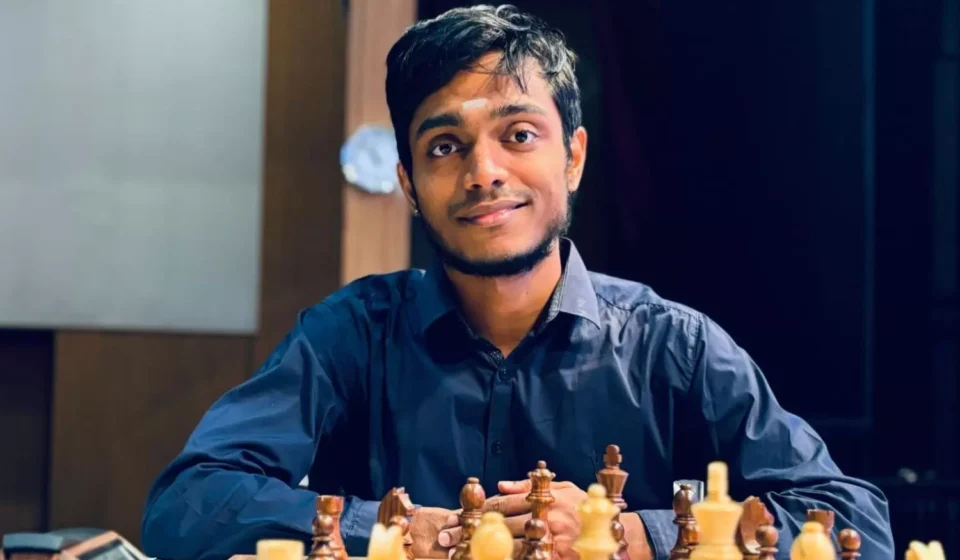

The second round of the prestigious Prague Chess Festival Masters section witnessed a dramatic shift in fortunes for the defending champion, Grandmaster Aravindh Chithambaram. Following a disappointing start to the tournament, the Indian sensation demonstrated remarkable resilience on Thursday, securing a vital victory over the controversial and formidable American Grandmaster Hans Niemann. This win not only revitalized Aravindh’s campaign to retain his title in the Czech capital but also underscored the high-octane nature of the 2026 edition of the festival. Meanwhile, the eyes of the global chess community remained fixed on the reigning World Champion, Gukesh Dommaraju, who navigated a precise but ultimately peaceful encounter against Uzbekistan’s Nodirbek Yakubboev, resulting in his second draw of the event.
Aravindh Chithambaram: From Blunder to Brilliance
Aravindh Chithambaram entered the second round under significant pressure. Having dropped his opening game, the defending champion faced the daunting task of playing with the black pieces against Hans Niemann, a player known for his aggressive style and unpredictable opening choices. The encounter lived up to its billing as a rollercoaster of tactical complexity and psychological warfare.
The game initially appeared to be swinging in Niemann’s favor as the American navigated the opening with characteristic confidence, exerting pressure on Aravindh’s position. The tension reached a fever pitch on the 31st move when Aravindh committed a significant tactical oversight, blundering his Knight. In many elite-level games, such an error against a player of Niemann’s caliber would signal an immediate resignation or a swift slide into defeat. However, the Prague Chess Festival has often been a stage for extraordinary defensive efforts, and Aravindh’s performance on Thursday was no exception.
Capitalizing on a series of inaccuracies from Niemann, who struggled to convert his material advantage under the pressure of the clock and Aravindh’s counter-play, the Indian Grandmaster orchestrated a stunning turnaround. By complicating the position and creating tactical threats that Niemann failed to neutralize, Aravindh managed to not only recover his standing but eventually force a winning position. The American was forced to concede, handing Aravindh his first full point of the tournament. This result moves Aravindh into joint fourth place with 1 point from two games, effectively keeping his title defense aspirations alive.
The World Champion’s Calculated Approach
While Aravindh’s game was defined by volatility, the clash between Gukesh Dommaraju and Nodirbek Yakubboev was a masterclass in theoretical precision and defensive solidity. Gukesh, who recently ascended to the throne of World Champion, has been the subject of intense scrutiny as he adjusts to the unique pressures of competing as the man with the target on his back.
Facing Yakubboev, a former winner of the Qatar Masters and a key figure in Uzbekistan’s rising chess dominance, Gukesh engaged in a sophisticated battle within the Queen’s Gambit Declined. Both players demonstrated exceptional preparation, maintaining high accuracy levels throughout the encounter. The game adhered strictly to modern theoretical paths, with neither side able to carve out a definitive advantage.
After 30 moves of high-level maneuvering, the players reached a position of dynamic equality. Recognizing that any attempt to overextend would likely result in a disadvantage, the two Grandmasters agreed to a draw via three-fold repetition. For Gukesh, the result represents a steady, if cautious, start to the tournament. With two draws from two games, he remains within striking distance of the leaders, prioritizing stability in the early rounds of a long and grueling event.
Performance in the Challengers Section
The Prague Chess Festival is not merely about the Masters; the Challengers section serves as a vital proving ground for emerging talents and seasoned veterans aiming for a spot in the following year’s top flight. India’s representation in this section remained solid in Round 2, though wins proved elusive.
Divya Deshmukh, one of the fastest-rising stars in women’s chess and a key member of India’s Olympiad-winning squad, played out a hard-fought draw. Deshmukh has gained a reputation for her fearless attacking play, but in the second round, she showed her ability to hold difficult positions against experienced opposition. Joining her in the draw column was Surya Sekhar Ganguly, a veteran of Indian chess and a former second to Viswanathan Anand. Ganguly’s experience was on full display as he navigated a complex middle game to ensure a split of the points, maintaining a stable position in the tournament standings.
Chronology of the Prague Chess Festival 2026
The 2026 Prague Chess Festival began with high expectations, given the presence of the reigning World Champion and a field of young, hungry Grandmasters. The timeline of the first two rounds illustrates the competitive parity of the field:
- Round 1: The tournament opened with several decisive results. Aravindh Chithambaram suffered an unexpected loss, immediately putting the defending champion on the back foot. Gukesh Dommaraju started his campaign with a draw, signaling a measured approach to the event.
- Round 2: Thursday’s action saw the "Indian resurgence" as Aravindh defeated Niemann. The round was characterized by a mix of high-accuracy draws among the top seeds and tactical brawls in the lower half of the table.
- Standings Post-Round 2: The leaderboard remains congested. While several players hold a slight lead, the pack—including Aravindh and Gukesh—is separated by a mere half-point or point, setting the stage for a pivotal third round.
Tactical Analysis: The Queen’s Gambit Declined and the Move 31 Blunder
The technical aspects of Round 2 provide insight into the current state of elite chess. In the Gukesh-Yakubboev game, the Queen’s Gambit Declined (QGD) served as the battleground. The QGD is one of the most reliable openings for Black, focusing on central control and solid pawn structures. Gukesh’s choice to engage in this line suggests a preference for "safe" chess in the early rounds, avoiding the high-risk, high-reward complications of the Indian Defenses. The 30-move draw is a testament to the depth of modern engine-assisted preparation, where top-tier players can often find the "only" moves to maintain balance.
In contrast, the Aravindh-Niemann game was an anomaly in the world of high-level precision. Aravindh’s blunder on move 31 is being analyzed by pundits as a potential lapse in concentration or a result of extreme time pressure. However, his subsequent recovery is what garnered praise from analysts. The ability to "reset" psychologically after a visible error is a hallmark of elite players. Niemann’s failure to convert the advantage suggests that the American may have been overconfident or struggled with the transition from a technical win to a practical endgame.
Broader Impact and Implications for Indian Chess
The performances in Prague carry significant weight for the Indian chess ecosystem. With Gukesh holding the World Championship title, every move he makes is seen as a reflection of the country’s dominance in the sport. His steady start in Prague is viewed by many as a professional handling of a "target-on-back" scenario.
For Aravindh Chithambaram, this victory is a statement of intent. As the defending champion, the pressure to perform is immense. Defeating a player like Hans Niemann, who often attracts significant media attention, provides Aravindh with a psychological boost that could propel him through the remainder of the tournament.
The presence of four Indians across the Masters and Challengers sections highlights the depth of talent emerging from the subcontinent. The Prague Chess Festival has historically been a kind hunting ground for Indian players, and the current standings suggest that the 2026 edition could once again see an Indian presence on the podium.
Official Responses and Player Reactions
While formal press conferences at the Prague Chess Festival are typically reserved for the conclusion of the event, social media and on-site reports provided a glimpse into the players’ mindsets. The official Prague International Chess Festival Twitter account noted the "exciting games" and the high level of competition, urging fans not to miss the upcoming rounds.
Observers noted that Niemann appeared visibly frustrated following his loss to Aravindh, quickly exiting the playing hall. Aravindh, conversely, was seen in deep discussion with his team, likely analyzing the move 31 blunder to ensure such tactical lapses are not repeated in the rounds to follow. Gukesh remained characteristically stoic, his post-game analysis with Yakubboev showing two professionals satisfied with a high-quality draw.
Looking Ahead: Round 3 Pairings
The third round, scheduled for Friday, promises several high-stakes matchups that could define the trajectory of the tournament.
- Gukesh Dommaraju vs. Jorden van Foreest: Gukesh will have the white pieces against the Dutch Grandmaster. Van Foreest, a former Tata Steel Chess winner, is known for his creative and sometimes eccentric opening choices. Gukesh will likely look to use his first-move advantage to push for his first win of the tournament.
- Aravindh Chithambaram vs. Parham Maghsoodloo: Aravindh faces the powerhouse from Iran. Maghsoodloo is one of the most aggressive players on the circuit, and following Aravindh’s victory over Niemann, this clash is expected to be a highlight of the round. A win for Aravindh could see him move into the top three.
As the Prague Chess Festival progresses, the narrative remains focused on whether the "old guard" of the tournament, like Aravindh, can hold off the surge of the World Champion and the international challengers. With seven rounds remaining, the battle for the trophy is far from over, but Round 2 has certainly set the stage for a dramatic week in Czechia.