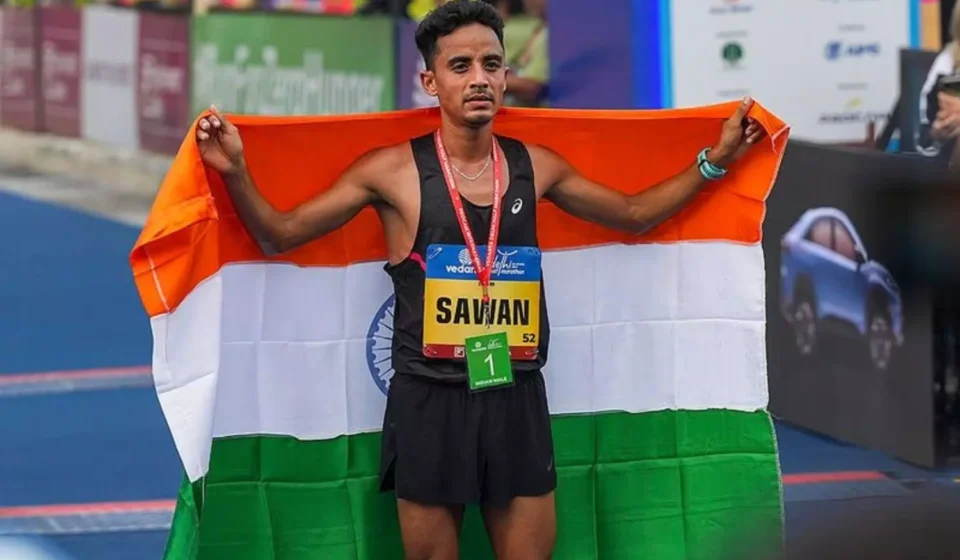
Sawan Barwal Rewrites Indian Athletics History by Breaking 48-Year-Old National Marathon Record at NN Marathon Rotterdam

In a historic display of endurance, tactical discipline, and sheer athletic willpower, 27-year-old Sawan Barwal has etched his name into the annals of Indian sports by shattering the country’s longest-standing national record in the men’s marathon. Competing at the prestigious NN Marathon Rotterdam on Sunday, Barwal crossed the finish line with a time of 2 hours, 11 minutes, and 58 seconds, finally eclipsing a benchmark that had remained untouched for nearly five decades. The previous record of 2:12:00, established by the legendary Shivnath Singh in Jalandhar in 1978, had long been considered the "Holy Grail" of Indian long-distance running—a mark so resilient that it outlasted multiple generations of elite athletes.
Barwal’s performance in the Netherlands saw him finish 20th in a world-class elite field, but his primary victory was against the clock and the weight of history. By shaving two seconds off Singh’s 48-year-old mark, Barwal has not only modernised the Indian record books but has also signaled a potential renaissance for the nation’s marathon circuit on the global stage.
The Historic Breakthrough in Rotterdam
The NN Marathon Rotterdam is globally renowned for its flat, fast course and favorable maritime climate, making it a preferred destination for athletes seeking personal bests and national records. On Sunday, the conditions proved ideal for Barwal, who entered the race with a clear objective: to challenge the 2:12:00 barrier that had stifled Indian runners since the late 1970s.
Barwal’s race strategy was characterized by remarkable consistency. From the starting gun at the foot of the Erasmus Bridge, he maintained a calculated pace, avoiding the common pitfall of an overly aggressive start in a high-caliber international field. According to preliminary timing data, Barwal maintained an average pace of approximately 3 minutes and 7 seconds per kilometer. His split times indicated a balanced effort, passing the halfway mark (21.0975 km) in a timeframe that kept him well within striking distance of the record.
The final five kilometers of a marathon are often where records are lost to fatigue, but Barwal showed immense mental fortitude. As he navigated the tree-lined streets of Rotterdam toward the finish line on Coolsingel, his stride remained rhythmic and efficient. His final time of 2:11:58 represents a watershed moment, ending a 48-year wait for a new standard in Indian distance running.
Deciphering the 48-Year Stalemate: The Legacy of Shivnath Singh
To understand the magnitude of Barwal’s achievement, one must look back at the career of Shivnath Singh. A native of Bihar and a legend of the Indian Army, Singh was a pioneer who competed during an era of vastly different training methodologies and equipment. His record of 2:12:00, set on May 28, 1978, was achieved without the benefit of modern carbon-plated running shoes, advanced hydration science, or the precision GPS tracking available today.
Singh was famous for running barefoot or in thin, minimalist footwear, yet he possessed a cardiovascular engine that allowed him to compete with the world’s best, including a notable 11th-place finish at the 1976 Montreal Olympics. For 48 years, his record stood as a silent challenge to every Indian runner who followed. While Indian records in the 100m, 400m, and even the 3000m steeplechase fell multiple times over the decades, the marathon mark remained stubbornly fixed.
Many elite Indian runners, including the likes of Nitendra Singh Rawat, T Gopi, and Shivnath Singh’s contemporaries, came agonizingly close—sometimes within 30 to 40 seconds—but none could breach the 2:12:00 wall until Barwal’s Sunday morning surge in Rotterdam.
Race Analysis and Technical Execution
Barwal’s success in Rotterdam can be attributed to a combination of meticulous preparation and the evolution of Indian distance training. Over the past few years, Barwal has been a rising star in the domestic circuit, gradually lowering his personal bests across various distances. His transition to the full marathon required a shift in volume and intensity, often training in high-altitude environments to boost red blood cell production and aerobic capacity.
Technical experts point to several factors that contributed to the sub-2:12 performance:
- Pacing Discipline: Barwal did not get caught up in the blistering pace set by the East African leaders, who often target sub-2:04 times in Rotterdam. By running his own race and sticking to a 2:11-high pace, he ensured he had the energy reserves for the "wall" at 35 kilometers.
- Course Selection: The Rotterdam course is essentially at or below sea level, providing higher oxygen density compared to high-altitude courses, and its minimal elevation gain (virtually flat) is conducive to maintaining a steady cadence.
- Technological Advancements: While the athlete’s lungs and legs do the work, modern "super shoes" with carbon fiber plates and PEBA-based foams provide approximately 4% greater energy return compared to traditional racing flats. Barwal’s access to modern gear undoubtedly helped bridge the narrow gap that had eluded his predecessors.
Sawan Barwal: The Rise of a New Distance Icon
At 27, Sawan Barwal is entering his athletic prime. His journey to the national record has been one of steady progression rather than an overnight sensation. Having represented India in various international forums, including Asian-level competitions, Barwal has consistently shown an ability to perform under pressure.
His breakthrough in Rotterdam is expected to elevate his profile significantly, likely securing him better sponsorship opportunities and inclusion in elite international training camps. Within the Indian athletics community, Barwal is known for his quiet work ethic and his ability to absorb high-mileage training loads—a necessity for any serious marathoner.
This record-breaking run also serves as a validation for the coaching staff and the support systems provided by the Athletics Federation of India (AFI) and various sports institutes that have been pushing for a more scientific approach to distance running.
Comparative Global Context and Technological Evolution
While 2:11:58 is a monumental achievement for India, a factual analysis requires placing the time in a global context. The world record, currently held posthumously by Kelvin Kiptum (2:00:35), is nearly 11 minutes faster than the Indian record. Furthermore, the Olympic qualifying standard for the men’s marathon has become increasingly stringent, often requiring times under 2:08:10.
However, Barwal’s achievement is a crucial step in the right direction. For decades, Indian marathoners were stagnant. By finally breaking the 1978 record, Barwal has removed a psychological barrier. In the world of athletics, once a long-standing "unbreakable" record is finally broken, it often leads to a "clumping" effect where multiple athletes begin to surpass the old mark, having seen that it is indeed possible.
Comparing Barwal’s 2:11:58 to other Asian nations, India still trails behind powerhouses like Japan, where dozens of runners regularly break 2:10. Nevertheless, the two-second improvement over Shivnath Singh’s time represents the first tangible progress in nearly half a century, providing a new baseline from which the next generation of Indian runners can build.
Official Responses and the Impact on Indian Athletics
While official statements from the Athletics Federation of India (AFI) are expected to follow formal verification of the timing chips and race conditions, the mood in the Indian athletics fraternity is one of jubilation. Coaches and former athletes have taken to social media and news outlets to congratulate Barwal, noting that the "curse" of the 1978 record has finally been lifted.
"This is a day we have waited for since I was a young athlete," noted a former national coach. "Shivnath Singh’s record was a shadow over every marathoner in this country. Sawan Barwal has done a great service to the sport by showing that we can finally move past the 1970s and into the modern era of distance running."
The implications for the future are significant. Barwal’s performance is likely to:
- Encourage more youngsters to take up the full 42.195 km distance rather than sticking to the 5,000m or 10,000m tracks.
- Attract more international brands and marathons to invite Indian elite runners to their "Gold Label" events.
- Prompt a review of the marathon training programs in India to identify how to further shave those three to four minutes required for Olympic and World Championship podium contention.
Conclusion: A New Era Begins
Sawan Barwal’s 2:11:58 at the NN Marathon Rotterdam is more than just a number on a scoreboard; it is the closing of a long chapter in Indian sports history and the beginning of a new one. By eclipsing Shivnath Singh’s legendary 1978 mark, Barwal has proven that the limits of Indian endurance are expanding.
As the news of his achievement spreads, the focus will now shift to how much further Barwal—and those inspired by him—can push the boundaries. With the 48-year-old record finally consigned to the history books, the road ahead for Indian marathoners looks clearer and faster than ever before. Barwal’s two-second margin may seem small in the context of a two-hour race, but in the context of a nation’s sporting journey, it represents a giant leap forward.