

The global economy is currently undergoing a structural transformation that economists describe as "K-shaped," a term signifying a divergence where one segment of the population or market thrives while another experiences stagnation or decline. While the K-shaped recovery was a hallmark of the post-pandemic era—separating asset owners from wage-dependent households—recent market data and geopolitical developments suggest a secondary fracture is forming within the upper arm of the "K" itself. This internal divide is manifesting most prominently within the technology sector, specifically between the physical infrastructure of Artificial Intelligence (AI) and the software companies attempting to monetize it, as well as within the high-income demographic where a new class of "secure elites" is separating from overleveraged high earners.
The Bifurcation of the High-Income Demographic
Recent analysis from financial publications, including Fortune, indicates that the top 20% of high-income households are no longer a monolithic block of financial stability. Instead, a divide has emerged between those with resilient balance sheets and those who are "walking on eggshells." This latter group consists of high earners who, despite substantial salaries, have become overleveraged due to profligate spending and a lack of disciplined budgeting.
These individuals are increasingly vulnerable to the "higher-for-longer" interest rate environment. As credit remains restrictive, the cost of servicing personal debt—ranging from jumbo mortgages to high-end consumer credit—is beginning to erode the perceived wealth of this demographic. In contrast, the "secure elites" are defined by low debt-to-income ratios and significant holdings in appreciating assets, particularly in the technology and energy sectors. This demographic shift mirrors the broader volatility in the equity markets, where the distinction between "yesterday’s economy" and the "innovation economy" has never been more pronounced.
Geopolitical Headwinds and the Market’s Response
The ongoing conflict in the Middle East, particularly the tensions involving Iran, serves as a primary catalyst for the widening of the K-shaped market. Market analysts, including hypergrowth expert Luke Lango, suggest that the economic repercussions of the war will persist long after a potential ceasefire. The conflict has introduced a sustained energy cost premium, with Brent crude prices fluctuating between $75 and $85 per barrel, creating a persistent headwind for consumer-exposed businesses.
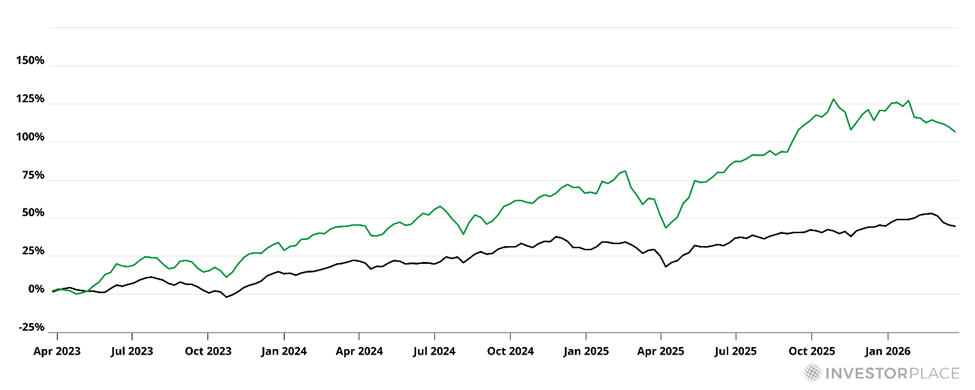
For the broader market, these conditions represent a "restrictive" environment. The Equal Weight S&P 500, which reflects the performance of the average American company, has seen a respectable but lagging growth of approximately 40% over the past two years. However, this figure is dwarfed by the Global X Artificial Intelligence & Technology ETF (AIQ), which has surged by more than 100% in the same period.
The rationale for this divergence lies in the nature of capital investment. While consumer-facing industries are sensitive to shifts in sentiment and energy prices, the "hyperscalers"—tech giants like Microsoft, Alphabet, and Amazon—operate on five-to-ten-year capital expenditure (capex) horizons. Their decisions to build massive AI data centers are largely decoupled from short-term macro noise. Nvidia’s confirmed orders, which have reached nearly $1 trillion, illustrate that the demand for AI hardware remains inelastic despite the geopolitical instability in the Middle East.

The Internal Divide: AI Infrastructure vs. AI Software
While the narrative of "AI versus the rest of the market" dominated 2023 and early 2024, a new and perhaps more significant divide is emerging within the AI sector itself. This "AI K-shape" separates the "secure elite" of hardware and infrastructure providers from the increasingly vulnerable software and service providers.
On the winning side are the chipmakers, cooling system manufacturers, and data center real estate investment trusts (REITs). These entities are the primary beneficiaries of the current "build-out" phase. Their revenues are secured by multi-billion-dollar contracts from hyperscalers who are racing to achieve computational dominance.
Conversely, the software side of the AI trade is showing signs of distress. The iShares Expanded Tech-Software Sector ETF (IGV) has experienced a significant drawdown, falling 30% since late October. Major industry players such as Salesforce (CRM), Workday (WDAY), and UiPath (PATH) have seen double-digit percentage drops in their valuations. This shift suggests that the market is reassessing the "SaaS" (Software as a Service) model’s ability to successfully monetize AI.
The ROI Problem and the "SaaS-pocalypse"
The core of the software sector’s struggle is the uncertainty surrounding the return on investment (ROI) for AI-integrated tools. A recent study by researchers at the Massachusetts Institute of Technology (MIT) examined hundreds of corporate AI initiatives and concluded that the vast majority of organizations have yet to see a meaningful bottom-line impact.
Businesses are currently facing a "wait and see" dilemma. While they are eager to experiment with AI, many are hesitant to commit to expensive, recurring software subscriptions when the productivity gains remain theoretical or marginal. This has led to a phenomenon some analysts call the "SaaS-pocalypse," where software companies that were once considered safe bets are now struggling with slowing growth and customer churn.
The Private Credit Crisis: A Moment of Truth
The most alarming indicator of this shift is found in the private credit market. Private credit—lending that occurs outside the traditional banking system—has exploded in size over the last decade, reaching an estimated $1.7 trillion globally. Major funds such as Blue Owl Capital (OWL), Blackstone (BX), and Ares Management (ARES) have historically viewed software companies as ideal borrowers due to their predictable subscription-based cash flows.
However, the assumption that SaaS companies are "safe" is being tested. Morgan Stanley recently estimated that defaults in the direct lending space could soar to 8%, approaching the peak levels seen during the 2020 pandemic. This trend is being driven by software companies whose AI products are not generating sufficient cash flow to service their high-interest debt.
The strain is already manifesting in the form of "gating," where credit funds limit or suspend investor withdrawals to prevent a run on the fund. This lack of liquidity is a signal that the "extend and pretend" strategy—where lenders restructure loans to avoid recognizing defaults—is reaching its limit. Legendary investor Louis Navellier has warned that the private credit market is approaching a "moment of truth," where the market will finally distinguish between sound assets and impaired loans.
Chronology of the Market Shift
The current economic landscape is the result of a specific sequence of events over the last 24 months:
- Late 2022 – Early 2023: The launch of generative AI models triggers a massive speculative wave. Investors pile into any company with an "AI story," regardless of whether they provide hardware or software.
- Mid 2023: Hyperscalers begin massive capex increases. Nvidia’s earnings become the primary barometer for the health of the tech sector.
- Late 2023: Interest rates remain high, putting pressure on "yesterday’s economy" stocks and overleveraged households. The K-shape becomes the dominant economic narrative.
- Early 2024: Geopolitical tensions in the Middle East escalate. Energy prices rise, further squeezing the consumer. Luke Lango and other analysts note that AI infrastructure remains immune to these pressures.
- Late 2024 – Present: The "AI K-shape" emerges. Hardware continues to thrive, while software stocks (IGV) and private credit funds show signs of severe stress. Reports of "gated" funds and rising default projections become public.
Broader Impact and Future Implications
The widening gap within the K-shaped economy suggests that the "AI revolution" is entering a more sober and difficult phase. The initial excitement of the infrastructure build-out is being met with the harsh reality of software monetization and debt servicing. For investors, the primary implication is that the "buy everything AI" strategy is no longer viable.
The market is likely to see a flight to "fortress" stocks—companies with massive cash reserves, low debt, and dominant market positions. These "secure elites" of the corporate world are expected to absorb the capital that is currently fleeing the vulnerable software and private credit sectors.
Furthermore, the struggles in private credit may have a systemic impact. If defaults reach the projected 8%, it could lead to a broader tightening of credit conditions, making it even more difficult for mid-sized companies to innovate or expand. This would further entrench the K-shape, as only the largest and most liquid firms would have the resources to navigate the restrictive environment.
Ultimately, the future of AI depends on whether the software sector can bridge the "monetization gap." If businesses eventually find ways to turn AI tools into significant profit drivers, the software arm of the "K" may eventually recover. However, until that transition occurs, the divide between the physical builders of AI and the digital users of AI will likely continue to widen, creating a precarious environment for both high-income households and institutional investors alike.