Lenovo Unveils Groundbreaking ThinkBook Modular AI PC Concept at MWC 2026, Signifying a Pragmatic Shift in Laptop Innovation

Lenovo, a perennial innovator in the personal computing space, once again captured significant attention at MWC 2026 with the debut of its ThinkBook Modular AI PC concept. Unlike many of its previous experimental designs, which often leaned towards the overtly futuristic and commercially improbable, this latest concept distinguishes itself through an unexpected yet compelling sense of practicality and immediate usability. While past MWC showcases from Lenovo, such as the ThinkBook Transparent Display Laptop seen at MWC 2024, captivated audiences with their avant-garde aesthetics, they often left observers with the impression of a distant, perhaps unattainable, future. The ThinkBook Modular AI PC, however, proposes a vision of computing that feels remarkably grounded, offering a glimpse into a future where adaptability and user-centric design are paramount, seamlessly integrated into a familiar form factor. This pragmatic approach suggests a deliberate evolution in Lenovo’s conceptual design philosophy, moving from pure spectacle to a more direct exploration of actionable innovation for the contemporary and near-future professional landscape.
A New Paradigm for Portable Productivity
From its initial appearance, the ThinkBook Modular AI PC presents itself as a sleek, professional 14-inch touchscreen business laptop, designed with the clean lines and understated elegance typical of Lenovo’s ThinkBook series. Its front profile offers no immediate hint of its radical modular capabilities, maintaining an aesthetic that could easily blend into any modern office environment. This deliberate normalcy is, in fact, one of its most innovative aspects, setting the stage for a reveal that emphasizes function over overt flashiness. The true ingenuity of the concept unfolds upon closer inspection, particularly when examining the device’s rear and its array of transformative features. This design choice underscores Lenovo’s intention to integrate advanced flexibility without compromising on a polished, professional facade.
The Ingenuity of the Dual-Display System
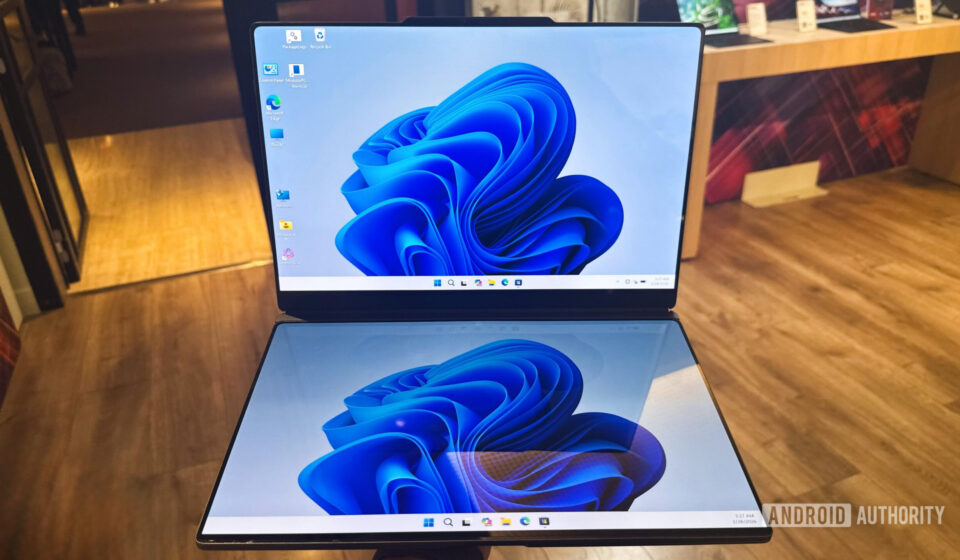
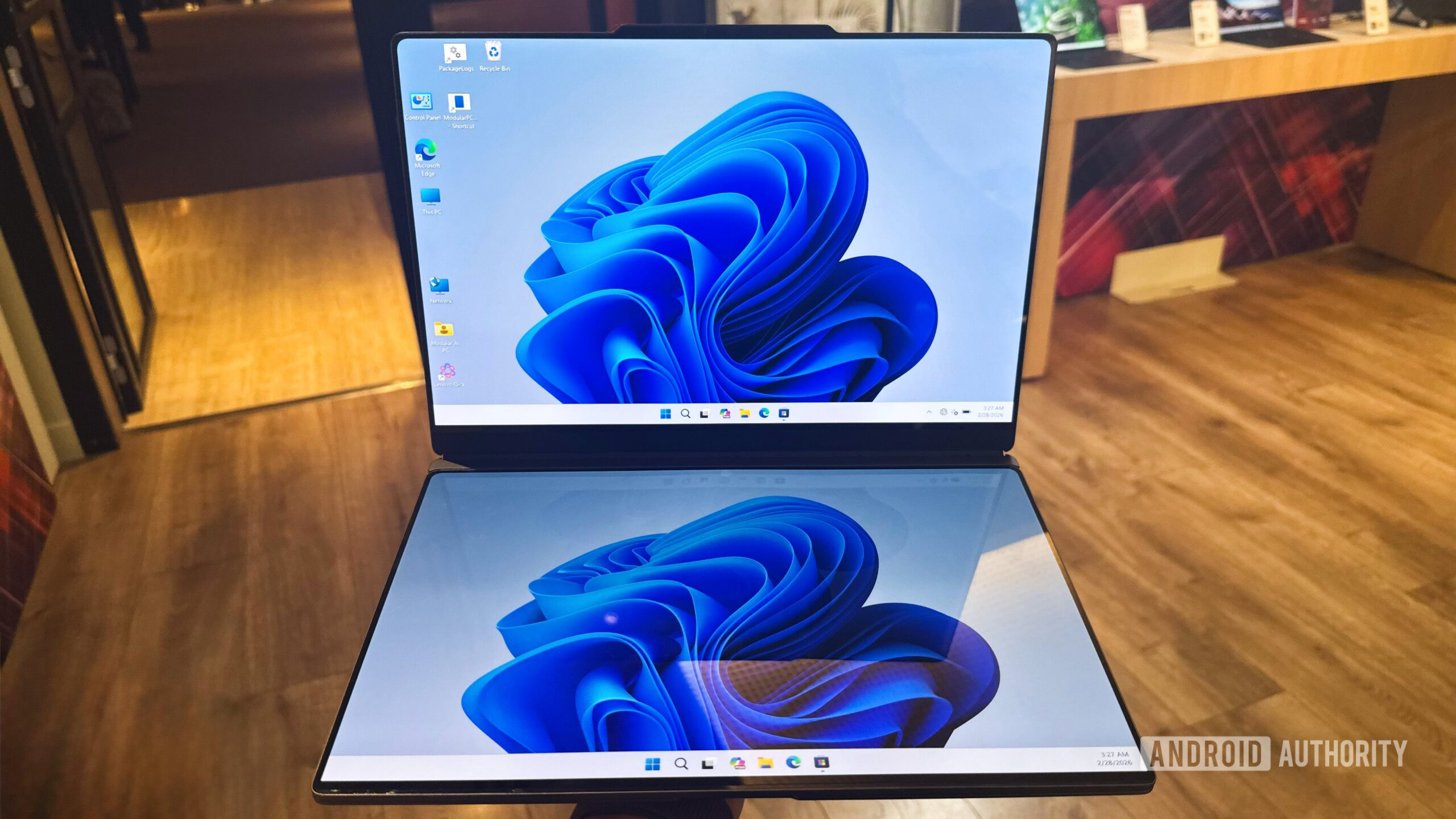
The most striking modular element of the ThinkBook Modular AI PC is its secondary 14-inch display, ingeniously attached to the rear lid via a series of pogo pins. This display sits flush with the laptop’s chassis, making it almost imperceptible until its functionality is explicitly demonstrated. The immediate and most apparent use case for this integrated second screen is enhanced collaboration and presentation. Imagine a scenario in a bustling café or a collaborative meeting room: instead of the cumbersome act of swiveling a laptop or having colleagues strain to view a shared screen, the primary user can maintain their focus on the main display while the secondary screen effortlessly mirrors or extends content to an audience directly opposite them. This simple yet profound alteration in interaction streamlines shared viewing experiences, fostering more natural and effective communication in both casual and formal settings.
However, the utility of this secondary display extends far beyond mere screen sharing. Lenovo has engineered it to be fully magnetic and detachable, transforming it into an independent, portable monitor. Equipped with its own kickstand, this secondary screen can be deployed in both vertical and horizontal orientations, offering unparalleled flexibility for multitasking, content creation, or extended display real estate. While it currently requires power from a separate pogo pin adapter, the concept demonstrates a clear pathway towards integrated multi-monitor setups that are inherently mobile. This feature directly addresses the growing demand for flexible workspaces, especially in the era of hybrid work models, where professionals frequently transition between various environments, from home offices to co-working spaces and client sites. The ability to instantly augment one’s screen real estate without carrying a separate, bulky external monitor represents a significant leap in portable productivity solutions.
Transforming Input and Interaction
The modularity of the ThinkBook concept further extends to its input mechanisms, allowing for an unprecedented level of user customization and ergonomic flexibility. The physical keyboard itself is removable, offering users the option to detach it from the main chassis. This capability opens up a range of new interaction paradigms. For instance, the detachable keyboard can be wirelessly paired with the main unit, effectively converting the laptop into a dual-screen workstation where the primary screen is complemented by the formerly rear-mounted display, now positioned for an expansive visual experience. This setup caters to professionals who require extensive screen space for data analysis, graphic design, coding, or complex document comparisons, all within a highly adaptable format.
The ability to use the keyboard wirelessly also enhances ergonomic comfort, allowing users to position the keyboard at a distance or angle that best suits their posture and workflow, mitigating the constraints of a fixed laptop layout. This adaptability aligns with broader trends in workspace design, which increasingly prioritize user comfort and the ability to personalize one’s computing environment. The seamless interchangeability between a traditional laptop configuration and an advanced dual-screen workstation underscores the concept’s commitment to versatility, making it a potentially invaluable tool for a diverse range of professional applications.
Revolutionizing Connectivity with Swappable I/O Ports
Perhaps one of the most subtly revolutionary features of the ThinkBook Modular AI PC is its approach to input/output (I/O) ports. Addressing a common frustration among laptop users – the fixed and often inconvenient placement of ports – Lenovo has designed modular and physically swappable I/O units. Standard ports such as USB-A, USB-C, and HDMI are not hardwired into a specific location but exist as independent modules that can be physically shifted from left to right, or vice versa, depending on the user’s desk setup, peripheral arrangement, or ergonomic preferences. This level of customization allows users to optimize cable management and accessibility on the fly, eliminating the need for awkward cable routing or dongle reliance.
To prevent the loss of these detachable modules, Lenovo has even conceived of a small, integrated case designed to store the ports when they are not in use or when their position needs to be changed. This thoughtful inclusion highlights the meticulous attention to detail underpinning the entire modular concept. Beyond immediate convenience, swappable ports also present significant long-term advantages. They offer a degree of future-proofing, allowing users to potentially upgrade or replace specific port types as technological standards evolve (e.g., transitioning from an older USB standard to a newer, faster one without replacing the entire laptop). This aspect also subtly hints at potential sustainability benefits by extending the usable lifespan of the device and reducing electronic waste, a growing concern in the tech industry.
Under the Hood: Powering the Modular AI Vision
While the modularity is the headline feature, the internal specifications of the ThinkBook Modular AI PC concept provide a glimpse into its potential performance capabilities. The unit showcased at MWC 2026 is equipped with an Intel Core Ultra 7 255H processor, 32GB of memory, and a 1TB M.2 PCIe SSD for storage. The inclusion of an Intel Core Ultra processor is particularly significant, as these chips are designed with integrated Neural Processing Units (NPUs) specifically optimized for accelerating on-device Artificial Intelligence (AI) workloads. This positions the concept firmly within the emerging "AI PC" category, capable of handling complex AI tasks locally, such as real-time language translation, advanced image and video editing, intelligent system optimization, and enhanced security features, without constant reliance on cloud services.
The choice of processor aligns with the broader industry trend towards decentralizing AI processing, bringing powerful AI capabilities directly to the user’s device for improved speed, privacy, and efficiency. While the concept’s 33Wh battery capacity was noted as "unfortunate" in the initial assessment, it is crucial to remember that this is a conceptual prototype. A production-ready model would undoubtedly require significant battery life improvements, potentially leveraging the AI capabilities of the Core Ultra processor for more efficient power management and intelligent resource allocation. The specifications, therefore, serve as a foundational proof-of-concept, demonstrating that such a highly modular system can be built upon a robust, AI-capable hardware platform.
Lenovo’s Strategic Play and Broader Implications
Lenovo has a well-documented history of using MWC as a platform to test innovative ideas, with many conceptual elements eventually finding their way into commercial products. The ThinkBook Modular AI PC feels less like a mere demonstration of technological prowess and more like a strategic sounding board for future product development. It signals Lenovo’s intention to actively explore what the "next generation" of personal computing should entail, particularly in an era defined by hybrid work, AI integration, and an increasing demand for flexible, sustainable technology.
Timeline and Evolution of Lenovo Concepts:
- Early 2010s: Lenovo frequently showcased convertible laptops (e.g., Yoga series) that blurred lines between laptops and tablets, pushing form factor innovation.
- Mid-2010s: Introduction of modular concepts like the ThinkPad X1 Tablet with attachable modules (projector, 3D camera), demonstrating early modular thinking for specific functions.
- MWC 2024: Unveiling of the ThinkBook Transparent Display Laptop, a bold, highly futuristic concept focusing on visual innovation. This concept, while visually stunning, was widely perceived as a distant possibility.
- MWC 2026: Debut of the ThinkBook Modular AI PC, marking a shift towards practical, user-centric modularity, combining hardware flexibility with the promise of on-device AI.
Industry Reactions and Analyst Perspectives (Inferred):
Industry analysts are likely to view the ThinkBook Modular AI PC as a significant step for Lenovo, positioning the company as a leader in exploring pragmatic modularity. "This concept from Lenovo is a clear indication that the industry is moving beyond superficial design changes to genuinely enhance user experience and device longevity," remarked a hypothetical senior analyst at Tech Insights. "The blend of modular hardware and integrated AI processing addresses critical needs for modern professionals seeking adaptable, powerful, and potentially more sustainable computing solutions."
The implications of such a modular design extend beyond mere convenience. In an increasingly environmentally conscious world, the ability to upgrade specific components or replace worn-out parts rather than discarding an entire device contributes to a circular economy model. While the initial cost of modular components might be higher, the potential for extended product lifespan and reduced e-waste could offer significant long-term value for consumers and align with corporate sustainability goals.
Challenges and the Path to Commercialization:
Bringing a concept like the ThinkBook Modular AI PC to market would involve navigating several challenges:
- Manufacturing Complexity: Producing highly integrated, durable, and reliable modular components at scale.
- Cost: The specialized engineering and components could lead to higher retail prices, requiring careful market positioning.
- Standardization: Ensuring compatibility and ease of use for swappable modules.
- Durability: Designing pogo pins, magnetic attachments, and detachable elements that can withstand repeated use without degradation.
- User Adoption: Educating consumers on the benefits and usage of such a flexible system.
Despite these hurdles, the ThinkBook Modular AI PC serves as a powerful indicator of future trends. It reflects a growing industry focus on adaptive hardware, smart software, and environmental responsibility. While the full concept may never be released exactly as shown, it is highly probable that individual elements – the detachable secondary display, the wirelessly connected keyboard, or the modular I/O ports – will be refined and integrated into Lenovo’s mainstream ThinkBook and ThinkPad lines in the coming years. This strategic approach allows Lenovo to gauge market appetite and technological feasibility incrementally, paving the way for a more flexible, personalized, and AI-powered computing experience in the not-so-distant future. The MWC 2026 showcase thus stands not merely as an exhibition of a futuristic device, but as a compelling blueprint for the evolution of the modern professional laptop.