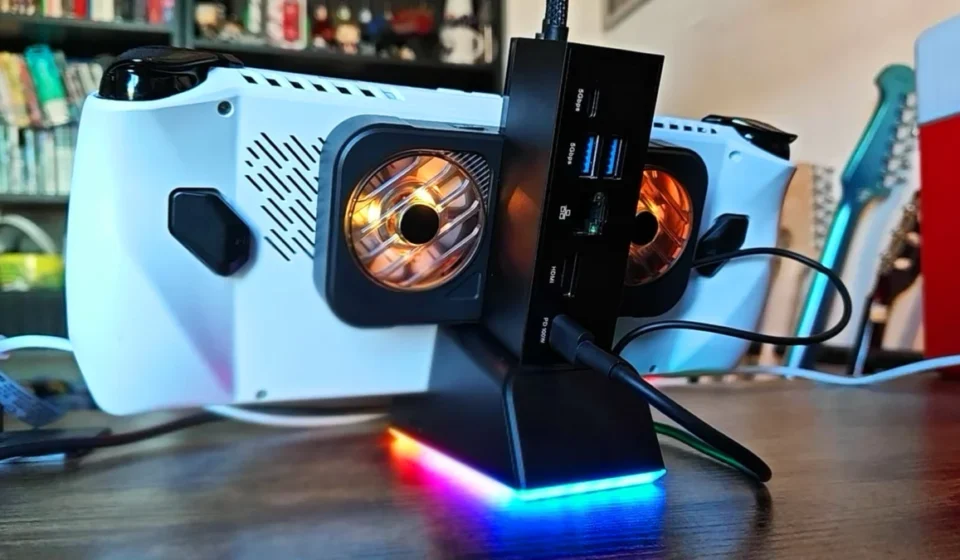

The burgeoning market for handheld gaming PCs, spearheaded by devices like the Steam Deck, ASUS ROG Ally, and Lenovo Legion Go, has created a significant demand for versatile accessories that bridge the gap between portable power and traditional desktop experiences. Among the companies rapidly carving out a space in this ecosystem is JSAUX, a brand known for offering a range of affordable yet functional add-ons. Their latest offering, the JSAUX 7-in-1 RGB Cooling Docking Station, aims to provide a comprehensive solution for users seeking enhanced connectivity, display output, and even thermal management. This review delves into the capabilities and limitations of this multi-functional dock, assessing its value proposition in a competitive landscape.
Unpacking the JSAUX 7-in-1 RGB Cooling Docking Station
Navigating the plethora of docking stations available can be a daunting task, with options ranging widely in price and feature sets. JSAUX has positioned itself as a provider of value, and the 7-in-1 RGB Cooling Docking Station is no exception. This accessory, designed to accommodate devices such as the Steam Deck, ROG Ally, Legion Go, and the newer ROG Ally X, offers a suite of ports intended to maximize the utility of these handheld powerhouses.
The core functionality of any docking station is to facilitate seamless connection to external displays and peripherals. The JSAUX 7-in-1 addresses this with a robust set of inputs and outputs. It features two USB-A 3.0 ports, ideal for connecting controllers, keyboards, mice, or external storage devices. An Ethernet port is included, promising stable, high-speed wired internet connectivity, crucial for online gaming and large downloads. For video output, the dock boasts an HDMI 2.1 port, capable of supporting resolutions up to 4K at 120Hz, along with HDR and Variable Refresh Rate (VRR) technologies. This specification is particularly noteworthy, as it aligns with the display capabilities of many modern monitors and TVs, offering the potential for a truly immersive gaming experience.
Power delivery is another critical aspect. The docking station incorporates USB-C ports for passthrough charging. This allows users to power their handheld device while it is connected to the dock, ensuring uninterrupted gameplay or productivity sessions. The inclusion of a dedicated USB-C port for the RGB cooling fans also signifies a modular design, allowing users to customize their setup based on their needs.

Design and Build Quality: A Blend of Form and Functionality
The JSAUX 7-in-1 RGB Cooling Docking Station presents a horizontally oriented design, a departure from the more common vertical stands. This form factor can be advantageous for desk organization, allowing the dock to sit unobtrusively among other peripherals. Weighing approximately 360 grams, it strikes a balance between being substantial enough to feel stable and light enough for easy portability, should the need arise to disassemble and pack it.
The chassis is constructed with an aluminum-plated finish, lending it a premium feel and contributing to its perceived durability. This material choice suggests a product built to withstand the rigors of regular use, including potential minor impacts. The reviewer notes that the build quality inspires confidence, implying that the dock is likely to endure accidental knocks or falls from a desk setup, a practical consideration for any tech accessory.
Performance: Video Output and Connectivity
The primary objective for many users of such a docking station is to achieve high-fidelity video output. JSAUX has a track record of delivering in this regard, and the 7-in-1 model is no exception. Supporting 4K resolution at a 120Hz refresh rate, along with HDR and VRR, it aims to provide a visually stunning experience. Paired with a compatible monitor, such as the MSI G32CQ4 mentioned in the review, the dock facilitates crisp and clear gaming sessions.
While the theoretical capabilities are impressive, the practical application is often limited by the hardware constraints of the handheld devices themselves. Many current-generation handheld PCs, including the ASUS ROG Ally Z1 Extreme, may struggle to consistently achieve 4K resolution at 120Hz, especially in demanding triple-A titles. However, the dock’s ability to handle these high specifications ensures that users are future-proofed and can leverage the full potential of their external displays when the handhelds’ performance allows.
The review mentions occasional instances where the dock failed to detect the ROG Ally. While these were infrequent and resolved, such connectivity hiccups can be frustrating for users. The Ethernet port, while not extensively tested in the review, is rated by JSAUX to deliver speeds of up to 1000 Mbps, which would be a significant upgrade over Wi-Fi for many online activities.

The RGB Cooling Element: A Mixed Bag
The defining feature of this particular JSAUX offering is its integrated RGB cooling fans. The inclusion of cooling fans is a logical addition, given that portable gaming consoles can generate substantial heat, particularly when pushed to their limits with intensive games. Handheld PCs like the ROG Ally are designed to operate within thermal envelopes, with manufacturers specifying maximum operating temperatures, such as 96 degrees Celsius for the Ally. The effectiveness of cooling is often dependent on the chosen Thermal Design Power (TDP) settings and the specific game being played.
The reviewer’s experience with the cooling fans suggests a nuanced outcome. While the fans are engaged, they are noted to be not particularly quiet. More significantly, their impact on temperature control appears to be minimal. In demanding scenarios, such as playing games like ARC Raiders, the temperature reduction observed was only around two to five degrees Celsius. This modest improvement, the reviewer concludes, is "nothing worth writing home about."
The pricing of the JSAUX 7-in-1 RGB Cooling Docking Station, at $59.99 / £59.99, places a notable emphasis on the inclusion of these fans as a unique selling proposition (USP). Similarly, the RGB lighting, while offering an aesthetic enhancement for those who appreciate customizable desk setups, is met with indifference by the reviewer, suggesting it may not be a universally compelling feature.
Compatibility and Nuances
It is important to note that the cooling fans are specifically engineered with the ROG Ally X in mind. JSAUX’s website clarifies that "cooling efficiency may decrease with other handhelds due to intake misalignment." This suggests that while the dock itself is designed for broad compatibility with popular handhelds like the Steam Deck, ROG Ally, and Legion Go, the effectiveness of the cooling component might vary. Users with MSI devices, for instance, are explicitly noted as not being the primary target audience for the cooling aspect.
When placing the ROG Ally Z1 Extreme on the dock, the reviewer found that it did not impede on available space. However, to maximize the potential airflow from the fans, the reviewer removed their grip case, indicating that certain accessories might interfere with the optimal function of the cooling system.

Verdict and Value Proposition
The JSAUX 7-in-1 RGB Cooling Docking Station emerges as a competent accessory that excels in delivering high-quality video output and reliable connectivity at an attractive price point. The build quality is robust, and the design is practical for desk integration. The inclusion of an HDMI 2.1 port capable of 4K@120Hz, HDR, and VRR, along with essential USB-A ports and an Ethernet connection, covers the fundamental needs of most handheld PC users looking to connect to external displays and peripherals.
However, the standout feature, the RGB cooling fans, appears to be the product’s most significant compromise. The observed cooling benefits are marginal, and the fans contribute to noise levels. For a product priced at approximately $60, the fans’ limited efficacy raises questions about their value proposition. JSAUX also offers a 6-in-1 variant of their docking station, which typically retails for a considerably lower price (around $20 less). Given that the 6-in-1 model likely provides many of the core connectivity features without the less impactful cooling and RGB elements, it represents a potentially more cost-effective option for users who prioritize essential functionality over aesthetic flair and marginal thermal improvements.
For users who are particularly concerned about thermal management and are invested in the specific compatibility of the ROG Ally X, the cooling feature might hold some appeal. However, for the average user seeking a dependable and affordable docking solution, the JSAUX 7-in-1 RGB Cooling Docking Station offers excellent core functionality but may not fully justify the premium for its cooling and RGB additions over simpler alternatives. The product ultimately delivers a solid user experience for its primary functions, but the efficacy of its unique selling points remains debatable in the broader context of its value.
Pros:
- Excellent video output quality with 4K@120Hz, HDR, and VRR support.
- Reliable build quality with a sturdy aluminum-plated chassis.
- Comprehensive port selection including two USB-A, Ethernet, and USB-C passthrough.
- Affordable price point compared to many premium docking solutions.
- Compact and practical horizontal form factor.
Cons:
- Cooling fan performance is marginal and offers minimal temperature reduction.
- RGB lighting and cooling fans may not be compelling enough to justify a higher price over simpler models.
- Occasional, though infrequent, connectivity issues noted.
- Cooling fan effectiveness is specifically optimized for ROG Ally X, potentially reducing efficiency on other handhelds.