Mars Dune Alpha Simulation Reaches 150-Day Milestone, Offering Critical Insights for Future Human Exploration

Four volunteers have now spent 150 days isolated within NASA’s Mars Dune Alpha habitat, a meticulously designed 1,700-square-foot facility at the Johnson Space Center in Houston, Texas. This extended period of confinement is a crucial component of the Crewed Exploration of Analogue Environments and Operations (CHAPEA) mission, designed to gather invaluable data on the psychological and physiological challenges associated with long-duration space travel. The insights gleaned from this simulated Martian outpost are directly informing NASA’s ambitious plans to send humans to the Red Planet in the coming decades.
The four crew members – Ross Elder, Ellen Ellis, Matthew Montgomery, and James Spicer – voluntarily entered the Mars Dune Alpha habitat on October 19 of the previous year. Their mission, scheduled to conclude on October 31 of the current year, represents a significant commitment to advancing human space exploration. This week, NASA released a series of photographs offering a rare glimpse into the daily lives of these intrepid explorers as they navigate the complexities of a simulated deep space environment.
Daily Life and Scientific Endeavors Within the Habitat
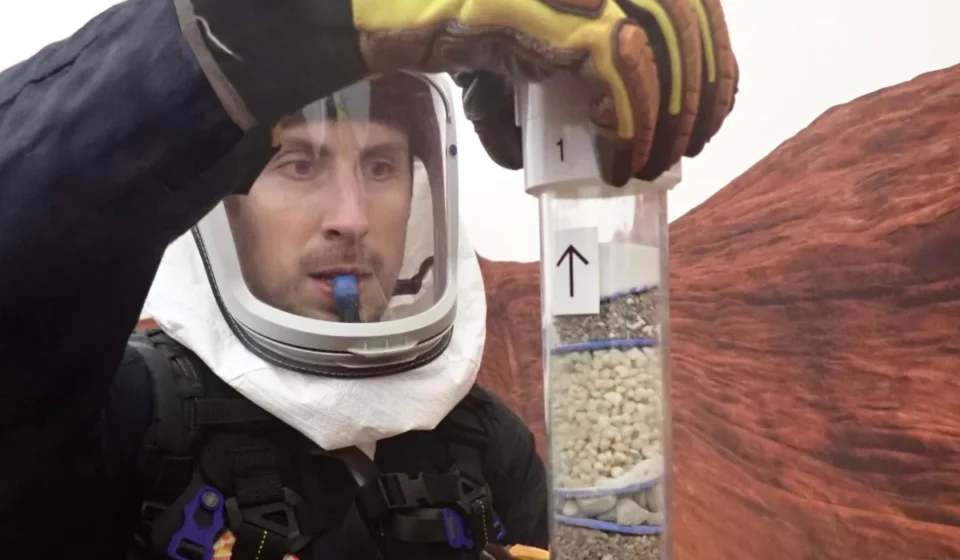
The released images depict a blend of routine activities and scientific research that characterize the crew’s existence within the habitat. Ross Elder and Matthew Montgomery are shown engaged in scientific investigations, underscoring the mission’s primary objective: to gather empirical data. In another snapshot, Ellen Ellis joins Montgomery in a game of table tennis, a seemingly ordinary recreational activity that highlights the importance of maintaining crew morale and social interaction within a confined and isolated setting. While James Spicer does not appear in these particular images, it is presumed he is actively participating in the mission, potentially capturing some of the photographic evidence himself.
The CHAPEA mission is rigorously observing how the volunteers respond, both physically and mentally, to the prolonged duration spent in an enclosed and isolated environment. This includes monitoring their stress levels, sleep patterns, dietary habits, and overall well-being. The data collected will be instrumental in developing countermeasures and support systems for future astronauts undertaking voyages that could last years.
Beyond scientific research, the crew faces a spectrum of challenges designed to mimic the realities of a Mars mission. These include managing resource shortfalls, undertaking essential maintenance tasks, and tending to a hydroponic garden, an integral part of ensuring food security on long-term missions. The success of these daily activities is paramount to the crew’s survival and the mission’s overall objectives.
The Psychological and Communication Hurdles of Deep Space
A significant aspect of the Mars Dune Alpha simulation is the replication of communication delays inherent in deep space travel. Ross Elder, prior to commencing the mission, articulated the profound implications of this delay. "Because the crew is replicating living on the surface of Mars some 250 million miles away, communications with Earth can be delayed by approximately 22 minutes each way and may be entirely blocked," Elder stated. He further emphasized, "Because of this, we may be unable to expect input from Mission Control back in Houston when time-critical emergencies arise. Therefore, it’s critical for the crew to rely on our teamwork, skills, decision making, and quick action to ensure the safety and success of the mission."
This communication lag necessitates a high degree of autonomy and self-reliance among the crew. They must be capable of making critical decisions independently, managing unexpected challenges, and resolving technical issues without immediate guidance from Earth. This aspect of the simulation is vital for understanding crew dynamics and leadership under extreme pressure.
Habitat Design and Operational Features
The Mars Dune Alpha habitat itself is a testament to the detailed planning involved in simulating extraterrestrial living conditions. The facility comprises approximately nine rooms, including a shared bathroom, and dedicated areas for communal meals and social interaction. Each crew member also has their own private sleeping quarters, offering a degree of personal space within the shared environment.
Adjacent to the living quarters is a specialized area designed to replicate the Martian surface. This allows the volunteers to conduct simulated "Mars walks," practicing the procedures and equipment necessary for Extravehicular Activities (EVAs) on another planet. These simulated EVAs are crucial for testing spacesuits, mobility systems, and surface exploration techniques.
Broader Context and the Road to Mars
The CHAPEA mission is part of a larger, multi-faceted effort by NASA to prepare for human missions to Mars. The agency aims to land the first humans on the Red Planet in the 2030s, a goal that requires overcoming significant technological, physiological, and psychological hurdles. While the precise timeline remains subject to ongoing development and funding, simulations like Mars Dune Alpha are indispensable in paving the way for this historic endeavor.
Supporting Data and Chronology
- October 19, [Previous Year]: Four volunteers – Ross Elder, Ellen Ellis, Matthew Montgomery, and James Spicer – begin their 150-day simulation inside the Mars Dune Alpha habitat at NASA’s Johnson Space Center.
- [Current Year], March 18: NASA’s Johnson Space Center shares an update and photographs marking the 150-day milestone of the CHAPEA mission, highlighting crew activities and the importance of the simulation.
- [Current Year], October 31: The CHAPEA mission is scheduled to conclude, with the four volunteers exiting the Mars Dune Alpha habitat.
- 2030s (Target Decade): NASA’s projected timeframe for sending the first human astronauts to Mars.
Analysis of Implications and Future Research
The Mars Dune Alpha simulation offers a tangible platform for addressing critical questions that will shape the future of human space exploration. The data collected on crew performance, mental health, and adaptation to isolation will directly influence the design of future spacecraft, habitats, and mission protocols. Understanding the psychological toll of prolonged confinement and communication delays is as vital as developing robust life support systems and propulsion technologies.
The successful completion of this 150-day phase demonstrates the feasibility of extended human stays in simulated Martian environments. It provides NASA with empirical evidence to refine its strategies for crew selection, training, and in-mission support. The challenges encountered and overcome by Elder, Ellis, Montgomery, and Spicer will serve as invaluable case studies for future missions.
Moreover, the simulation highlights the growing importance of analogue missions in space exploration. These Earth-based simulations allow scientists and engineers to test and validate technologies, procedures, and human factors in a controlled yet realistic setting, mitigating risks and optimizing outcomes for actual missions to other worlds. The Mars Dune Alpha habitat, therefore, represents not just a living space, but a critical research laboratory pushing the boundaries of human capability in the cosmos. The data gathered from this mission will be a cornerstone in the ongoing quest to make humanity a multi-planetary species.