Google Cloud Expands AI Video Creation Capabilities in Vids with Controllable Avatars and Veo 3.1 Integration

The landscape of digital content creation underwent a significant shift this Thursday as Google Cloud announced a comprehensive suite of updates for Vids, its artificial intelligence-driven video production application. Designed to bridge the gap between complex professional editing software and basic presentation tools, the latest enhancements focus on accessibility, creative control, and seamless integration within the broader Google Workspace ecosystem. By introducing controllable avatars, customizable persona generation, and the integration of the Veo 3.1 Lite model, Google is positioning Vids as a central hub for both corporate communication and personal storytelling. These updates represent a strategic move to democratize high-quality video production, allowing users with no prior technical expertise to generate polished, professional-grade content through simple text prompts and intuitive interfaces.
Advanced Control Mechanisms: Controllable and Customizable Avatars
The most technically significant addition to the Vids platform is the introduction of Controllable Avatars. In previous iterations of AI video tools, digital personas were often limited to static "talking head" formats, where movement was restricted to facial expressions and minor gestures. The new update allows users to insert avatars into specific scenes and direct them to interact with uploaded objects—such as a specific company product, a piece of medical equipment, or a retail prop—using straightforward text commands. This development addresses a major pain point in AI video generation: spatial awareness and object interaction. By maintaining consistent faces and voices across all generated frames, the system ensures that the final output looks refined and intentional, eliminating the need for expensive reshoots or multiple takes to get a single interaction correct.
Complementing the controllable aspect is the new Customizable Avatars feature. This tool empowers users to design a digital spokesperson from the ground up. Through text-based instructions, creators can adjust the physical appearance of an avatar, swap clothing to match corporate branding or a specific theme, and alter backgrounds to reflect the intended atmosphere of the video. Crucially, the AI maintains the likeness and vocal characteristics of the avatar throughout these changes, providing a level of brand consistency that was previously difficult to achieve without professional CGI teams. For enterprises, this means the ability to create a consistent "brand face" that can appear in different contexts—from a formal boardroom setting for an annual report to a casual home office for an internal training video—all within the same application.
Democratizing Generative Video: Veo 3.1 Lite Integration
In a move that significantly expands the reach of Google’s generative AI, the company has integrated the Veo 3.1 Lite model directly into Vids. This marks the first time that the Veo technology, Google’s most advanced video generation model to date, has been made accessible to users with personal Google accounts. Veo 3.1 Lite allows individuals to generate dynamic 8-second videoclips using either a text prompt or by uploading a reference image. This functionality is intended to serve as a creative "spark," providing b-roll footage, transitions, or conceptual visuals that would otherwise require stock footage subscriptions or original filming.
To encourage adoption while managing computational resources, Google is offering personal account holders 10 free generations per month. This "freemium" approach is designed to introduce the general public to the capabilities of generative video, potentially setting a new standard for how individuals approach social media content, school projects, and personal greetings. The Lite version of the model is optimized for speed and efficiency, ensuring that the creative flow remains uninterrupted by long rendering times, a common hurdle in high-fidelity AI generation.
Streamlining the Workflow: Direct YouTube Export
Efficiency remains a core pillar of the Google Workspace philosophy, and the latest update to Vids reflects this through a new direct export feature to YouTube. Previously, users were required to download their finished projects as localized files and then manually upload them to YouTube—a process that involved multiple steps, potential data loss during compression, and significant time consumption for large files.
The new integration allows for a one-click publishing workflow. Once a video is finalized within the Vids interface, it can be sent directly to a linked YouTube channel. This feature is particularly beneficial for small business owners, educators, and corporate communications teams who manage high volumes of video content. By removing the friction between creation and distribution, Google is tightening the loop of the content lifecycle, making Vids not just a creation tool but a vital part of the digital marketing and communication pipeline.
A Chronology of Innovation: Building the Vids Ecosystem
The updates announced this Thursday are the latest in a rapid succession of improvements made to the Vids platform since its initial unveiling. To understand the current state of the application, it is essential to look at the developmental milestones achieved over the past several months.
In early 2024, Google introduced "Cartoon Avatars," offering both 2D and 3D stylized characters. This was a strategic move to provide a more universal and emotionally resonant alternative to photorealistic avatars, which can sometimes fall into the "uncanny valley." These stylized personas have proven popular in educational and internal training contexts where a friendly, approachable tone is preferred over a strictly formal one.
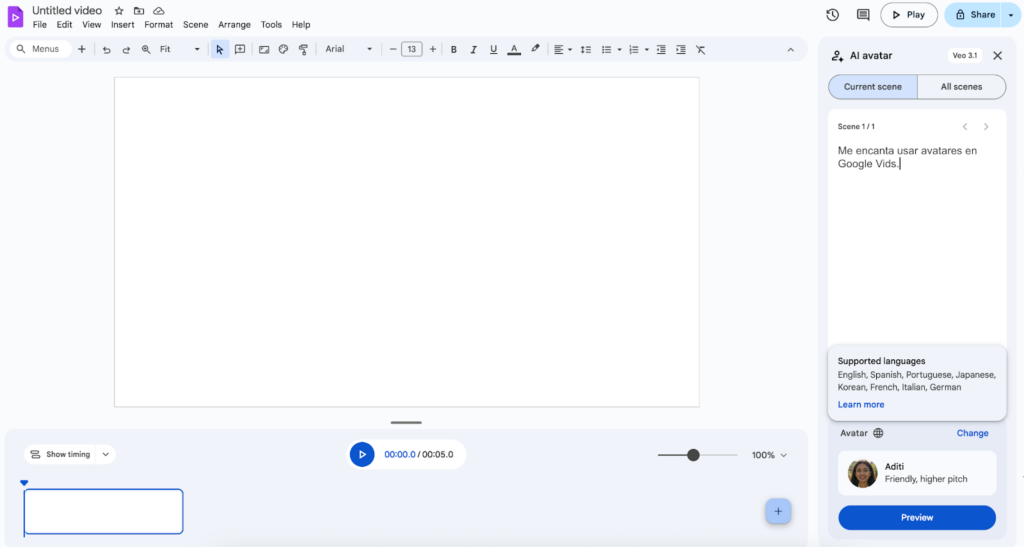
In February, the platform significantly expanded its global footprint by adding support for seven new languages for both avatars and narration: French, German, Italian, Korean, Portuguese, Spanish, and Japanese. This localized support included not just text-to-speech capabilities but also cultural nuances in avatar gestures and lip-syncing, making Vids a truly international tool for multinational corporations.
Furthermore, the integration of Lyria 3, Google’s advanced music generation model, provided Vids with a robust audio engine. Lyria 3 allows users to generate custom soundtracks from text descriptions, ranging from 30-second atmospheric clips to full-length tracks. By combining video generation (Veo), persona generation (Vids Avatars), and audio generation (Lyria), Google has created a comprehensive "AI director’s suite" that covers every sensory aspect of video production.
Market Context and Supporting Data
The expansion of Google Vids comes at a time when the demand for video content is reaching unprecedented levels. According to recent industry reports, video traffic accounts for over 80% of all consumer internet traffic. Furthermore, a study by Wyzowl found that 91% of businesses now use video as a marketing tool, an all-time high since the survey began. However, the primary barriers to video production remain cost and time.
Google’s internal data suggests that the average corporate training video can take weeks to produce when involving traditional filming and editing. By leveraging AI, Vids aims to reduce this timeline to hours or even minutes. The integration into Google Workspace—which boasts over 3 billion users—gives Google a massive built-in audience. Unlike competitors such as Sora (OpenAI) or Runway, which often operate as standalone creative tools, Vids is positioned as a productivity tool, sitting alongside Docs and Sheets. This integration allows for "collaborative video editing," where multiple team members can comment on and edit a video project in real-time, mirroring the workflow that revolutionized document processing a decade ago.
Industry Implications and Ethical Considerations
The rapid advancement of AI-generated avatars and video raises important questions regarding digital ethics and security. In response to these concerns, Google has reiterated its commitment to responsible AI. All content generated within Vids is subject to Google’s safety filters to prevent the creation of harmful or deceptive material. Additionally, Google employs SynthID, a tool developed by Google DeepMind, to apply digital watermarks to AI-generated content. These watermarks are imperceptible to the human eye but can be detected by specialized software, ensuring that AI-generated videos can be identified as such, thereby mitigating the risks associated with deepfakes and misinformation.
From a market perspective, the enhancement of Vids places significant pressure on traditional creative software providers like Adobe and Canva. While Adobe has integrated AI through its Firefly model, Google’s advantage lies in the deep integration with the cloud-based Workspace. If a user can turn a Google Slides presentation into a professional video with a single click, the incentive to export data to external video editing software diminishes.
Conclusion: The Future of the "Fourth Pillar"
Google Vids was originally introduced as the "fourth pillar" of the Workspace productivity suite, joining the ranks of Docs, Sheets, and Slides. With the latest round of updates, it is clear that Google no longer views video as an optional add-on but as a fundamental medium for modern work and communication. By providing controllable avatars, customizable personas, and high-end generative capabilities via Veo 3.1 Lite, Google Cloud is empowering a new generation of "non-editors" to communicate with the visual impact of a professional production studio.
As the platform continues to evolve, the focus will likely shift toward even deeper personalization and smarter automation. For now, the Thursday update serves as a powerful statement of intent: the future of video is not just about recording reality, but about using artificial intelligence to synthesize it into clear, engaging, and accessible narratives for everyone.