The High Cost of the Cold Handoff: Why Landing Page Optimization is the New Frontier for Creator Marketing Success

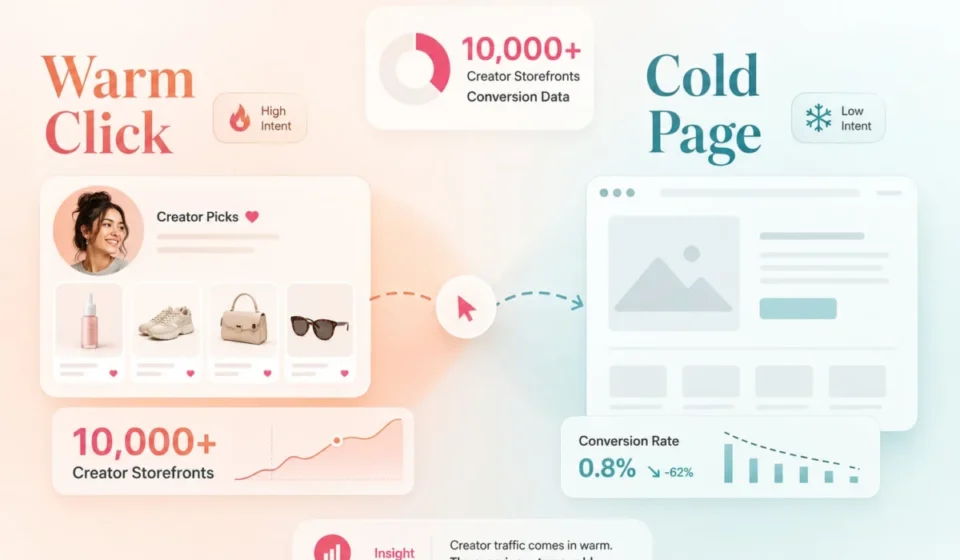
For years, the multi-billion-dollar creator economy has operated under a persistent assumption: if a campaign fails to convert, the fault lies with the creator, the content, or the commission structure. However, a comprehensive analysis of thousands of creator programs over the past 18 months reveals a different reality. Brands are now seeing conversion rate lifts of 30%, 40%, and in some cases, as high as 214%, not by switching talent or increasing budgets, but by fundamentally redesigning the destination of the user’s click. This shift addresses what industry analysts call the "Warm Click, Cold Page" problem— a structural failure in the digital marketing funnel where the trust established by a creator is abruptly severed the moment a consumer lands on a generic brand website.
As influencer marketing matures into a standard line item for Global 2000 brands and direct-to-consumer (DTC) startups alike, the focus is shifting from top-of-funnel discovery to bottom-of-funnel efficiency. The data suggests that the "conversion gap" is rarely a creator problem; rather, it is a destination problem. While brands have historically audited creator selection, renegotiated affiliate rates, and obsessed over creative briefs, they have largely ignored the landing experience. The evidence now points toward a mandatory evolution: the transition from generic affiliate links to co-branded, creator-specific storefronts hosted on the brand’s own domain.
The Psychology of the Warm Click
To understand why traditional landing pages fail creator-driven traffic, one must examine the psychological context of the referral. A creator often spends years building a rapport with their audience. Whether they are experts in skincare, fitness, or home organization, their followers view their recommendations through a lens of established trust and specific context. When a follower clicks a link, that click is "warm"—the consumer is already partially sold on the product based on the creator’s endorsement.
The breakdown occurs during the handoff. Most affiliate links resolve to one of three places: a brand’s homepage, a standard product detail page (PDP), or a generic discount-code lander. These environments are typically "cold." They do not recognize the visitor’s origin, they do not mention the creator by name, and they provide the same experience to a loyal follower as they would to a random visitor from a search engine. This "cold handoff" forces the consumer to restart their consideration process from scratch, navigating a massive catalog without the guidance of the person who brought them there. The result is a significant drop-off in conversion as the continuity of trust is broken.
Empirical Evidence: Data from the Field
The magnitude of this problem—and the potential of the solution—is reflected in the performance metrics of brands that have moved toward creator-specific landing experiences. These pages typically feature the creator’s identity, their headshot, their specific curated product picks, and a streamlined checkout process, all while remaining on the brand’s official domain to maintain professional legitimacy.
Cozy Earth, a premium bedding and apparel brand, serves as a primary case study for this shift. By moving creator traffic from standard affiliate links to co-branded creator pages, the company reported an average 214% increase in conversion rates. Perhaps more significantly, the average order value (AOV) rose by 67%. This suggests that when consumers feel they are shopping a "curated collection" recommended by a trusted source, they are not only more likely to buy but also more likely to purchase multiple items.
![What Conversion Data From 10,000+ Creator Storefronts Reveals [Warm Click, Cold Page Problem]](https://influencermarketinghub.com/wp-content/uploads/2026/07/5a619d4d-chatgpt-image-jul-3-2026-12_33_04-pm.jpg)
In the health and wellness sector, the UK-based marketplace Healf has scaled this model across more than 1,700 creator partnerships. By providing creators with personalized pages they were proud to share, the brand achieved a 40.8% conversion rate on referred traffic. This figure significantly exceeds industry benchmarks for the health category, which typically hover between 2% and 5%. The brand’s affiliate leadership noted that the model not only improved sales but also served as a recruitment tool, as high-tier influencers prefer destinations that reflect their personal brand.
Similar results have been observed in the beauty and food industries. Buttah Skin recorded a 30% higher conversion rate and a 78% lift in AOV when using dedicated creator pages over standard product pages. Meanwhile, the electrolyte gum brand Electro reported that creator-led storefronts now account for a staggering 81% of their total e-commerce revenue. These figures indicate that the trend is not industry-specific but rather a fundamental shift in how social commerce functions.
The Chronology of Creator Infrastructure
The current move toward creator-specific landing pages represents the third major era of influencer marketing infrastructure.
- The Wild West Era (2010–2016): Brands engaged in "shoutouts" with little to no tracking. ROI was measured in likes and comments.
- The Affiliate Era (2017–2022): The rise of platforms like LTK and the standardization of UTM parameters allowed for better tracking. However, the technology focused on the link rather than the landing page. Clicks were tracked, but the user experience remained fragmented.
- The Storefront Era (2023–Present): Brands are now building "infrastructure for trust." This involves dynamic landing page builders that allow marketing teams to spin up hundreds of personalized pages without requiring constant intervention from engineering or web design teams.
This evolution has been accelerated by the "event-scale" success of major creator drops. For example, when Crocs partnered with streamer Kai Cenat, the resulting creator-specific landing page drove over 350,000 sessions. Managing that volume of traffic while maintaining a personalized feel is only possible through specialized commerce infrastructure.
Strategic Patterns of High-Converting Creator Pages
Analysis of high-performing programs reveals two consistent patterns that separate successful creator pages from those that plateau.
1. Curation Depth Over Catalog Size
There is a common misconception that giving a customer more choices leads to more sales. In the context of creator marketing, the opposite is true. Creator pages that feature 6 to 15 curated products consistently outperform pages that display the full brand catalog by a factor of two to three. The shopper is arriving because they trust the creator’s taste. The landing page’s primary function is to validate that taste. When a creator selects a dozen items they actually use and provides a brief "why I love this" testimonial for each, it removes the cognitive load of shopping and moves the customer directly to the checkout phase.
2. Persistent Creator Visibility
Trust continuity requires that the creator remains visible throughout the entire journey, including the moment of purchase. The most successful landing pages keep the creator’s name, image, and voice prominent. This serves as a psychological "security blanket" for the consumer. While a standard campaign landing page is optimized for general conversion, a creator page is optimized for trust continuity. If the creator disappears the moment the user clicks "Add to Cart," the conversion probability drops.
![What Conversion Data From 10,000+ Creator Storefronts Reveals [Warm Click, Cold Page Problem]](https://s.influencermarketinghub.com/imaginary/convert?type=webp&url=https://influencermarketinghub.com/wp-content/uploads/2026/07/d15fc009-image3-1024x490.jpg)
The 30-Day Diagnostic Framework
For brands looking to test this hypothesis, industry experts recommend a 30-day intervention. Rather than overhauling an entire program, brands should select 5 to 10 active creator relationships and build dedicated landing pages for them. During this period, three key metrics must be monitored:
- Relative Conversion Rate: Comparing the creator page against the previous affiliate destination. A successful implementation typically yields at least a 20% lift within the first month.
- Average Order Value (AOV): If conversion rises but AOV remains flat, it usually indicates that the page lacks an "editorial layer"—the creator’s personal narrative or descriptions of why products work together.
- The 30-Day Repeat Rate: This is a critical indicator of cohort quality. Customers acquired through a trust-continuous journey often show higher loyalty than those acquired through a one-time discount code.
A quick diagnostic for any brand is to compare their creator-link conversion rate against their standard product page conversion rate. If creator traffic is converting at less than 2%, while the site average is 3% or 4%, the "conversion gap" is almost certainly a landing-experience issue.
Broader Implications and Future Outlook
The "Warm Click, Cold Page" problem is becoming more acute as the cost of customer acquisition (CAC) on traditional social platforms continues to rise. Brands can no longer afford to waste expensive creator-generated traffic on inefficient landing experiences.
Furthermore, as privacy regulations like the deprecation of third-party cookies make traditional retargeting more difficult, the importance of "first-visit conversion" has skyrocketed. Creator-specific pages offer a way to capture intent and close the sale in a single session by leveraging external social proof.
In the long term, this shift suggests that the "homepage" of the future may not be a single URL, but rather thousands of personalized entry points tailored to the specific community or creator that referred the user. For brands, the challenge is no longer just finding the right creators, but building the operational capacity to host them properly. Those who treat the landing experience as a vital part of the creator relationship are finding that their programs are not just growing, but compounding in value. Those who continue to route warm clicks to cold pages are, quite simply, leaving the majority of their ROI on the table.