TradeSmith CEO Unveils Data-Driven Seasonality Research to Navigate Global Market Volatility and Predictive Uncertainty

The financial services industry is witnessing a significant shift toward data-centric, historical analysis as a primary means of navigating increasingly volatile global markets. Keith Kaplan, CEO of the financial technology firm TradeSmith, recently presented a comprehensive case for "market seasonality," arguing that recurring calendar-based patterns offer a more reliable signal for investors than traditional macroeconomic forecasting. This approach, which emphasizes historical consistency over real-time news cycles, seeks to mitigate the impact of geopolitical instability, fluctuating interest rates, and the inherent unpredictability of corporate earnings reports. By analyzing decades of market data, Kaplan’s research team has identified specific windows of time where thousands of individual stocks have historically demonstrated a high probability of price appreciation, regardless of the broader economic narrative.
The emergence of this research comes at a time when traditional market predictors are facing increased scrutiny. With the global economy grappling with regional conflicts in the Middle East, shifting Federal Reserve leadership, and the rapid integration of artificial intelligence into corporate infrastructure, the "noise" of daily headlines has become a significant hurdle for retail and institutional investors alike. Kaplan’s methodology suggests that while the future is inherently unpredictable, the past contains structured rhythms that tend to repeat with statistical significance.
The Historical Context of Market Seasonality
Seasonality in financial markets is not a new concept, though its application has evolved from anecdotal observations to high-frequency algorithmic modeling. Historically, traders have relied on phenomena such as the "January Effect"—a period where stock prices, particularly small-caps, tend to rise—and the "Santa Claus Rally" during the final week of December. Commodity markets have long been dictated by planting and harvesting cycles, while the gold market frequently responds to annual cultural festivals and central bank purchasing schedules in Asia.

The "Sell in May and Go Away" adage is perhaps the most famous example of seasonal sentiment, rooted in the historical underperformance of stocks during the six-month period between May and October. However, the research presented by TradeSmith suggests that these broad market generalities are only the tip of the iceberg. Modern computing power now allows for the identification of "micro-seasonal" windows—specific spans of days or weeks—tailored to individual equities rather than the market as a whole.
This shift toward hyper-specific seasonality is a response to the diminishing returns of traditional forecasting. Kaplan cited the work of Philip Tetlock, a professor at the Wharton School, whose long-term studies on expert predictions revealed that many professional forecasters perform no better than random chance. Tetlock’s conclusion that the average expert is roughly as accurate as a "dart-tossing chimp" serves as the foundational argument for why TradeSmith has pivoted toward a purely data-driven, historical model.
Methodology: Processing Two Quintillion Data Points
To validate the efficacy of seasonal patterns, the TradeSmith engineering team developed proprietary software capable of processing massive datasets. According to the firm’s disclosures, the system analyzed more than two quintillion historical price points across approximately 5,000 stocks. The objective was to determine if there were optimal, recurring dates to buy and sell individual securities based on their performance over the last several decades.
The backtesting process spanned 18 years, aiming to find patterns that persisted through various market cycles, including the 2008 financial crisis, the bull market of the 2010s, and the volatility of the COVID-19 pandemic. The research indicates that by isolating these specific calendar windows, investors could achieve a historical accuracy rate of approximately 83%. This level of consistency suggests that seasonal influences—ranging from institutional rebalancing and tax-loss harvesting to consumer behavior and corporate fiscal year-ends—create a "gravitational pull" on stock prices that often overrides temporary news shocks.
Case Studies in Seasonal Consistency: SAM and NVDA
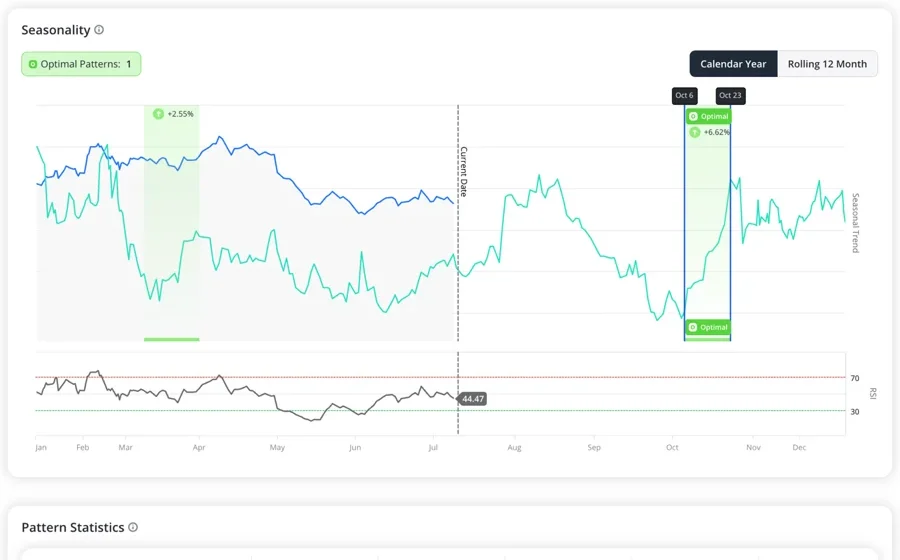
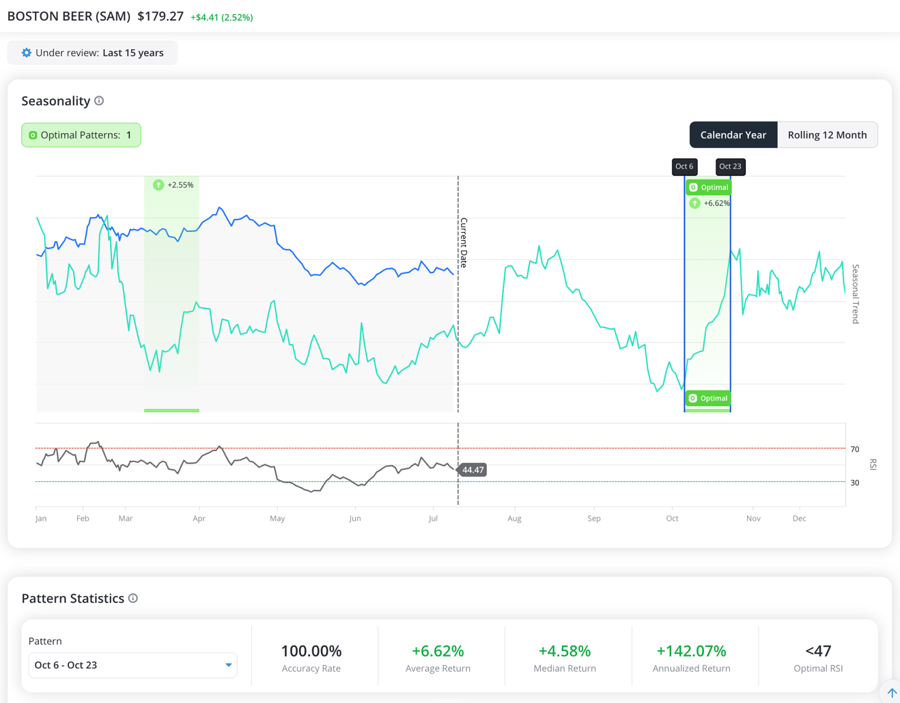
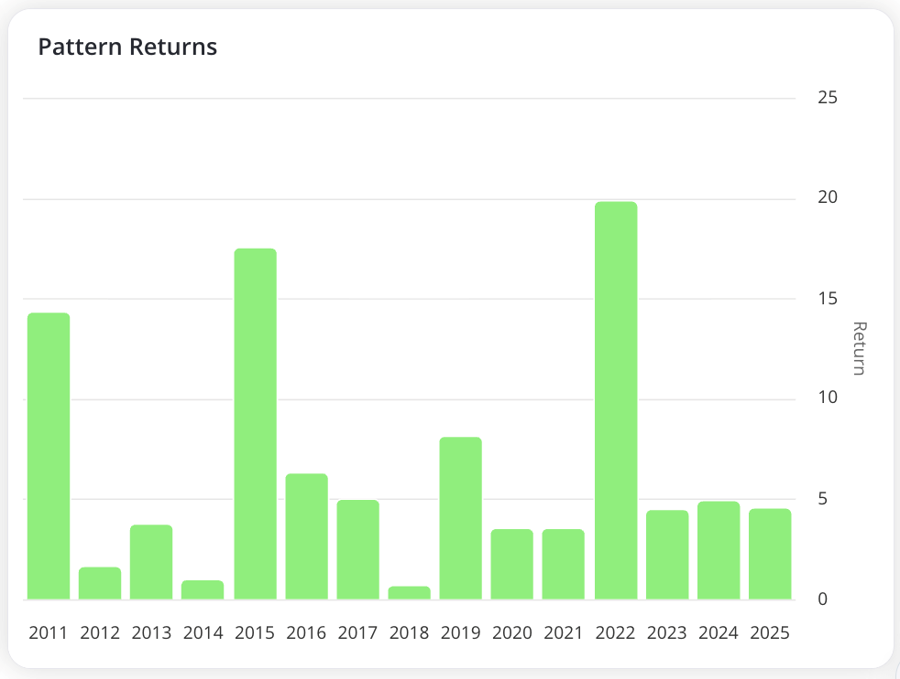
The research highlighted several specific examples where stocks adhered to strict calendar-based performance windows. One notable case is Boston Beer Company (SAM). Analysis revealed that the stock has entered a "green zone" every October 6 for the past 15 years. During the subsequent 17-day window, the stock rose an average of 6.6%. Most significantly, this rally occurred 100% of the time during the 15-year study period, demonstrating a level of reliability that is rarely found in traditional fundamental or technical analysis.
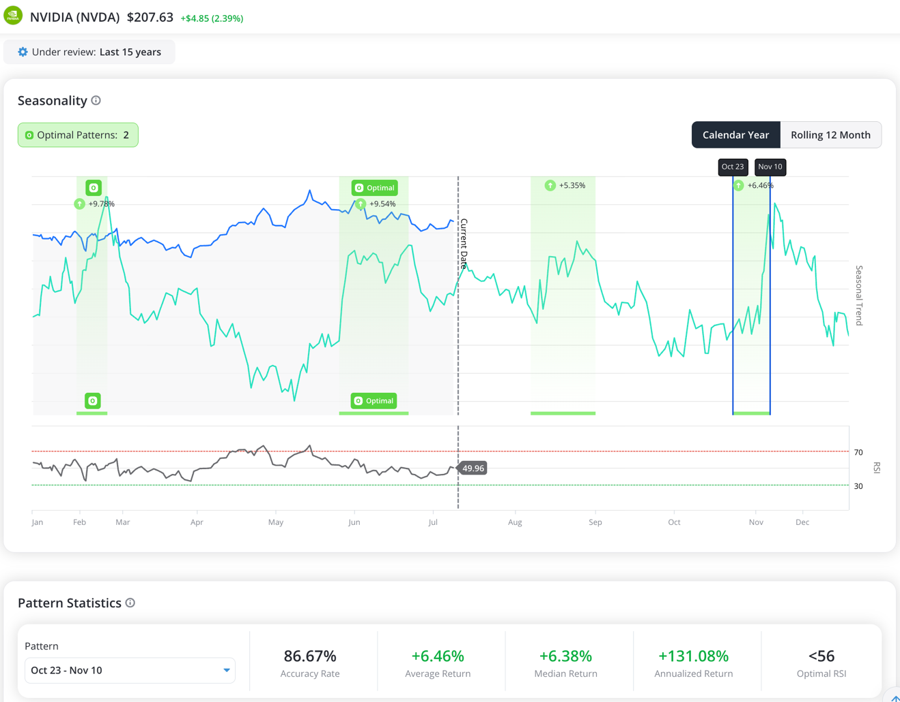
A similar pattern was observed in Nvidia (NVDA), a leader in the semiconductor and artificial intelligence sectors. Despite the high volatility often associated with tech stocks, Nvidia has historically risen an average of 6.5% over an 18-day period beginning every October 23. This pattern held true in 13 of the last 15 years. Kaplan noted that these moves were independent of specific earnings announcements or product launches; they represented a recurring market rhythm that existed long before Nvidia became a household name in the AI revolution.
These case studies illustrate the core of the TradeSmith thesis: that specific stocks have individual "heartbeats" or cycles. For an investor, identifying these windows allows for a more surgical approach to market entry and exit, potentially reducing the time capital is exposed to broader market risks.
The Nile Analogy: Predictive Patterns vs. Weather Forecasting
To explain the logic behind trusting historical patterns over future predictions, Kaplan utilized a historical analogy involving ancient Egypt and the Nile River. For centuries, the survival of the Egyptian civilization depended on the annual flooding of the Nile. Rather than trying to predict the weather in distant highlands—an impossible task at the time—the Egyptians built "Nilometers." These were stone columns marked with historical flood levels.
By observing where current water levels sat in relation to centuries of marks on the stone, priests could accurately predict whether the coming year would bring a surplus, a drought, or a destructive flood. They did not need to understand the meteorology of the Nile’s source; they only needed to trust the patterns recorded over generations. TradeSmith posits that the stock market functions similarly. While the "weather" of geopolitics and interest rates is unpredictable, the "water levels" of historical price action provide a reliable roadmap for what is likely to happen next.
Chronology of the Breakthrough 2026 Event
The presentation of this research was the centerpiece of the "Breakthrough 2026" event, a collaborative webinar featuring Kaplan and veteran investor Louis Navellier. The event was structured to provide a strategic outlook for the next two years, a period many analysts expect to be defined by high-stakes political transitions and technological disruption.
- Phase One: Identification of the "Noise" Problem. The event began by addressing the psychological toll that the current 24-hour news cycle takes on investors, leading to emotional decision-making.
- Phase Two: Introduction of the Seasonality Tool. Kaplan demonstrated the software interface, showing how it scans thousands of tickers to find upcoming "green zones."
- Phase Three: Live Case Study. A current stock recommendation was shared to allow participants to track the real-time application of the seasonality model.
- Phase Four: Strategic Integration. Navellier and Kaplan discussed how seasonality can be combined with fundamental "Big Data" analysis to filter for the highest-quality stocks entering their best seasonal windows.
The event concluded with a call for investors to adopt a more "mechanical" approach to the markets, using data to remove the fear and greed that often lead to poor timing and capital losses.
Broader Economic Implications and Market Reaction
The push toward seasonality-based investing reflects a broader trend in the financial industry: the democratization of algorithmic trading. Strategies that were once the exclusive domain of quantitative hedge funds and institutional trading desks are increasingly being made available to individual investors through platforms like TradeSmith.
As of early 2024, the macroeconomic environment remains fraught with uncertainty. The recent appointment of Kevin Warsh as a key economic advisor in the U.S. and the ongoing tensions regarding the Strait of Hormuz—a vital chokepoint for global oil supplies—have kept markets on edge. In this context, the appeal of a "calendar-first" strategy is growing. By focusing on dates rather than headlines, investors can theoretically maintain a consistent strategy even when the geopolitical landscape is in flux.
Market analysts have noted that while seasonality is a powerful tool, it is most effective when used in conjunction with other indicators. The "Breakthrough 2026" research does not suggest that news doesn’t matter, but rather that the market’s reaction to news is often moderated by seasonal trends. For instance, a negative earnings report may have a muted impact if it occurs during a stock’s historically strongest seasonal window, as institutional buyers may use the dip as an entry point for a planned seasonal move.
Conclusion: The Shift Toward Data-Driven Certainty
The research presented by Keith Kaplan and TradeSmith underscores a fundamental change in how market participants perceive risk and opportunity. By shifting the focus from "what might happen" to "what usually happens," the firm is advocating for a more disciplined, evidence-based approach to wealth accumulation.
The claim of 83% historical accuracy across a massive pool of equities suggests that market cycles are more deeply ingrained in the financial system than many realize. As 2026 approaches, the ability to distinguish between market noise and reliable patterns will likely be a defining characteristic of successful investment strategies. For those following the TradeSmith model, the calendar is no longer just a tool for tracking time—it is a sophisticated instrument for predicting the next "flood" of market capital.