
The South Korean equity market experienced a historic contraction during Monday’s trading session, sent into a tailspin by a localized selloff that rapidly evolved into a systemic market event. The benchmark KOSPI index, a primary barometer for the health of Asia’s fourth-largest economy, plummeted by more than 8% in early trading, triggering an automatic marketwide circuit breaker. This regulatory mechanism, designed to provide a "cooling-off" period during periods of extreme volatility, halted all trading for 20 minutes. However, the intervention proved insufficient to stem the tide of bearish sentiment. Upon the resumption of activities, the selling pressure intensified, culminating in a 10.8% decline by the closing bell—marking one of the most severe single-day drawdowns in the exchange’s history.
At the epicenter of this financial storm were the nation’s two most influential corporate entities: Samsung Electronics and SK Hynix. As the world’s leading producers of memory chips, these organizations represent more than a mere sector; they are the structural pillars of the South Korean economy. During the session, Samsung Electronics shares tumbled by 13.3%, while SK Hynix, a critical supplier of high-bandwidth memory (HBM) to artificial intelligence (AI) pioneers, saw its valuation erode by 14.7%. Because these two giants collectively account for over 50% of the KOSPI’s total market capitalization, their simultaneous decline effectively dictated the trajectory of the entire national index, illustrating the risks inherent in a market heavily concentrated in a single industry.
Chronology of the Market Contraction
The volatility in Seoul did not occur in a vacuum but followed a period of mounting anxiety regarding the sustainability of the global artificial intelligence boom. The timeline of the collapse began with the opening bell at 9:00 AM KST, where initial sell orders concentrated on the technology sector. Within the first hour of trading, the KOSPI’s decline surpassed the 8% threshold, prompting the Korea Exchange (KRX) to implement a Level 1 circuit breaker. This was the first time such a measure had been used since the onset of the COVID-19 pandemic in early 2020.
The 20-minute pause allowed institutional and retail investors to reassess their positions, but the fundamental drivers of the selloff—fears of a slowdown in US tech demand and a revaluation of AI-related earnings—remained unaddressed. When the market reopened at approximately 10:30 AM, the index briefly stabilized before a second wave of selling, driven by margin calls and algorithmic trading, pushed the KOSPI to its final 10.8% deficit. Analysts noted that the sheer volume of the selloff suggested a fundamental shift in institutional sentiment rather than a mere technical correction.
The Strategic Weight of the Semiconductor Duopoly
To understand the magnitude of the KOSPI’s collapse, one must examine the unique composition of the South Korean stock market. Unlike the more diversified S&P 500 or the FTSE 100, the KOSPI is disproportionately sensitive to the semiconductor cycle. Samsung Electronics and SK Hynix are not only domestic leaders but are the linchpins of the global memory-chip industry, providing the DRAM and NAND flash components essential for everything from smartphones to the massive data centers powering large language models.
When these two companies stumble, the ripple effects are felt globally. The recent selloff was catalyzed by growing skepticism among international investors regarding the "return on investment" (ROI) for AI infrastructure. For the past eighteen months, the market has rewarded companies for their proximity to AI development. However, recent quarterly reports from US-based tech firms have begun to highlight the staggering costs of building out this infrastructure, leading to a "wait-and-see" approach that has disproportionately impacted the suppliers of the necessary hardware, such as Samsung and SK Hynix.
Global Contagion and the US Market Response
The tremors in Seoul were quickly felt across the Pacific. As the South Korean market closed, pre-market trading in New York signaled a difficult day for American semiconductor and memory stocks. Micron Technology Corporation (MU), a primary competitor to the Korean duopoly, saw its shares fall by more than 8%. Similarly, SanDisk Corporation (SNDK) experienced a tumble exceeding 14%, reflecting a broader industry-wide recalibration of growth expectations.
Even NVIDIA Corporation (NVDA), the undisputed leader of the AI revolution and the primary beneficiary of the recent surge in data center spending, was not immune. After a roughly 5% drop in the preceding session, NVIDIA’s stock initially moved lower in sympathy with the Asian markets before staging a modest recovery later in the day. The volatility underscored a critical reality for modern investors: the global technology supply chain is so deeply integrated that a "flu" in Seoul can lead to a "fever" in Silicon Valley.
Supporting Data: The Earnings Environment and AI Capex
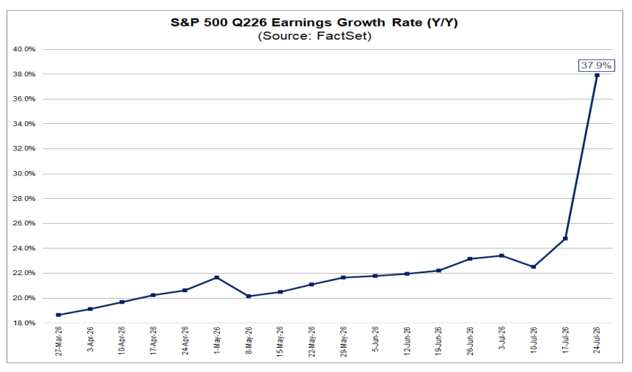
The current market environment is characterized by a paradox. On one hand, corporate earnings for the S&P 500 are robust. According to data from FactSet, the average earnings growth for the second quarter is projected to reach 37.9%, a significant upward revision from the 18.8% estimated in late March. If these figures hold, it would represent the strongest earnings performance since the post-pandemic recovery of late 2021.
However, the quality of these earnings is being scrutinized through the lens of capital expenditure (Capex). Alphabet Inc. (GOOG), the parent company of Google, serves as a cautionary tale for the current season. Despite reporting year-over-year earnings growth of 297.6% and crushing per-share estimates, Alphabet’s stock dropped by approximately 7% following its announcement. The catalyst for the decline was the company’s disclosure of its AI spending plans. Alphabet raised its capital expenditure forecast to a range of $195 billion to $205 billion through 2026, signaling to investors that the cost of maintaining a competitive edge in AI is rising faster than the immediate revenue generated by those investments.
This "capex anxiety" is the primary headwind facing the "Magnificent Seven" and their suppliers. Investors are increasingly concerned that the hundreds of billions of dollars being poured into AI chips and data centers may not yield the expected productivity gains or revenue streams in the short-to-medium term.
The Big Tech Earnings Gauntlet: A Critical Week Ahead
The global financial community is now focusing its attention on a 48-hour window that could define the market’s direction for the remainder of the year. Four of the largest technology companies in the United States—Meta Platforms, Inc. (META), Microsoft Corporation (MSFT), Amazon.com, Inc. (AMZN), and Apple Inc. (AAPL)—are scheduled to report their quarterly results.
Together, these four entities account for nearly 18% of the total value of the S&P 500. Their performance will serve as a referendum on the health of the digital economy and the viability of continued AI investment. Market analysts are specifically looking for clarity on several key metrics:
- AI Monetization: Concrete evidence that AI integrations are driving subscription growth or advertising efficiency.
- Capex Transparency: Detailed breakdowns of how much is being spent on hardware versus software and research.
- Consumer Resilience: For Apple and Amazon, insights into the strength of the global consumer amidst persistent inflationary pressures.
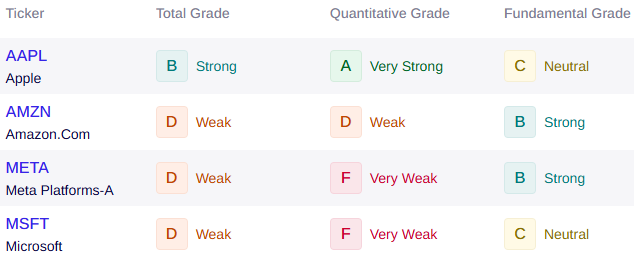
Current analyst sentiment is mixed. While some proprietary grading systems, such as Louis Navellier’s Stock Grader, suggest that Apple currently maintains a "Strong" rating based on underlying fundamentals and buying pressure, other giants like Amazon, Meta, and Microsoft have seen their quantitative grades slip to "Weak" levels in recent weeks. These ratings reflect a cooling of the "buying pressure" that propelled tech stocks to record highs earlier this summer.
Broader Impact and Long-term Implications
The events in South Korea and the subsequent volatility in the US highlight a maturing phase of the AI cycle. The initial "hype phase," characterized by indiscriminate buying of any company mentioning "artificial intelligence," has concluded. The market has entered a "verification phase," where fundamental financial health and realistic growth projections take precedence over speculative potential.
One of the emerging narratives from this correction is the shift in focus from "Famous Tech" to "Infrastructure Tech." As Alphabet, Amazon, and Microsoft spend hundreds of billions of dollars, the primary beneficiaries may not be the platforms themselves, but the companies providing the essential infrastructure. This includes:
- Power and Energy: The massive electricity requirements of AI data centers are driving demand for advanced grid technology and nuclear energy solutions.
- Thermal Management: Specialized cooling systems are becoming increasingly critical as high-performance chips generate unprecedented levels of heat.
- Networking and Connectivity: High-speed data transfer within and between data centers is creating opportunities for networking specialists beyond the traditional chipmakers.
Conclusion: A Market in Transition
The 10.8% plunge in the KOSPI serves as a stark reminder of the interconnectedness of global finance and the fragility of markets concentrated in high-growth technology sectors. While the immediate cause was a localized selloff in Samsung and SK Hynix, the underlying message is clear: the market is demanding a more disciplined approach to the AI buildout.
As the earnings season progresses, the focus will remain on whether the staggering capital expenditures of the world’s largest companies can be justified by tangible growth. For now, the volatility in South Korea has set a somber tone, suggesting that while the long-term potential of artificial intelligence remains intact, the path to achieving that potential will be marked by significant revaluations and a heightened focus on corporate efficiency. Investors are moving away from the "growth at any cost" mentality of the past two years, opting instead for a more nuanced evaluation of which companies are truly positioned to profit from the next stage of the technological revolution.