
Apple Shifts Strategy Toward Foldable Devices and Edge Artificial Intelligence Under New Leadership

The global technology landscape is preparing for a significant shift as Apple Inc. signals a transition from its traditional hardware cycles toward a future defined by foldable displays and decentralized artificial intelligence. While the company has historically avoided being the first to enter new product categories, its upcoming product launch suggests a continuation of its "fast-follower" strategy—a methodology that prioritizes technical refinement and user experience over speed to market. This strategic pivot coincides with a major leadership transition and a fundamental change in how the company approaches the burgeoning field of artificial intelligence, specifically through the implementation of "Edge AI."
The Strategic Philosophy of Refined Innovation
Apple’s history is defined by a consistent pattern of entering established markets and dominating them through superior integration. The company did not invent the digital music player, yet the iPod became the definitive device of the 2000s. Similarly, smartphones existed for years before the 2007 debut of the iPhone, which subsequently redefined the category. This "fashionably late" approach allows Apple to observe the technical failures and consumer pain points experienced by early adopters. By the time Apple enters a market, it typically addresses these issues with a more polished, proprietary solution.
Industry analysts note that this strategy is being applied once again to the foldable smartphone market. While competitors like Samsung and Google have iterated on foldable designs for several years, Apple has remained on the sidelines, reportedly focusing on the durability and aesthetics of the hardware. This period of observation is expected to culminate in the unveiling of a new flagship device that aims to solve the industry’s most persistent hardware challenges.
Entering the Foldable Segment: The iPhone Ultra
Market reports and supply chain indicators suggest that Apple is set to introduce its first foldable device, likely branded as the iPhone Ultra. This move represents a direct challenge to the established dominance of Samsung, which introduced its first foldable smartphone seven years ago. Google followed suit with the Pixel Fold in 2023. Apple’s entry into this space is not merely a response to competition but an attempt to standardize a form factor that has, until now, remained a niche segment of the premium market.
The iPhone Ultra is expected to address two primary criticisms of current foldable technology: the visible display crease and the awkwardness of aspect ratios when the device is unfolded. Reports indicate that Apple has spent years developing a proprietary hinge mechanism and display layering system designed to minimize the physical and visual "valley" that occurs where the screen folds. Furthermore, the iPhone Ultra is anticipated to feature a wider internal display, optimized for multitasking and professional-grade video consumption, differentiating it from the narrower designs often seen in the current market.

The pricing strategy for the iPhone Ultra reflects its positioning as a luxury, high-performance tool. Estimates place the retail price between $1,999 and $2,500. While this price point is significantly higher than standard flagship models, market research firm IDC projects that Apple could ship more than 10 million units in its first year. If realized, these figures would immediately position Apple as the second-largest player in the foldable market, leveraging its existing ecosystem of loyal users to drive rapid adoption.
Leadership Transition: The Ternus Era Begins
The launch of the iPhone Ultra serves as a milestone for the company’s internal governance. The transition of leadership from Tim Cook to John Ternus as CEO marks the beginning of a new chapter for the Cupertino-based giant. Ternus, who previously served as Apple’s hardware chief, brings a deep technical background to the role of CEO. His promotion is seen as a signal that Apple is doubling down on its "vertically integrated" philosophy, where the hardware, silicon, and software are developed in total synchronicity.
Under Ternus, the company is expected to accelerate its development of custom silicon, which has already given Apple a significant advantage in power efficiency and performance. The timing of this leadership change is critical; as the industry moves toward AI-heavy computing, the ability to design chips that can handle complex neural processing on-device will be the primary differentiator between market leaders and laggards.
The Pivot to Edge AI: Redefining the Intelligence Landscape
While the foldable hardware is the most visible aspect of Apple’s new strategy, the more profound shift lies in the company’s approach to artificial intelligence. The first phase of the AI boom was characterized by a massive investment in centralized data centers and cloud-based processing. Companies like NVIDIA and Microsoft have thrived by building the infrastructure required to process massive amounts of data in the cloud. However, Apple is pivoting toward "Edge AI."
Edge AI refers to the practice of running artificial intelligence algorithms directly on the local device—such as a smartphone or laptop—rather than sending data to a remote server. This approach offers several distinct advantages:
- Privacy: By processing data locally, sensitive user information never leaves the device, aligning with Apple’s long-standing marketing emphasis on user privacy.
- Latency: Local processing eliminates the "round-trip" time required for data to travel to a server and back, resulting in faster response times for AI-driven tasks.
- Efficiency: As AI models become more ubiquitous, the energy costs of massive data centers become a concern. Edge AI distributes the computing load across billions of individual devices.
Apple’s "Apple Intelligence" framework is designed to utilize this edge-based architecture. While complex queries may still be routed to Private Cloud Compute servers, the majority of day-to-day AI interactions will be handled by the Neural Engine found in Apple’s A-series and M-series chips. This hybrid model allows Apple to compete in the AI space without being entirely dependent on the massive data center build-outs that have defined the strategies of its rivals.
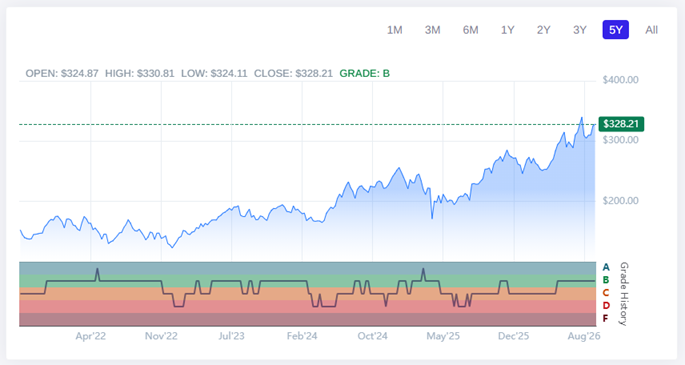
Financial Revitalization and Fundamental Growth
For several years, Apple faced questions regarding its growth momentum. The company’s financial performance occasionally saw plateaus as smartphone replacement cycles lengthened. However, recent data suggests a resurgence in the company’s fundamentals. Apple currently holds a "B" grade in various stock grading systems, an improvement after spending much of the last five years in the "C" to "D" range.
Financial analysts project a robust fiscal year for the company, with earnings expected to grow by 18% and sales anticipated to increase by 14.8%. These figures represent Apple’s strongest growth projections in several years. The catalyst for this growth is twofold: the high-margin potential of the iPhone Ultra and the "supercycle" of upgrades expected as consumers seek hardware capable of running the new Apple Intelligence features. Because older iPhone models lack the necessary RAM and processing power for advanced on-device AI, Apple is positioned to see a significant wave of hardware refreshes across its global user base.
The Broader Impact: The AI Reset and National Infrastructure
Apple’s shift toward Edge AI is part of a larger trend that some economists are calling the "AI Reset." This phase of the technological revolution moves beyond the initial "arms race" for chips and toward the integration of AI into the fabric of daily life and national infrastructure.
Recent discussions in the United States have compared the current AI push to a "new Manhattan Project," involving national laboratories and significant federal interest in maintaining a lead in semiconductor technology. While Apple is a consumer-facing entity, its demand for advanced chips and its role in setting the standard for mobile computing make it a central player in this broader economic narrative. The companies that supply the chips, sensors, and power-management systems for Apple’s Edge AI ecosystem are likely to be the secondary beneficiaries of this shift.
Conclusion and Market Implications
Apple’s move into foldables and Edge AI represents a calculated gamble that the next decade of computing will be defined by versatile hardware and localized intelligence. By waiting for the foldable market to mature before entering, Apple aims to capture the premium segment of the market with a device that solves the technical flaws of its predecessors. Simultaneously, by prioritizing Edge AI, the company is carving out a unique position that emphasizes privacy and efficiency over the raw scale of cloud-based models.
For investors and consumers alike, the upcoming announcements signify more than just a new phone. They represent a fundamental change in Apple’s business model—one that seeks to reignite sales growth through high-value hardware and a proprietary AI ecosystem. As the "AI Reset" continues to unfold, Apple’s ability to control its own silicon and software stack may prove to be its greatest competitive advantage, potentially establishing a new standard for the industry to follow.