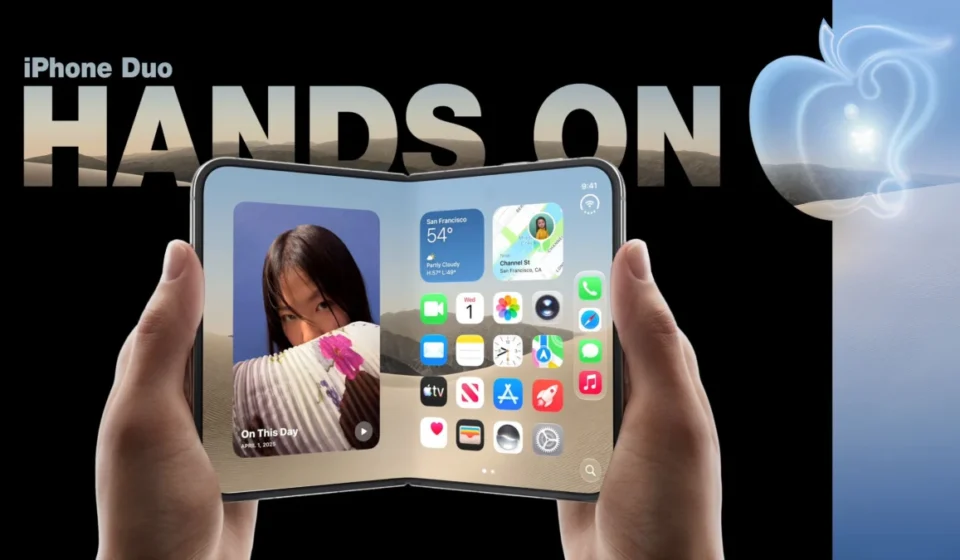

Following a highly anticipated "Surprise and Shine" event on Wednesday, September 9, 2026, Apple officially unveiled its most ambitious iPhone to date: the foldable iPhone Duo. The device, which has been the subject of widespread speculation and rumors for years, represents a significant departure from Apple’s traditional smartphone design, entering the burgeoning foldable market with a premium price tag and a suite of innovative features. Following the keynote presentation, select members of the media were granted exclusive hands-on access to the iPhone Duo, offering initial impressions of its design, functionality, and the software experience tailored for its unique form factor.
The iPhone Duo enters the market with a starting price of $1,999 for the 256GB model, a figure that immediately positions it as a luxury device. The initial impression is one of meticulous craftsmanship. Despite its foldable nature, the device feels remarkably sturdy and premium in hand, a testament to Apple’s engineering prowess. When closed, the outer display measures a compact 5.4 inches, smaller than the contemporary iPhone 18 Pro, suggesting a design prioritizing portability in its folded state. However, the true spectacle unfolds when the device is opened, revealing a generous 7.6-inch inner display.
Innovative Display Technology and Crease Mitigation
A key challenge for all foldable smartphones has been the visibility and feel of the crease where the display folds. Apple appears to have addressed this head-on with the iPhone Duo, employing a novel nano-texture polymer for the inner display. This material is engineered to significantly reduce glare while simultaneously minimizing the prominence of the crease. The display layer itself features a micro-lens texture, meticulously written pixel by pixel using maskless laser lithography. This advanced technique aims to create a perceptually flat, matte surface that further masks the visual and tactile sensation of the fold.
While the crease is not entirely eliminated – it remains discernible under certain lighting conditions – early impressions suggest Apple has achieved a superior result compared to competitors like Samsung. The longevity of foldable displays is always a concern, as repeated folding and unfolding can exacerbate crease visibility. Apple claims to have incorporated viscoelastic adhesives that allow the display layers to glide over each other, a mechanism intended to contribute to the device’s durability and maintain the integrity of the display over time. The long-term performance of this technology will be a critical factor in user satisfaction.
Under-Display Camera and Seamless Integration
Another notable innovation on the iPhone Duo is the complete absence of a visible camera cutout on the inner display. Apple has successfully integrated the front-facing camera beneath the screen. While it remains largely invisible on lighter screen backgrounds, a subtle demarcation can be observed when the display is darker, indicating the camera’s location. This under-display camera technology contributes to a more immersive and uninterrupted viewing experience on the expansive inner screen.
Software Tailored for a Foldable Future
Recognizing that the success of a foldable device hinges as much on software as it does on hardware, Apple has made significant strides in adapting its iOS ecosystem to the iPhone Duo’s unique form factor. Apps are designed to transition seamlessly between the outer and inner displays and adapt intelligently to the device’s various states. The interface features a new vertical dock, and main controls are strategically placed along the sides of the displays. The status bar is subtly integrated into a corner, a sensible adaptation for a foldable device, ensuring that essential information is readily accessible without obstructing content. The software prioritizes one-handed use, a crucial consideration for a device that can be used in multiple configurations.
Multitasking capabilities are a core focus. Users can effortlessly run two applications side-by-side, with each app occupying precisely half of the inner display. While there is currently no option to resize these app windows, users can lock app pairs together, enabling them to launch simultaneously in the future. Swiping between these paired applications is designed to be fluid and intuitive. Crucially, applications function reliably whether the iPhone Duo is fully open, closed, or partially folded.
Versatile Usage Modes and StandBy Integration
The iPhone Duo excels in its adaptability to different usage scenarios. When partially folded, the device can be propped up, and the interface intelligently repositions, moving controls to the bottom of the display. iOS dynamically adjusts to the device’s orientation and angle, strategically moving content away from the crease to ensure tappable areas remain accessible and easy to reach, regardless of the device’s position. This intelligent adaptation extends to audio, which automatically tunes based on the device’s configuration.
The popular StandBy feature, introduced in recent iOS versions, has also been enhanced for the iPhone Duo. Even when not connected to a charger, users can fold the device into a tent-like orientation to activate StandBy, which then displays widgets, music controls, calendar events, weather information, and more. It also functions as a sophisticated bedside clock, complete with a new "glow alarm clock" feature.
Camera System and Creative Features
The iPhone Duo features a streamlined camera system comprising two high-resolution sensors: a 48MP Fusion Main camera and a 48MP Ultra Wide camera. Notably, it omits a dedicated Telephoto lens. While optical zoom capabilities are limited to 2x, this is achieved through a cropped view from the Main camera. The outer display houses a 12MP front-facing camera.
Apple has introduced several unique camera features that leverage the Duo’s foldable design. The device supports 4K Dolby Vision time-lapses, a feature that benefits greatly from the Duo’s ability to prop itself up for extended shooting durations. The "Smart Take" option utilizes AI to automatically capture a photo when all subjects are within the frame, allowing users to participate in group shots without needing a separate timer.
To aid in portrait photography, especially with children, the "Kid Cue" feature can display Peanuts animations on the outer screen to capture a child’s attention and elicit smiles. For enhanced user control during photography, "Duo Preview" allows the subject to see themselves on the outer display, offering immediate feedback on the framing and composition. FaceTime calls also embrace the Duo’s dual-display nature. "FaceTime Duo" enables a caller to use the outer display’s camera, facilitating a more inclusive group call experience without the need for everyone to huddle around a single screen.
Performance and Connectivity
Under the hood, the iPhone Duo is powered by the same cutting-edge A20 Pro chip found in the iPhone 18 Pro, ensuring top-tier performance and efficiency. Complementing the processor is Apple’s new C2 modem, which promises faster and more efficient connectivity compared to its predecessor, the C1X. The C2 modem also brings support for mmWave 5G speeds across the United States, enabling ultra-fast mobile data transmission.
Pricing, Availability, and Market Context
The $1,999 starting price for the 256GB model underscores the iPhone Duo’s position at the apex of Apple’s product lineup. For users requiring more storage, options extend up to 2TB, with the highest capacity model priced at $3,199. Pre-orders for the iPhone Duo are slated to begin on Friday, October 16, with the official launch to follow on October 23.
The introduction of the iPhone Duo arrives at a time when the foldable smartphone market is gaining momentum. While competitors have been refining their foldable offerings for several years, Apple’s entry, characterized by its signature attention to detail and integrated software experience, is expected to significantly influence consumer perception and adoption of this new form factor. The device’s success will likely depend on its ability to justify its premium price point through a compelling combination of innovative hardware, robust software, and long-term durability, setting a new benchmark for foldable smartphones. The broader implications for the smartphone industry are substantial, potentially accelerating innovation in display technology and mobile computing as manufacturers strive to meet the evolving demands of consumers seeking more versatile and immersive mobile experiences.