
In the annals of industrial history, few moments are as pivotal as the demonstration conducted at the New York Crystal Palace in 1854. Before a skeptical and expectant crowd, an inventor named Elisha Otis stood on an open elevator platform, suspended high above the exhibition floor by a single hoisting rope. At his signal, an assistant severed the rope with an axe. The platform plummeted, but only for a fraction of a second. A spring-loaded safety brake, designed by Otis to engage the moment tension left the cable, locked the platform firmly against the guide rails.
This singular event did more than just prove a mechanical concept; it removed the psychological and structural barriers that had limited urban development for centuries. While hoists and basic elevators had existed for decades, they were notoriously dangerous and used primarily for freight. Otis’s invention solved the "safety bottleneck," transforming the elevator from a risky industrial tool into a reliable piece of public infrastructure. This shift fundamentally altered the trajectory of modern architecture, turning the upper floors of buildings—previously the least desirable due to the physical exertion required to reach them—into the most prestigious real estate in the world.
The Historical Context of the Safety Brake
The 1854 demonstration occurred during the Exhibition of the Industry of All Nations, a world’s fair intended to showcase American ingenuity. At the time, the world’s major cities were facing a crisis of density. Without a way to safely transport people vertically, buildings were effectively capped at five or six stories. The "walk-up" was the standard, and as urban populations swelled, cities could only expand outward, leading to inefficient sprawl.
Otis’s safety brake utilized a simple but effective mechanism: a wagon spring attached to the top of the elevator car. Under normal operation, the weight of the car on the rope kept the spring compressed. If the rope snapped, the spring would snap back into its natural position, forcing metal "dogs" or pawls into notches in the side rails.
The economic implications were immediate. Following the demonstration, the Otis Elevator Company saw a surge in orders. In 1857, the first commercial passenger elevator was installed in the E.V. Haughwout Building in New York City. By the late 1880s, the advent of steel-frame construction combined with safe elevators allowed for the birth of the skyscraper. The bottleneck had been cleared, and the vertical city was born.
Identifying the Bottlenecks in Modern Technology
The pattern established by Elisha Otis—where a secondary invention enables a primary vision to flourish—remains a cornerstone of technological advancement. In the 21st century, the primary vision is often dominated by Artificial Intelligence (AI), renewable energy, and space exploration. However, these ambitious goals are currently facing their own "Otis moments"—critical bottlenecks in supply chains, materials science, and manufacturing processes.
Market analysts note that while companies like NVIDIA, Tesla, and SpaceX capture the majority of public attention, the logistical and technical bottlenecks are often solved by specialized firms that operate behind the scenes. These "bottleneck solvers" frequently possess significant pricing power because their services or components are non-discretionary. If the component is essential and the supply is limited, the provider of that component becomes the gatekeeper of the entire industry’s progress.

The Semiconductor Packaging Crisis
Currently, the most significant bottleneck in the global technology sector is the production of advanced semiconductors required for AI. While much of the focus has been on chip design and the lithography processes used by firms like ASML and TSMC, a critical secondary step has emerged as a major constraint: advanced packaging.
Before a high-performance chip can be utilized in a data center, it must be "packaged"—a process that involves protecting the silicon, connecting it to the circuit board, and, increasingly, stacking multiple chips together to enhance performance. As AI models grow more complex, traditional packaging is no longer sufficient. The industry has moved toward "2.5D" and "3D" packaging, where logic chips are integrated with High-Bandwidth Memory (HBM) in extremely tight configurations.
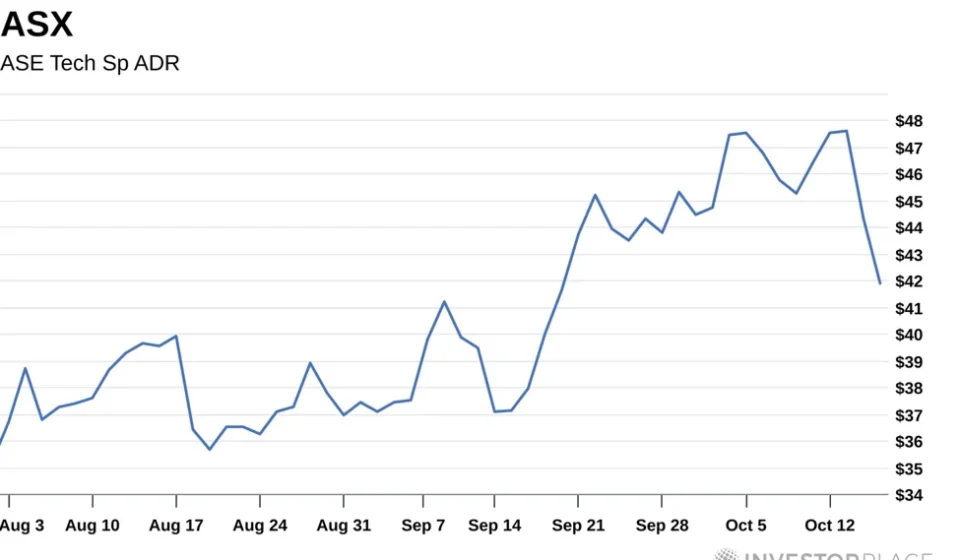
ASE Technology Holding Co., Ltd. (ASX) has emerged as a primary solver of this bottleneck. As the world’s largest independent provider of semiconductor assembly and test services, ASE has become an essential partner for TSMC. Currently, TSMC’s internal "Chip on Wafer on Substrate" (CoWoS) capacity is insufficient to meet the explosive demand from AI accelerator customers like NVIDIA and AMD. Consequently, a significant portion of this high-precision work is outsourced to ASE.
Financial Performance and Industry Projections
The scarcity of advanced packaging capacity has granted firms like ASE substantial pricing power. Industry reports indicate that packaging prices for AI-related components have seen increases of over 20% in the past year alone. This reflects a genuine capacity bottleneck in a supply chain step that cannot be bypassed.
Data from recent financial disclosures and market analysis services, such as Luke Lango’s Innovation Investor, highlight the growth trajectory of this sector:
- Revenue Outlook: ASE has raised its 2026 outlook for its advanced packaging division (internally referred to as "LEAP") to over $3.5 billion.
- Capital Expenditure: To meet demand through 2030, the company has signaled capital spending guidance of approximately $8.5 billion, with further increases expected to expand capacity.
- Growth Rates: Analysts project a 25% compounded annual revenue growth for advanced packaging through 2030. Due to pricing power and economies of scale, compounded EBITDA growth is estimated to exceed 35%.
This data suggests that while the "visionary" chip designers face intense competition and market volatility, the "bottleneck" providers maintain a more stable and lucrative position within the ecosystem.
Elon Musk’s "XPANSE" and the Next Generation of Bottlenecks
A similar dynamic is unfolding within the various enterprises led by Elon Musk. Analysts have begun to view Tesla, SpaceX, xAI, and the "X" social media platform not as disparate companies, but as components of a unified technological empire sometimes referred to as "XPANSE." This vision involves the integration of orbital data centers, a massive semiconductor manufacturing complex, and the mass deployment of humanoid robots (Optimus).
However, the realization of this multi-planetary, AI-driven empire faces three primary bottlenecks:

1. Orbital Energy Requirements
SpaceX’s plans for Starlink and orbital computing require unprecedented levels of power. Traditional solar panels used on satellites are often too heavy or inefficient for the scale required. The bottleneck here is the development of high-efficiency, radiation-hardened solar arrays that can be deployed in orbit at a fraction of current costs. Companies specializing in gallium arsenide (GaAs) solar cells or flexible thin-film technologies are positioned to become the "Otis" of the space-based internet.
2. Specialized Semiconductor Equipment
As Musk moves toward vertically integrating chip production for Tesla’s Full Self-Driving (FSD) and xAI’s training clusters, he encounters a bottleneck in precision manufacturing equipment. The production of specialized AI chips requires "back-end" tools that can handle the unique thermal and electrical requirements of high-density silicon. Firms that produce these highly specialized machines are essential for Musk’s move toward hardware independence.
3. Rare Earth Materials and Magnetics
The Optimus humanoid robot and Tesla’s electric motors rely heavily on high-performance permanent magnets, typically made from Neodymium-Iron-Boron (NdFeB). Currently, the supply chain for these materials is heavily concentrated in specific geographic regions, creating a geopolitical and logistical bottleneck. Companies that control non-traditional sources of rare earth elements or possess proprietary technology for processing these materials into high-grade magnets are critical to the scaling of robotics.
Broader Economic Impact and Implications
The identification of these bottlenecks is more than an academic exercise; it is a fundamental strategy for modern industrial investment. When a bottleneck is removed, it doesn’t just benefit the company that solved it—it unlocks a "multiplier effect" across the entire economy.
Just as the safety elevator enabled the construction of thousands of skyscrapers, the resolution of the AI packaging bottleneck is currently enabling the rollout of global AI infrastructure. The resolution of the orbital power bottleneck will likely enable a new era of global connectivity and space-based manufacturing.
From a journalistic and economic perspective, the focus on these "bottleneck solvers" provides a more nuanced view of technological progress. It shifts the narrative from the charismatic visionary to the practical engineer and the specialized manufacturer. In a market often driven by hype and speculation, the companies that control a "critical step that cannot be skipped" offer a baseline of factual, data-driven value.
As the global economy transitions toward a more automated and space-capable future, the lessons of 1854 remain relevant. Great visions will always exist, but they will remain grounded until someone, like Elisha Otis, finds a way to make the journey safe and the infrastructure viable. The companies currently solving the bottlenecks in AI packaging, orbital energy, and robotic materials are the quiet architects of the next industrial era, ensuring that the grand visions of the 21st century can finally rise.