Michael Burry Increases Short Position Against Micron Technology as AI Sector Faces Scrutiny Over Cyclical Memory Glut Concerns

Global financial markets are currently navigating a confluence of macroeconomic and geopolitical pressures that have placed significant strain on Wall Street’s high-growth sectors. As of late October, the 10-year Treasury yield has surged to 5.14%, marking its highest level in nearly 19 years, while the 30-year Treasury yield reached a 2004-era peak of 5.43%. Simultaneously, energy markets are experiencing renewed volatility, with Brent crude pushing toward $107 per barrel and West Texas Intermediate (WTI) trading above $95. This "risk-off" environment is increasingly targeting crowded trades, most notably the artificial intelligence (AI) sector, which has dominated market gains over the past eighteen months.
Central to this market tension is the renewed bearish activity of Michael Burry, the founder of Scion Asset Management and the investor famously portrayed in The Big Short. Burry has reportedly intensified his short position against Micron Technology (MU), a prominent manufacturer of memory chips essential for AI data centers. This move comes at a time when institutional investors and quantitative analysts are sharply divided on whether the semiconductor industry is on the verge of a structural transformation or a classic cyclical collapse.
Macroeconomic Headwinds and the Federal Reserve’s Stance
The broader market pressure is compounded by hawkish signals from the Federal Reserve. Philadelphia Fed President Anna Paulson recently joined a growing cohort of policymakers suggesting that the current inflationary environment may necessitate further monetary tightening. In a public statement, Paulson noted that if economic conditions continue on their current trajectory, "some modest further tightening may be warranted." This sentiment has dampened hopes for a near-term pivot to rate cuts, further elevating the cost of capital for capital-intensive industries like semiconductor manufacturing.
Geopolitical instability is also contributing to the prevailing uncertainty. Stalled negotiations between the United States and Iran, coupled with active conflict in the Middle East—evidenced by Houthi militants firing missiles toward Saudi Arabia—have created a volatile backdrop for global trade. For tech companies with complex global supply chains, these tensions represent a dual threat of increased operational costs and potential logistical disruptions.
The Bear Case: Michael Burry and the Memory Glut Theory
Michael Burry’s decision to short Micron Technology is rooted in the belief that the semiconductor industry is repeating the boom-and-bust cycles of its past. On his Substack platform, Burry argued that memory makers have reached "ridiculous prices" and are poised for an intense sell-off as the cycle turns. His thesis rests on the emergence of a "memory glut," a condition where supply significantly outpaces demand, leading to a collapse in profit margins.
Burry’s concerns are supported by observations from other industry leaders. Jason Chen, the CEO of Acer, recently warned of rising supply from Chinese memory producers entering the market. According to this perspective, the record profits recently reported by Micron were not the result of durable, long-term demand, but rather a temporary supply hiccup caused by post-pandemic logistics and a frantic rush to build AI infrastructure. Burry posits that once this initial build-out phase concludes, the market will find itself oversupplied with commodity memory chips, specifically Dynamic Random Access Memory (DRAM).
A Chronology of Michael Burry’s Recent Market Positions
While Burry gained legendary status for his successful bet against the U.S. housing market in 2008, his more recent short positions have met with mixed results, leading some analysts to question his timing.
- 2021: Tesla Short. Burry took a high-profile short position against Tesla, citing overvaluation. However, the stock continued to climb throughout much of the year, forcing a reassessment of the position.
- January 2023: The "SELL" Warning. Burry posted a cryptic one-word tweet, "SELL," just before the market embarked on a robust rally that saw the S&P 500 gain more than 20% by the end of the year.
- 2023: S&P 500 Puts. Reports indicated that Scion Asset Management loaded up on put options against the S&P 500 and Nasdaq-100. These positions were eventually unwound as the indices continued to reach new highs.
- Late 2025: Fund Closure. In a surprising move, Burry briefly closed his fund to outside investors, conceding that his value-oriented read on the market had been out of step with the Nasdaq’s nearly 70% climb.
This track record highlights the inherent risk of contrarian investing: being right about a fundamental flaw does not necessarily equate to being right about the timing of the market’s reaction.
The Quantitative Counter-Argument: Fundamentals and Institutional Buying
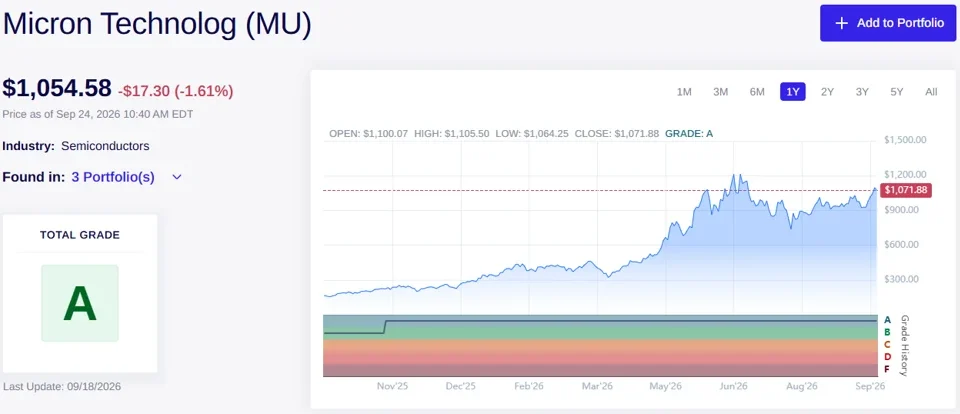
In direct opposition to Burry’s bearish outlook, quantitative analysts such as Louis Navellier maintain a highly optimistic view of Micron Technology. Navellier’s "Stock Grader" system, which utilizes eight fundamental and technical measures to rank equities, currently assigns Micron an "A" grade.
The bullish case is supported by significant data points:

- Revenue Growth: Micron’s fourth-quarter revenue is projected to jump nearly 349% year-over-year, reaching approximately $50.8 billion.
- Earnings Per Share (EPS): Earnings are expected to surge to more than $31 per share, a dramatic turnaround from previous cyclical lows.
- Analyst Revisions: Over the past three months, Wall Street analysts have revised their earnings estimates for Micron upward by nearly 34%.
Furthermore, Navellier’s "Quantitative Grade" tracks institutional buying pressure, or "following the money." Despite Burry’s short position, Micron’s stock has shown resilience. For instance, on the same day Burry announced he was adding to his short "in some size," the stock closed up 5% for the session and ended the month with a 14% gain. This suggests that while Burry is betting on a future decline, the current "big money" flows are still moving into the stock.
High-Bandwidth Memory (HBM): A Structural Shift?
The debate over Micron’s future often hinges on the distinction between commodity memory and High-Bandwidth Memory (HBM). While Burry and Acer’s CEO point to a glut in the commodity DRAM market—the chips used in standard laptops and desktops—bulls argue that AI has created a new, non-cyclical demand for HBM.
HBM consists of specialized chips stacked vertically to allow for faster data processing, which is essential for the AI accelerators produced by companies like Nvidia. Producing HBM is significantly more complex and resource-intensive than producing standard DRAM; industry estimates suggest that manufacturing HBM requires approximately three times the factory capacity of ordinary memory.
Micron and its primary competitor, SK Hynix, have both reported that their HBM output for 2024 and 2025 is effectively sold out. The CEO of SK Hynix has suggested that the supply crunch for AI-specific memory could last for several years, potentially breaking the traditional boom-to-bust cycle that has historically characterized the semiconductor industry.
Analysis of Implications and Market Sentiment
The conflict between Burry’s conviction and Navellier’s quantitative data represents a fundamental choice for investors: betting on a predicted reckoning versus following current evidence.
If Burry is correct, the AI boom is a speculative bubble built on "sand," and the eventual correction will be as severe as the 2000 dot-com crash or the 2008 financial crisis. In this scenario, the current "sold out" status of HBM chips is merely a symptom of the peak of the cycle, soon to be followed by order cancellations and inventory write-downs.
Conversely, if the quantitative data holds, the semiconductor industry is undergoing a structural re-rating. In this view, the integration of AI into every facet of the global economy represents a permanent increase in the "memory intensity" of computing, providing a long-term tailwind that outweighs traditional cyclical concerns.
Looking Ahead: The Upcoming "Stock Grader" Overhaul
As the market approaches the November midterms, volatility is expected to persist. Financial analysts Marc Chaikin and Louis Navellier have announced a collaborative effort to overhaul their quantitative tools to better navigate this environment. They suggest that a rare market setup is taking shape, which could lead to significant divergence between "A-rated" stocks and those with failing fundamentals.
The financial community remains divided. While the media often highlights Burry’s "Cassandra-like" prophecies—named after the Trojan priestess cursed to provide true prophecies that no one believed—his critics point out that in the world of high-stakes investing, being "early" can be functionally indistinguishable from being "wrong." For now, Micron Technology remains the primary battlefield for these two diametrically opposed investment philosophies, with its stock price serving as the ultimate arbiter of who has correctly read the pulse of the digital age.