
The Paradox of Efficiency and Market Volatility Mask Structural Growth in Global Artificial Intelligence Infrastructure

The current landscape of the global financial markets presents a striking contradiction between short-term sentiment-driven volatility and long-term structural demand for transformative technologies. While recent sessions have seen a significant sell-off in technology equities, historical economic principles and granular data from the artificial intelligence sector suggest that this weakness is not a reflection of diminishing demand. Instead, the market appears to be experiencing the "Jevons Paradox," a phenomenon first identified in the 19th century, where increased efficiency in the use of a resource leads to a dramatic surge in its total consumption. As artificial intelligence becomes cheaper and more efficient to deploy, its integration into the global economy is accelerating, creating a divergence between retail pricing trends and fundamental industrial throughput.
The Historical Context of the Jevons Paradox
To understand the current trajectory of the artificial intelligence market, one must look back to 1865 and the work of English economist William Stanley Jevons. In his seminal book, "The Coal Question," Jevons addressed a common misconception among British engineers and policymakers. At the time, improvements in steam engine design were making coal use significantly more efficient. Many observers assumed this would lead to a reduction in national coal consumption. Jevons argued the opposite, stating that the economical use of fuel is not equivalent to diminished consumption. He posited that as the use of coal became more efficient, it became more cost-effective for a wider range of industrial applications, thereby "detonating" demand rather than stifling it.
This economic principle has remained consistent through the industrial and digital revolutions. Today, it is manifesting in the AI sector through the collapse of "token" prices—the basic units of data processed by large language models (LLMs). While skeptics point to falling token prices as a sign of a cooling market, the Jevons Paradox suggests that these lower costs are the very catalyst driving the vertical surge in total compute volume. Efficiency gains at the engineering level are being passed to consumers and enterprises, who respond by scaling their usage at an exponential rate.
Macroeconomic Pressures and the "Ugly Tape" of Recent Sessions
The recent downturn in AI-related equities can be traced to a confluence of geopolitical and macroeconomic factors rather than a failure of the technology itself. Market sentiment shifted abruptly following a series of external shocks that pressured the broader indices. The declaration of an "Economic D-Day" involving potential secondary sanctions on entities doing business with Tehran led to an immediate spike in crude oil prices, which pushed toward the $90-per-barrel threshold. This geopolitical tension triggered a corresponding rise in Treasury yields, effectively unwinding the relief rally previously sparked by expectations of a more moderate fiscal path under prospective Treasury leadership.
Simultaneously, the domestic consumer environment showed signs of strain. Walmart (WMT), a bellwether for American retail health, recently reported a soft quarter. U.S. comparable sales grew by only 2.6%, missing the expected 3.8% target. More telling was the average ticket increase of just 1.1%, suggesting that rising gasoline prices and persistent inflation are forcing households to "trade down" and tighten discretionary spending. This pressured consumer environment has led to a "sympathy sell-off" in the technology sector, as investors move toward defensive postures despite the lack of a direct link between retail consumer habits and high-level enterprise AI spending.

Analyzing the Data: Token Consumption vs. Compute Costs
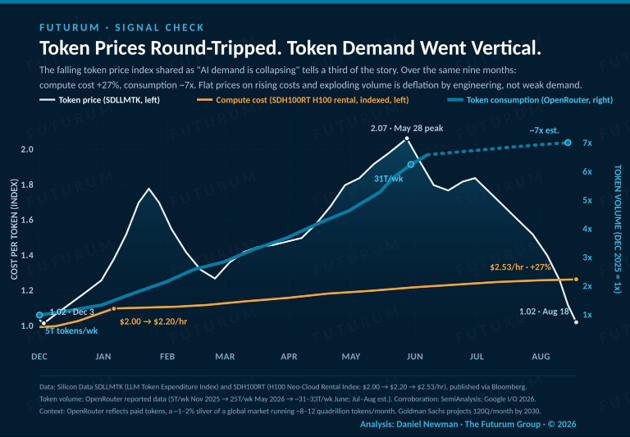
A closer examination of the data reveals a profound disconnect between the "bear case" for AI and the operational reality of the industry. Skeptics often cite the fact that AI token prices have "round-tripped" from a May peak of approximately 2.07 down to 1.02, returning to levels seen in late 2023. On the surface, a 50% drop in price might imply a lack of pricing power or waning interest. However, when viewed through the lens of efficiency and volume, the narrative changes.
During the same nine-month period where token prices fell, the underlying cost to rent H100 compute capacity actually rose by 27%, moving from $2.00 to $2.53 per hour. This indicates that the hardware required to generate these tokens has become scarcer and more valuable, not less. The drop in token prices is therefore a result of "deflation by engineering"—labs and providers are becoming so much better at utilizing the hardware that they can lower the end-user price while the demand for the hardware remains at an all-time high.
The volume metrics support this conclusion. OpenRouter, a major aggregator for LLM access, saw its volume surge from approximately 5 trillion tokens per week in late 2023 to an estimated 33 trillion tokens per week by mid-2024. Furthermore, Google disclosed during its recent I/O developer conference that it now processes more than 3.2 quadrillion tokens per month, a sevenfold increase year-over-year. Goldman Sachs projections suggest this is only the beginning, with the global token market expected to reach 120 quadrillion tokens per month by 2030.
Corporate Capex and Infrastructure Expansion
The fundamental strength of the AI cycle is perhaps most evident in the capital expenditure (Capex) plans of the "hyperscalers"—Microsoft (MSFT), Amazon (AMZN), Alphabet (GOOGL), and Meta (META). These entities operate on multi-year cycles and are not deterred by the short-term fluctuations in Walmart’s same-store sales or gasoline price volatility. Their focus remains on the massive build-out of data center infrastructure and the procurement of advanced networking equipment.
Recent corporate announcements underscore this continued commitment to the AI transition:
- Micron Technology Inc. (MU): The semiconductor giant has committed $10 billion to a new research and manufacturing facility focused on next-generation chip memory architectures. As AI models grow in complexity, the demand for high-bandwidth memory (HBM) is scaling in tandem with processing power.
- CoreWeave Inc.: The specialized cloud provider recently secured a multi-year deal with Hudson River Trading. This agreement is built on the deployment of Vera Rubin and HGX B200 systems, representing the cutting edge of Nvidia’s Blackwell architecture.
- Corning Inc. (GLW): A critical player in the physical infrastructure of the internet, Corning has expanded its fiber supply agreement with Zayo through 2030. This move is specifically designed to support the accelerated build-out of AI-centric network architectures that require significantly higher data throughput than traditional cloud services.
- Enovix Corp. (ENVX): Demonstrating the expansion of AI into the edge and robotics sectors, Enovix is doubling its drone-battery production capacity in South Korea. The company reported that its pipeline for high-energy-density batteries grew by 41% in a single quarter, driven by the needs of autonomous systems.
- Palo Alto Networks Inc. (PANW): Security remains a paramount concern in the AI era. The company recently entered into a $1 billion alliance with NTT DATA to focus on AI governance and secure infrastructure, ensuring that the proliferation of AI models does not compromise enterprise integrity.
Chronology of Market Sentiment and Upcoming Catalysts
The timeline of the current market phase shows a clear pattern of "noise" overriding "signal." Following the early August recovery rally, which saw many AI stocks regain ground lost during the July correction, the market hit a plateau. This stagnation was exacerbated by the aforementioned geopolitical tensions in the Middle East and the release of conservative retail earnings.
However, historical market behavior suggests that these periods of "sentiment-driven" weakness often precede significant fundamental re-ratings. The next major catalyst is the upcoming earnings report from Nvidia (NVDA). As the primary provider of the silicon that powers the AI revolution, Nvidia’s results and forward guidance serve as a reality check for the entire sector. If the company continues to show robust demand for its Blackwell-series chips and sustained growth in data center revenue, it may provide the necessary "off-ramp" from the current macro-driven volatility.
Furthermore, market analysts expect that the geopolitical tensions in the Middle East may see a temporary de-escalation in the coming weeks as diplomatic efforts intensify, which could lead to a cooling of oil prices and a stabilization of Treasury yields. Such a shift would allow the market to return its focus to the underlying earnings growth of the technology sector.
Broader Implications for Investors and the Global Economy
The broader implication of the Jevons Paradox in the AI era is that we are witnessing a structural shift in how productivity is generated. Unlike previous technological cycles that were often confined to a single sector, AI is an "omni-technology" that impacts everything from drug discovery and material science to financial modeling and autonomous logistics.
The current sell-off highlights the importance of distinguishing between "sympathy trades" and fundamental shifts. A sympathy sell-off occurs when high-quality stocks are dragged down by broader market indices or unrelated economic news. For the AI sector, the fundamental data—comprising token volume, hardware scarcity, and corporate Capex—remains overwhelmingly positive.
In conclusion, the 1865 observation that efficiency feeds demand rather than killing it is the most relevant framework for understanding the 2024 AI market. Cheap tokens are not a sign of a dying boom; they are the fuel for a much larger expansion. As the industry moves toward the 120 quadrillion token milestone, the volatility seen in recent weeks will likely be viewed as a temporary fluctuation in a long-term upward trajectory. The upcoming earnings season and the stabilization of the geopolitical landscape will be the ultimate arbiters of whether the market can successfully separate the noise from the signal. For now, the structural build-out of the AI revolution remains intact, driven by the relentless economic logic of efficiency and scale.