
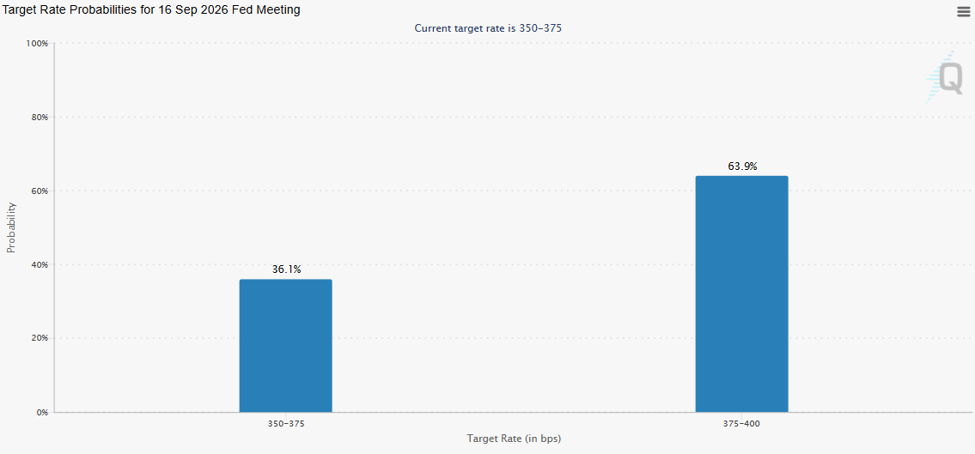
The Federal Reserve’s annual Jackson Hole Economic Symposium has long served as a pivotal stage for central bankers to signal major shifts in monetary policy. This year, the focus intensified on Fed Chair Kevin Warsh, whose remarks on inflation and the trajectory of interest rates have sent ripples through global financial markets. While market participants had anticipated a neutral stance regarding near-term rate cuts, Warsh delivered a distinctly hawkish message, emphasizing that the battle against inflation remains unfinished. His comments have recalibrated market expectations, with the CME Group’s FedWatch Tool now indicating a 63.9% probability of a quarter-point interest rate hike in September.
The central theme of Warsh’s address centered on the distinction between transitory price cooling and structural inflationary trends. Despite recent data suggesting a moderation in price increases during the summer months, Warsh remained skeptical of the long-term outlook. He noted that while recent readings were better than anticipated, they do not necessarily indicate a meaningful improvement in underlying trends. This stance effectively sidelined the "dovish" narrative that had been gaining traction among investors hoping for a policy pivot toward easing. Warsh’s insistence that the Federal Reserve must see inflation moving toward its 2% objective with "sufficient speed" suggests that the "higher-for-longer" interest rate environment is likely to persist through the final quarter of the year.
The Inflation Gauge Debate: Trimmed Mean PCE vs. Headline Data
To understand the hawkish pivot, one must examine the specific metrics favored by the Federal Reserve’s current leadership. A critical component of this analysis is the "trimmed mean" Personal Consumption Expenditures (PCE) price index, a measure produced by the Federal Reserve Bank of Dallas. Unlike headline inflation, which includes volatile food and energy costs, the trimmed mean PCE removes the most extreme price swings—both up and down—to isolate the core inflationary trend.
Recent data shows the trimmed mean PCE sitting at 2.3%. For several months, this figure has remained remarkably stable in the low-to-mid 2% range. From a dovish perspective, 2.3% is tantalizingly close to the Fed’s 2% target, suggesting that further tightening might be unnecessary. However, Warsh interpreted this stability not as a victory, but as a stall. In his view, a failure to reach the 2% target despite months of restrictive policy is evidence that the "last mile" of inflation control may require more aggressive action. The market’s reaction to this interpretation was immediate, as traders began pricing in the risk that the Federal Reserve would prioritize price stability over economic growth in the short term.
Bond Market Dynamics and the Resilience of the AI Trade
Historically, a hawkish Federal Reserve is viewed as a headwind for high-growth sectors, particularly technology and Artificial Intelligence (AI). Higher interest rates typically lead to higher discount rates, which lower the present value of future earnings—a metric vital for valuing hypergrowth companies. However, the bond market’s reaction to Warsh’s comments suggests a more nuanced outcome for the AI sector.
Following the Jackson Hole address, the yield on the two-year Treasury note—which is highly sensitive to short-term policy changes—jumped approximately eight basis points. Conversely, the 10-year Treasury yield saw a more modest increase of four basis points, while the 30-year yield remained largely unchanged. This phenomenon, often described as "bringing up the short end to save the long end," suggests that the market believes the Fed’s hawkishness will successfully prevent long-term inflation from becoming entrenched.
For the AI trade, the 10-year yield is the critical benchmark. Analysts have identified a "line in the sand" at 5% for the 10-year Treasury. As long as this yield remains below that threshold, the capital-intensive infrastructure build-out required for AI is expected to remain viable. Currently sitting at approximately 4.76%, the 10-year yield suggests that while the Fed may raise short-term rates, the long-term cost of capital remains within a range that supports continued innovation and expansion in the tech sector.
Geopolitical Escalation: The Strait of Hormuz and Global Oil Prices
Adding complexity to the Federal Reserve’s inflation fight is a renewed flare-up of tensions in the Middle East. Over the past weekend, U.S. forces conducted a precision strike on two Iranian rocket launchers on Larak Island, situated near the strategically vital Strait of Hormuz. According to U.S. Central Command (CENTCOM), Revolutionary Guard forces were preparing to launch rockets carrying sea mines into the strait, a move that would have severely disrupted global energy supplies.
The Strait of Hormuz is the world’s most important oil transit chokepoint, with approximately 20% of the world’s total oil consumption passing through the waterway daily. The military engagement, the first direct American strike on Iranian positions in over a month, immediately impacted energy markets. West Texas Intermediate (WTI) crude oil rose toward $86 per barrel, while Brent crude pushed back above the $90 mark.
Higher energy prices act as a "tax" on the global economy, driving up transportation costs, manufacturing expenses, and food prices. This "cost-push" inflation is precisely the type of broad-based price pressure that the Federal Reserve seeks to avoid. The potential for a sustained oil shock adds a layer of urgency to the Fed’s hawkish stance, as energy-driven inflation can quickly spill over into other sectors of the economy.
The U.S.-Canada Trade Dispute: Tariffs and Retaliation
While the Federal Reserve and the Middle East dominated the headlines, a significant trade dispute has erupted between the United States and Canada. Trade negotiations between the two nations collapsed on August 21, leading to the immediate imposition of 50% U.S. tariffs on approximately $20 billion worth of Canadian goods. The White House invoked Section 338 of the Tariff Act of 1930, a rarely used provision that allows for additional duties on products from countries that discriminate against U.S. commerce.
Canada responded swiftly, announcing a "dollar-for-dollar" retaliation set to take effect on September 8. The Canadian list includes over 700 U.S. products, with duties ranging from 15% to 50%, including a significant 50% tariff on American steel and aluminum. Prime Minister Mark Carney characterized the U.S. move as an "attack," while President Trump has urged Canada to "fall in line" or face more severe economic consequences.
Despite the escalating rhetoric, a closer examination of the tariff lists reveals a strategic selective process. The U.S. duties primarily target finished and consumer goods, such as automobiles, dairy, alcohol, and even hockey sticks. Notably, the White House has exempted energy, potash, and critical minerals from the tariffs. These exclusions are significant because the U.S. economy is heavily dependent on Canadian exports in these categories. Canada is a top-five global producer of oil and natural gas and a world leader in the production of uranium and potash, the latter being essential for global agriculture.
The Strategic Importance of Canadian Resources
The trade war headlines often obscure the fundamental economic reality: Canada remains a global powerhouse for the raw materials that drive both the traditional and high-tech economies. Even the AI boom, which relies on massive data centers, requires a "low-tech" foundation of copper, steel, and consistent power generation. Canada’s abundance of hydroelectric power, particularly in Quebec and British Columbia, provides a structural cost advantage for energy-intensive industries like aluminum smelting that cannot be easily offset by tariffs.
For investors, the current trade friction may create entry points into Canadian resource companies that are insulated from the dispute. Major entities such as Cenovus (CVE) and Canadian Natural Resources (CNQ) continue to see strong demand for their energy products, while Nutrien (NTR), a global leader in fertilizer, stands to benefit from a bull market in agriculture. The iShares MSCI Canada ETF (EWC) recently reached all-time highs, reflecting the underlying strength of Canada’s resource-based economy despite the geopolitical noise.
Implications for the September FOMC Meeting
The convergence of hawkish central bank rhetoric, geopolitical instability, and trade tensions sets a complex backdrop for the upcoming Federal Open Market Committee (FOMC) meeting in September. The Federal Reserve now faces a dual challenge: managing internal inflationary pressures while navigating external shocks to the global supply chain.
If the Fed proceeds with a rate hike in September, it will be a clear signal that the central bank is willing to risk a slowdown in economic growth to ensure that inflation does not become a permanent fixture of the post-pandemic economy. Conversely, if the Fed chooses to pause, it must do so without appearing "soft" on inflation, a difficult balancing act given the recent rise in energy prices.
As the market prepares for the next round of policy decisions, the focus will remain on the 10-year Treasury yield and the stability of global energy markets. While the hawkish tone from Jackson Hole was a departure from the anticipated dovish shift, the underlying resilience of sectors like AI and the continued demand for critical resources suggest that the broader market may be better equipped to handle higher rates than previously thought. The coming weeks will determine whether the Federal Reserve’s "tough talk" translates into action or if the market has already factored in the necessary adjustments for the next phase of the economic cycle.