
An ugly week for the AI trade Eric Fry on why familiar isn’t safe Brian Hunt’s Brazil call keeps paying Jonathan Rose eyes AI at a discount

The global semiconductor market recently endured one of its most volatile periods in nearly two decades, as a prolonged sell-off in artificial intelligence-related equities erased trillions of dollars in market capitalization. The Philadelphia Semiconductor Index (SOX), a primary benchmark for the industry, recorded an eight-session losing streak that concluded only after a marginal recovery late in the trading week. This downward trajectory represents the index’s most significant period of sustained decline since the 2008 financial crisis, signaling a potential shift in investor sentiment regarding the aggressive valuations of the AI sector.
According to data compiled by Reuters and various market analysts, the cumulative sell-off during this period liquidated approximately $2 trillion in market value across the global chip sector. In a single week, the semiconductor index plummeted by 11.4%, marking its most substantial weekly contraction since the spring of 2025. While the broader market indices, such as the S&P 500 and the Nasdaq Composite, also faced downward pressure—falling 2% and 4.5% respectively—the Dow Jones Industrial Average managed to eke out a small gain. This divergence suggests that the capital flight was not a generalized retreat from the equities market but rather a targeted exodus from the concentrated "AI trade" that has dominated Wall Street for the past two years.
Chronology of the Semiconductor Slump
The catalyst for the downturn was not a single event but a confluence of geopolitical, macroeconomic, and industry-specific factors that converged simultaneously. The timeline of the decline began with reports from East Asia indicating that Chinese memory manufacturers had achieved significant breakthroughs in next-generation chip architecture. This development raised concerns among Western investors regarding the long-term dominance of U.S. and South Korean firms in the high-end memory market, which is essential for AI processing.
Midway through the week, the release of a higher-than-expected inflation report in the United States shifted the narrative regarding Federal Reserve policy. The persistence of inflationary pressures raised the probability of the central bank maintaining elevated interest rates or potentially resuming rate hikes, a scenario that traditionally penalizes high-growth technology stocks with extended valuation multiples.
Furthermore, the week was characterized by growing skepticism regarding the "AI buildout" debt cycle. Analysts have begun to scrutinize the massive capital expenditures being undertaken by "hyperscalers"—the large-scale cloud service providers—noting that the mountain of debt funding these infrastructures may not yield immediate or proportional revenue growth. By the time the Philadelphia Semiconductor Index reached its eighth day of losses, the "AI premium" that had propelled the market to record highs earlier in the year appeared to be rapidly evaporating.

The Case Against Domestic Concentration
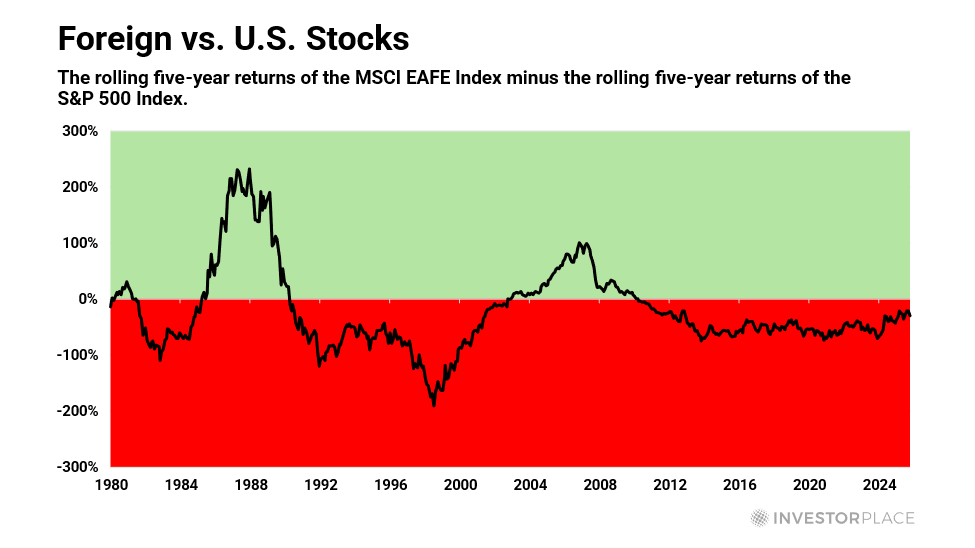
The recent volatility has reignited a debate among macroeconomists regarding the sustainability of U.S. market leadership. Eric Fry, editor of Fry’s Investment Report and a veteran macro analyst, argues that the historical outperformance of U.S. equities over the last decade has fostered a dangerous sense of complacency among domestic investors. Since the market troughs of 2009, the S&P 500 has delivered a total return of approximately 1,340%, a figure that dwarfs the 468% return of the MSCI EAFE Index, which tracks developed markets in Europe, Australasia, and the Far East.
However, Fry posits that this discrepancy is not solely the result of American technological innovation. Instead, he attributes a significant portion of the S&P 500’s gains to "multiple expansion," a phenomenon where investors become willing to pay more for each dollar of earnings based on optimistic sentiment. Currently, the S&P 500 trades at approximately 26 times earnings, while the MSCI EAFE trades at less than 18.
"Multiple expansion cannot continue forever," Fry noted in a recent analysis. "When valuations stretch this far, even positive news can struggle to drive prices higher, while negative news can trigger sharp, asymmetric corrections."
Historical data supports the theory that market leadership is cyclical. From 1986 to 1991, and again from late 2003 through early 2011, international developed markets outperformed the S&P 500 for multi-year stretches. In 1986, for instance, the EAFE index returned nearly 67%, more than triple the 18.7% gain seen in the S&P 500. With the EAFE and S&P 500 delivering nearly identical returns over the past 24 months, Fry suggests that the momentum may be shifting away from the U.S. and toward undervalued international markets, specifically citing Japan as a primary beneficiary of this rotation.
Brazil as a Physical Proxy for AI Infrastructure
While many investors view AI strictly through the lens of software and microprocessors, a growing contingency of analysts is focusing on the physical resources required to sustain the technology. Brian Hunt, editor of Money & Megatrends, has identified Brazil as a strategic beneficiary of the global AI infrastructure boom. Unlike the volatile semiconductor stocks, Brazil’s market is heavily weighted toward commodities and energy—the literal building blocks of data center expansion.
Brazil’s status as a "commodity superpower" provides a unique hedge against tech-sector volatility. The country is a leading producer of iron ore and copper, both of which are essential for the construction and wiring of the massive data centers required to house AI servers. Additionally, Brazil possesses vast reserves of rare earth elements, which are increasingly critical for robotics and advanced defense technologies integrated with AI.
Perhaps most significantly, Brazil’s energy profile makes it an attractive destination for power-hungry tech firms. The nation’s extensive network of rivers allows it to produce massive quantities of hydroelectric power, providing a renewable and relatively low-cost energy source for data centers. Since Hunt issued a bullish outlook on the iShares MSCI Brazil ETF (EWZ) in July, the fund has surged 21%, significantly outperforming the S&P 500’s 2% gain during the same period. This performance underscores the viability of an "AI-adjacent" strategy that avoids the high-valuation risks of the Nasdaq.
South Korea and the Memory Chip Disconnect
The search for value within the AI sector has also led analysts to the Korean peninsula. South Korea’s KOSPI index recently experienced a dramatic 7.6% single-day plunge, triggering circuit breakers and leaving the index nearly 39% below its summer highs. This collapse occurred despite fundamentally strong corporate performance from the country’s leading technology giants.
Samsung Electronics, a cornerstone of the South Korean economy, recently reported its most profitable quarter in corporate history. The company’s preliminary third-quarter operating profit reached approximately 107 trillion won (roughly $80 billion), representing a staggering 782% increase from the previous year. Despite these record-breaking figures, the stock price was dragged down by the broader regional sell-off and concerns over global chip demand.
Jonathan Rose, editor of Advanced Notice, views this disconnect between record profits and collapsing share prices as a generational entry point for patient investors. South Korea is home to the world’s two dominant producers of High Bandwidth Memory (HBM)—Samsung and SK Hynix. These components are indispensable for the GPUs (Graphics Processing Units) produced by companies like Nvidia.
"The AI Revolution extends well beyond Silicon Valley," Rose stated. "All those data centers and AI models require enormous amounts of memory. By looking at the iShares MSCI South Korea ETF (EWY), investors can participate in the heart of the AI buildout at a significant discount compared to U.S.-based semiconductor firms."
Broader Market Implications and Future Outlook
The "ugly week" for the AI trade serves as a stark reminder of the risks associated with thematic crowding. When a disproportionate amount of global capital flows into a handful of names—such as Nvidia, Microsoft, and Alphabet—the market becomes susceptible to "liquidity holes" where even minor shifts in sentiment can lead to outsized price drops.
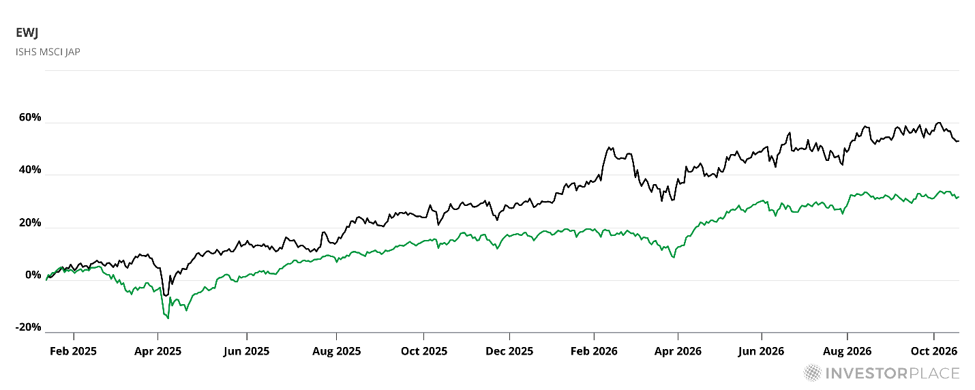
The recent market behavior suggests a transition from the "speculative phase" of AI investing to a "rationalization phase." In the speculative phase, any company mentioning AI saw its share price rise. In the rationalization phase, investors demand to see concrete earnings, manageable debt levels, and reasonable valuations. This shift favors international markets where the "AI premium" has not yet reached the levels seen in the United States.
Furthermore, the divergence between the Dow Jones and the Nasdaq indicates that "value" and "cyclical" stocks may be returning to favor. As the Federal Reserve contemplates its next move, the resilience of the Dow suggests that investors are looking for companies with established cash flows and lower sensitivity to interest rate fluctuations.
In conclusion, while the foundational promise of artificial intelligence remains intact, the financial vehicles used to access that growth are undergoing a rigorous re-evaluation. The transition from a U.S.-centric AI portfolio to a globally diversified strategy—incorporating Japanese manufacturing, Brazilian resources, and South Korean hardware—represents a strategic pivot toward sustainability. As the $2 trillion wipeout demonstrated, "familiar" is not synonymous with "safe" in an era of unprecedented technological and macroeconomic transition. Market participants will likely continue to monitor the Philadelphia Semiconductor Index as a bellwether for whether this correction is a temporary setback or the beginning of a long-overdue rebalancing of the global equity landscape.