NVIDIA Earnings Beat Expectations Amid Market Volatility and Shifting Investor Sentiment in the Artificial Intelligence Sector

The evolution of financial markets has mirrored the transformation of sports wagering in the United States, moving from a period of coded language and "reading between the lines" to an era of high-frequency data and explicit probability markets. In the 1970s, sports analysts like "Jimmy the Greek" on CBS’s The NFL Today had to navigate legal restrictions by predicting final scores rather than mentioning point spreads. If a team was favored by five points and an analyst predicted a ten-point victory, savvy viewers understood the implication: the team was expected to "cover the spread." Today, this concept of "beating the spread" has become the primary lens through which Wall Street views corporate earnings, particularly for market leaders like NVIDIA Corporation.
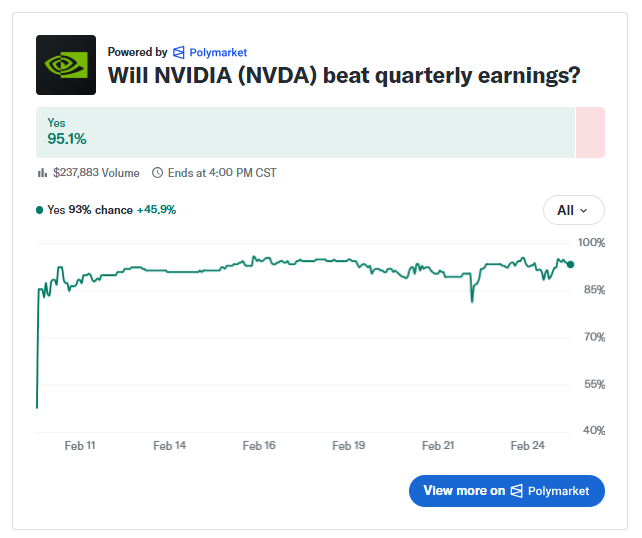
As the definitive bellwether for the artificial intelligence (AI) era, NVIDIA’s quarterly earnings reports are now treated with the same gravity as a major sporting event or a national election. Heading into the most recent fiscal quarter, probability markets assigned a staggering 90% chance that the company would exceed consensus earnings estimates. However, the high probability of a "win" shifted the market’s focus from a simple beat to the magnitude of that beat. When expectations are set at historic highs, even exceptional performance can result in a negative market reaction if the results do not exceed the most optimistic "whisper numbers."
Quarterly Financial Performance and the Earnings Scoreboard
NVIDIA’s latest financial disclosure revealed a company continuing to operate at an unprecedented scale of growth. The company reported earnings of $1.62 per share, surpassing the Wall Street consensus of $1.53 per share. Total revenue reached $68.1 billion, exceeding the $65.8 billion anticipated by analysts. This figure represents a 73% increase in revenue compared to the same period in the previous fiscal year, a growth rate that remains rare for a company with a multi-trillion-dollar market capitalization.
The primary driver of this growth remains the Data Center division, which recorded $62.3 billion in revenue, topping institutional expectations. Furthermore, NVIDIA provided forward-looking guidance for the current quarter, projecting revenue of approximately $78 billion. This outlook was notably higher than the $72.8 billion consensus estimate held by analysts prior to the announcement. By traditional financial metrics, the report indicated a robust and healthy expansion of NVIDIA’s core business.
The Market Reaction Paradox
Despite the significant beat on both the top and bottom lines, NVIDIA’s stock experienced a downward trajectory in immediate after-hours and subsequent trading, falling nearly 4%. This phenomenon, often referred to as a "sell the news" event, highlights a growing disconnect between fundamental performance and market expectations. Several factors contributed to this price action, ranging from institutional positioning to geopolitical concerns.
First, while the consensus revenue guidance was $72.8 billion, a segment of the analyst community had modeled "bull case" scenarios as high as $80 billion. When a company becomes the focal point of a global technological shift, the "official" estimates often lag behind the expectations of the most aggressive traders. Failure to meet these unofficial benchmarks can trigger algorithmic selling.
Second, the "physics of scale" has begun to influence NVIDIA’s market movements. As one of the largest publicly traded companies in the world, the sheer volume of capital required to move the stock higher increases exponentially. The market must absorb massive sell orders from investors who use the earnings strength as an opportunity to rebalance portfolios or lock in gains from the previous year’s rally.
Third, the technical landscape of the stock played a role. NVIDIA is currently one of the most heavily traded securities in the options market. Large-scale "covered call" writing and the subsequent hedging by market makers create mechanical pressure on the stock price. When a highly anticipated event passes, the "volatility crush" in options pricing can lead to automated selling as hedges are unwound.
Geopolitical Headwinds and Sustainability Concerns
Beyond the immediate price action, investors are scrutinizing the long-term sustainability of the AI buildout. A significant point of contention remains the Chinese market. Due to ongoing U.S. export restrictions on high-end semiconductors, NVIDIA has had to navigate a complex licensing environment. The company has noted that it is excluding certain China-based data center revenue from specific forecasts, leading to concerns about the loss of a historically vital growth engine.
Additionally, a debate is emerging regarding the transition of AI from the "training" phase to the "inference" phase. While NVIDIA dominates the hardware used to train massive large language models (LLMs), the market for running everyday AI applications—inference—is becoming increasingly competitive. Analysts are questioning whether NVIDIA can maintain its near-monopoly margins as specialized chips and in-house silicon from major cloud providers enter the fray.
Broader Ecosystem Performance and Supporting Data
NVIDIA’s results do not exist in a vacuum; they are part of a broader surge in the AI infrastructure ecosystem. Supporting data from related firms suggests that the demand for AI hardware remains intense. Super Micro Computer, Inc. (SMCI), a key provider of AI server solutions, has reported triple-digit sales growth. Similarly, Vertiv Holdings (VRT), which specializes in the cooling and power infrastructure required for high-density data centers, has delivered strong sales and upward-revised guidance.
Taiwan Semiconductor Manufacturing Co. Ltd. (TSM), the foundry responsible for producing NVIDIA’s chips, recently announced January sales growth of 37%. This figure significantly outperformed TSM’s own prior guidance of 30%. These data points confirm that the "Stage 1" buildout of the AI era—the physical construction and outfitting of data centers—is still in a period of high velocity.
The Theory of AI Dislocation and Leadership Rotation
Market analysts are increasingly pointing to a phenomenon described as "AI Dislocation." This theory suggests that while the overall AI boom is far from over, the leadership within the market is beginning to shift. This transition is typically categorized into two distinct stages:
Stage 1: The Pioneers and Hyperscalers
In the initial stage of a technological revolution, capital flows toward the most obvious beneficiaries. In the current cycle, this includes NVIDIA and the "hyperscalers"—Amazon, Alphabet, Meta, and Microsoft. These four companies alone are projected to spend approximately $650 billion on AI-related capital expenditures in 2026. However, as these giants spend hundreds of billions, the market begins to focus on their return on investment (ROI). High capital intensity can lead to margin compression for the buyers, even as it enriches the suppliers.
Stage 2: The Infrastructure Enablers
The second stage occurs when the market recognizes the companies that enable the buildout but operate from a smaller valuation base. These include firms involved in power systems, liquid cooling technology, semiconductor equipment, and networking backbones. As the "obvious" names like NVIDIA reach extreme valuations, institutional capital often rotates toward these "Stage 2" winners, where revenue growth can compound more rapidly relative to their market size.
Official Responses and Corporate Outlook
During the earnings conference call, NVIDIA Chief Executive Officer Jensen Huang addressed concerns regarding the longevity of the AI investment cycle. Huang emphasized that NVIDIA’s customers are not merely engaging in speculative buying but are already "monetizing" their investments. According to Huang, the computing capacity being purchased is being immediately utilized to generate cash flow through cloud services, software integration, and internal productivity gains.
"We are at the beginning of a new industrial revolution," Huang stated, reinforcing the company’s view that the transition from general-purpose computing to accelerated computing is a permanent structural change in the global economy. The company’s focus remains on the rollout of its next-generation Blackwell architecture, which is expected to meet the continuing demand for higher-performance, energy-efficient AI processing.
Fact-Based Analysis of Future Implications
The recent price action in NVIDIA serves as a case study in modern market mechanics. It demonstrates that in a "perfection-priced" environment, fundamental excellence is the baseline, not the catalyst for further gains. The 4% dip, despite a "blowout" quarter, suggests that the market is entering a more discerning phase of the AI trade.
For the broader market, NVIDIA’s ability to guide for $78 billion in revenue indicates that the "AI bubble" talk may be premature when compared to the revenue-less "dot-com" era. NVIDIA’s valuation has actually compressed in some metrics because its earnings have grown faster than its stock price. This suggests a market driven by earnings power rather than pure speculation.
However, the "AI Dislocation" remains a critical risk for investors concentrated solely in mega-cap names. As the infrastructure for artificial intelligence becomes more commoditized and specialized, the "spread" that companies must beat will only get wider. The focus of the coming fiscal year will likely shift from "who is building the chips" to "who is efficiently powering the centers" and "who is generating the most profit from the applications."
In conclusion, NVIDIA has successfully "won the game" by delivering historic financial results, but it failed to "cover the spread" set by a market with insatiable expectations. The path forward for the AI sector will likely involve a broadening of market leadership, as the immense capital flows from the hyperscalers find their way into the deeper layers of the global technological supply chain.