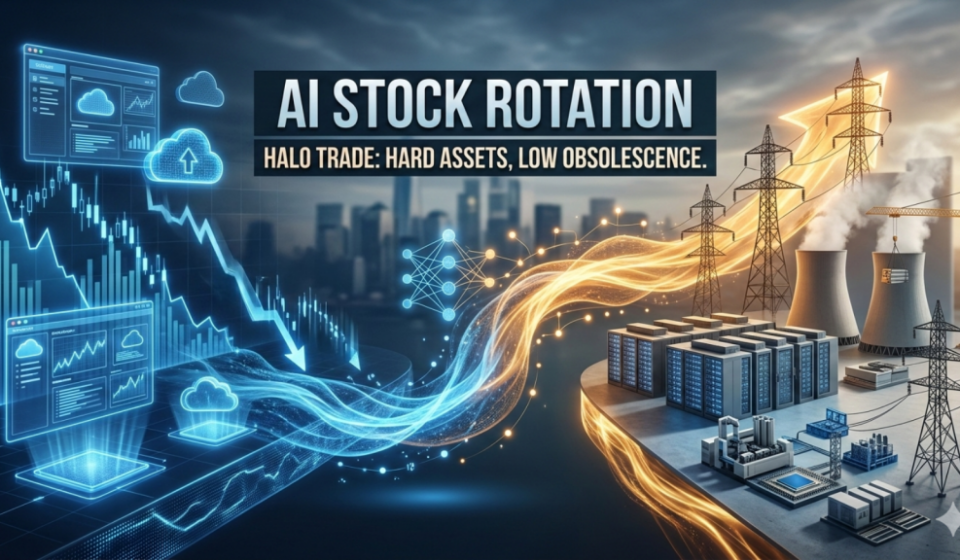
The HALO Trade and the Great 2026 Market Rotation: Why Physical Infrastructure is Outperforming Digital Software in the Age of Autonomous AI

The global financial markets in the first quarter of 2026 present a striking paradox that has left many retail investors bewildered while institutional desks aggressively reposition their portfolios. On the surface, the headline indices suggest a period of historical stagnancy; the S&P 500 and the Nasdaq Composite have remained virtually unchanged since the start of the year, drifting in a narrow horizontal channel that suggests a lack of conviction. However, this superficial "flatness" masks a violent and historically unprecedented rotation occurring beneath the surface. This phenomenon, now widely identified by Wall Street as the "HALO" trade—an acronym for Hard Assets, Low Obsolescence—marks a fundamental shift in how capital is allocated in an economy increasingly dominated by autonomous artificial intelligence.
While the major indices remain range-bound, the internal divergence between sectors has reached extreme levels. A massive repricing is underway, characterized by a sharp exodus from pure-play digital software companies and a parabolic surge into physical infrastructure and hardware. This "Atoms versus Bits" divide has become the defining narrative of 2026, as investors weigh the disruptive power of AI against the tangible requirements of the physical world.
The Repricing of the Digital Economy
The primary victims of this rotation are the former darlings of the "Software as a Service" (SaaS) era. As of March 2026, a significant cohort of major technology firms has seen valuations compressed by more than 30% in less than ninety days. This list includes industry stalwarts such as Adobe (ADBE), Salesforce (CRM), Intuit (INTU), and Workday (WDAY), alongside high-growth platforms like HubSpot (HUBS), Atlassian (TEAM), and The Trade Desk (TTD). Even consumer-facing digital giants like Reddit (RDDT), Pinterest (PINS), and Zillow (Z) have not been spared from the carnage.
Analysts suggest this is not a standard market correction but a fundamental structural repricing. For over a decade, the market rewarded digital platforms with high-growth multiples based on the assumption of long-term "moats" and high switching costs. However, the rapid advancement of agentic AI models—specifically the recent releases of Gemini 3.1 and ChatGPT 5.2—has challenged the durability of these digital moats.
When a startup can leverage autonomous AI to build a custom, functional CRM or marketing automation stack in a single afternoon for a fraction of the cost of a traditional enterprise subscription, the value proposition of legacy SaaS begins to dissolve. This "commoditization of code" has introduced a level of existential uncertainty that the market is now pricing in through aggressive multiple compression.
The Rise of the HALO Trade: Atoms Over Bits
Contrasting the decline in software is the meteoric rise of companies involved in the physical manifestation of technology. Shares in firms such as Vertiv (VRT), which specializes in data center cooling and power management, and Bloom Energy (BE), a provider of on-site power generation, have surged by more than 50% year-to-date. Other significant winners include manufacturers of AI-critical hardware and infrastructure components like SanDisk (SNDK), Western Digital (WDC), Lumentum (LITE), and Corning (GLW).
The logic driving the HALO trade is rooted in the physical limitations of the AI revolution. While AI can autonomously write software, manage workflows, and handle customer service, it cannot physically construct a data center, manufacture a high-bandwidth memory chip, or generate the gigawatts of electricity required to power massive GPU clusters. Consequently, the "hard assets" that support the digital world have become the new ultimate moats.
Institutional data reflects this shift clearly. In the first ten weeks of 2026, the Energy sector (XLE) has outperformed the Nasdaq by approximately 25 percentage points. Traditional industrial giants like Caterpillar (CAT) and infrastructure specialists like Comfort Systems USA (FIX) are reaching all-time highs, even as the "Magnificent Seven" tech leaders struggle to maintain positive territory for the year.
Chronology of the Shift: From LLMs to Autonomous Agents
The transition to the HALO framework did not happen overnight but is the culmination of a three-year technological acceleration.
- 2023–2024: The Hype Phase. The initial release of Large Language Models (LLMs) triggered a broad-based rally in all things AI. Software companies were the primary beneficiaries as they promised to integrate "copilots" into their existing products.
- 2025: The Infrastructure Bottleneck. As AI models grew in complexity, the demand for compute power and energy reached a breaking point. The market began to realize that the supply of GPUs, specialized memory (HBM), and electrical grid capacity were the primary constraints on AI growth.
- Early 2026: The Agentic Threshold. The release of Gemini 3.0 and Claude Opus 4.6 marked the transition from AI as a "tool" to AI as an "agent." These models demonstrated the ability to autonomously execute complex digital tasks, effectively threatening the business models of many software-based service providers. This sparked the current "violent rotation" as investors sought refuge in physical assets that AI cannot replicate or automate away.
Supporting Data: Sector Performance and Valuation Gaps
The divergence in performance between "Atoms" and "Bits" is supported by recent quarterly earnings reports and market data. According to recent filings, the capital expenditure (CapEx) of the four largest hyperscalers—Amazon, Microsoft, Alphabet, and Meta—is projected to exceed $250 billion in 2026, with the vast majority of that spending directed toward physical infrastructure.
| Sector/Asset Class | YTD Performance (March 2026) | Avg. Forward P/E Ratio |
|---|---|---|
| SaaS/Cloud Software | -28% | 18.5x (Down from 45x) |
| Data Center Infrastructure | +44% | 32.0x |
| Energy & Power Utilities | +22% | 16.5x |
| Materials & Industrial | +18% | 19.0x |
| S&P 500 (Headline) | +0.4% | 21.2x |
This data illustrates that while the index remains flat, the "internals" are in a state of upheaval. The valuation gap between software and hardware is narrowing for the first time in fifteen years, reflecting a new market consensus that physical constraints are more valuable than digital scalability in an AI-saturated environment.
HALO Offensive vs. HALO Defensive: Two Strategic Angles
Market strategists have divided the HALO trade into two distinct categories to help investors navigate the rotation.
HALO AI Offensive
These are the companies providing the essential "picks and shovels" for the AI buildout. They are the direct beneficiaries of the massive CapEx cycles currently underway. This group includes semiconductor equipment manufacturers, thermal management specialists, and specialized construction firms. For these companies, AI is a massive revenue tailwind. For instance, Comfort Systems USA (FIX) has seen its backlog for data center HVAC installations grow by triple digits as GPU clusters require increasingly sophisticated liquid and air-cooling solutions to prevent thermal throttling.
HALO AI Defensive
These are traditional, physical-world businesses that use AI to enhance their operations rather than being threatened by it. Companies like Walmart (WMT), Caterpillar (CAT), and Coca-Cola (KO) operate in the world of "atoms." AI helps them optimize logistics, predict maintenance cycles, and manage global supply chains, but it cannot replace the physical act of moving goods or manufacturing machinery. These stocks are viewed as "defensive" because their core utility is insulated from the digital disruption that is currently devaluing the software sector.
Institutional Reactions and Market Sentiment
The shift toward hard assets has been met with significant commentary from leading financial institutions. In a recent note to clients, a senior strategist at a major investment bank noted: "For twenty years, the ‘asset-light’ model was the holy grail of investing. Today, in a world where AI can generate infinite digital content and code, the ‘asset-heavy’ model provides the only true scarcity. You cannot download a kilowatt-hour, and you cannot prompt a cooling tower into existence."
Similarly, the flow of funds into Energy and Material ETFs has reached levels not seen since the commodities super-cycle of the early 2000s. Portfolio managers are increasingly viewing the HALO trade as a hedge against the potential "devaluation of digital labor." As AI reduces the cost of cognitive tasks toward zero, the relative value of physical resources and infrastructure naturally appreciates.
Broader Impact and Future Implications
The long-term implications of the HALO rotation suggest a permanent change in the market regime. The era of "growth at any cost" for software companies appears to be over, replaced by a "valuation for reality" framework. This shift may lead to a wave of consolidation in the tech industry, as legacy software firms with dwindling moats are forced to merge or pivot their business models toward specialized, high-security applications that AI agents cannot yet navigate.
Furthermore, the surge in physical infrastructure spending is likely to have significant macroeconomic effects. It is driving a "reshoring" of manufacturing and a massive reinvestment in the national electrical grid, which had previously suffered from decades of underinvestment. This transition suggests that while the digital revolution continues to accelerate, its success is now entirely dependent on the modernization of the physical world.
As the market moves further into 2026, the HALO trade remains the dominant investment framework. The headline flatness of the S&P 500 belies a fundamental truth: the economy is being rebuilt from the ground up, and the winners are those who control the physical foundations of the digital future. For investors, the message from the first quarter is clear: in an age of infinite bits, the only thing that truly matters is the atom.