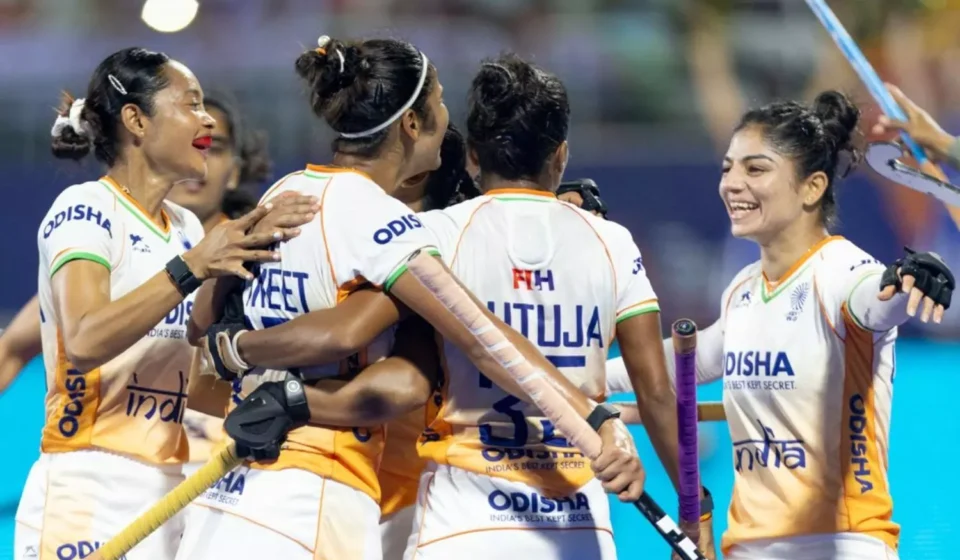
India Maintains Pool B Lead Following Hard Fought Two All Draw Against Scotland in FIH Hockey World Cup Qualifiers

The Indian women’s national hockey team retained its position at the summit of Pool B after a grueling 2-2 draw against a resilient Scottish side during the second group-stage encounter of the FIH Hockey World Cup Qualifiers 2026. Held at the state-of-the-art hockey facility in Hyderabad on Monday, the match served as a high-stakes tactical battle, leaving both nations with four points apiece from two matches. However, India’s superior goal difference, bolstered by their performance in the opening round, ensures they remain the team to beat in the group as the tournament approaches its knockout phases.
The encounter was a tale of two halves, characterized by Scotland’s clinical early execution and India’s relentless offensive pressure in the middle periods. Navneet Kaur and the emerging talent Sunelita Toppo provided the goals for the "Women in Blue," while Scotland relied on the clinical finishing of Heather McEwan and Fiona Burnet to secure a vital point on away soil. For the home fans in Hyderabad, the match was a rollercoaster of emotions, showcasing the rapid evolution of the Indian side under high-pressure qualification scenarios.
Chronology of Play: A Seesaw Battle in Hyderabad
The match commenced under humid conditions, with Scotland demonstrating immediate tactical discipline. Eschewing a conservative approach, the visitors pressed high from the opening whistle, catching the Indian defensive line off guard. This aggression bore fruit as early as the sixth minute. Following a swift transition through the midfield, Scotland earned the game’s first penalty corner. Heather McEwan, positioned perfectly at the edge of the circle, capitalized on a precise injection and a well-drilled routine to deflect the ball past the Indian goalkeeper. The early 1-0 lead for Scotland stunned the home crowd and forced India into an uncharacteristic period of frantic play.
As the first quarter progressed, India began to find their rhythm. The midfield, led by veteran presence and creative playmaking, started threading passes into the Scottish ‘D.’ Despite earning several penalty corners in the final minutes of the first quarter, the Indian battery struggled with the final execution, often finding the Scottish first-runner or the pads of goalkeeper Jessica Buchanan.
The second quarter saw a marked shift in momentum. India’s head coach appeared to have adjusted the team’s width, utilizing the flanks to stretch the Scottish defense. In the 18th minute, the persistence paid off. A penalty corner strike was initially blocked, but the rebound fell into the path of Navneet Kaur. Showing the composure that has made her a staple of the national team, Kaur reacted with lightning speed, firing a low, powerful shot into the bottom corner to restore parity at 1-1.
Buoyed by the equalizer, India intensified their assault. The Scottish defense, which had been resolute, began to show signs of fatigue under the constant barrage of circle entries. In the 29th minute, just seconds before the halftime hooter, a goalmouth scramble ensued following a driven cross from the right wing. In the chaos, Sunelita Toppo displayed exceptional poacher’s instincts, poking the ball home from close range to give India a 2-1 lead heading into the break.
The third quarter began with Scotland needing an immediate response, and they found it through structured buildup play. In the 33rd minute, a lapse in India’s defensive marking allowed Fiona Burnet to find space within the circle. Receiving a crisp pass from the midfield, Burnet executed a clinical finish to equalize at 2-2. The remainder of the third and the entirety of the fourth quarter were characterized by end-to-end action. India dominated possession and the shot count, winning a series of late penalty corners, but Jessica Buchanan delivered a masterclass in goalkeeping, pulling off at least four world-class saves to deny the hosts a winning goal.
Supporting Data and Pool B Standings
The result has significant implications for the Pool B leaderboard. Following two rounds of matches, the standings are as follows:
- India: 4 Points (Goal Difference: +3)
- Scotland: 4 Points (Goal Difference: +1)
- Wales: 3 Points (Pending final match outcomes)
- Other Pool B Participants: 0 Points
India’s position at the top is currently protected by their opening-match victory, which provided a healthy cushion in terms of goals scored. However, the draw against Scotland highlights a recurring challenge for the Indian side: penalty corner conversion. Despite earning eight penalty corners throughout the match, India managed to convert only one indirectly via a rebound. Scotland, by contrast, was highly efficient, scoring from one of their three total opportunities.
Possession statistics favored India (58% to 42%), and the hosts recorded 14 circle entries compared to Scotland’s 7. These figures underscore India’s territorial dominance but also point toward a need for greater clinicality in the final third—a factor that will be crucial as they move toward the semi-finals of the qualifiers.
Tactical Analysis and Defensive Resilience
The match provided a fascinating look at two contrasting styles of modern hockey. India employed a high-octane, possession-based game, relying on the speed of their wingers and the vision of their central midfielders to break down Scotland’s low block. The performance of Sunelita Toppo was particularly noteworthy; the young forward’s ability to find space in congested areas suggests she is becoming a vital asset for the national setup.
Scotland, coached with a focus on structural integrity, relied on a "soak and strike" strategy. By allowing India to have the ball in non-threatening areas, Scotland conserved energy for explosive counter-attacks. Their defensive organization, led by the veteran presence in their backline, forced India to take shots from difficult angles or rely on set pieces.
The standout performer of the match was undoubtedly Scotland’s Jessica Buchanan. Her performance in the final ten minutes prevented what seemed like an inevitable Indian victory. Buchanan’s ability to track the ball through traffic and her reflexes against close-range deflections frustrated the Indian strikers and earned Scotland a point that keeps their hopes of topping the group alive.
Official Reactions and Inferred Perspectives
While official post-match press conferences emphasized mutual respect, there were clear takeaways for both coaching staffs. The Indian camp is likely to view this as two points dropped rather than one point gained. The inability to capitalize on late-game dominance is an area that the coaching staff will undoubtedly address in video analysis sessions before the final group game.
"Playing at home brings a unique pressure, and while we are pleased to remain top of the pool, we must be more clinical in the circle," an inferred coaching perspective suggests. "The opportunities were there, but we allowed Scotland to stay in the game. Our focus now shifts entirely to Wales, where we need a comprehensive performance to secure our path."
On the Scottish side, the mood was one of quiet defiance. Securing a draw against the highest-ranked team in the pool, especially in front of a partisan crowd, is a significant moral victory. The Scottish staff will likely take confidence from their team’s ability to respond immediately after falling behind, a trait that will be essential in the knockout rounds.
Broader Implications for the 2026 World Cup Qualification
The FIH Hockey World Cup Qualifiers are the gateway to the 2026 showpiece event, which will be co-hosted by the Netherlands and Belgium. For India, qualifying is not just a matter of prestige but a necessity for the continued growth of the sport in the country. Following the success of the women’s team in recent years, including a historic fourth-place finish at the Tokyo Olympics, the expectations are at an all-time high.
The draw against Scotland serves as a timely reminder that the gap between the top-tier nations and the chasing pack is narrowing. Teams like Scotland and Wales have invested heavily in tactical scouting and physical conditioning, making them formidable opponents in a tournament format where one bad result can derail a qualification campaign.
For India to ensure a smooth passage to the World Cup, they must finish the group stage strongly. A top finish in Pool B would likely result in a more favorable draw in the crossover or semi-final matches, avoiding the heavyweights from Pool A until the final stages.
Looking Ahead: The Final Group Clash Against Wales
India’s journey in the group stage concludes on March 11, when they face Wales. This fixture is now a "must-win" or "must-draw" to guarantee the top spot, depending on Scotland’s result in their final group game. Wales is known for a physical brand of hockey and a disciplined defensive structure similar to Scotland’s, meaning India will need to find creative ways to unlock their backline.
The medical staff will be monitoring the recovery of the Indian players closely, as the intensity of the Hyderabad heat and the back-to-back nature of the tournament can lead to fatigue. Fans can expect a high-intensity encounter as India looks to refine its penalty corner routines and rediscover the scoring touch that saw them dominate their opening fixture.
As the sun sets on a thrilling day of hockey in Hyderabad, the road to the 2026 World Cup remains open. India holds the advantage, but as Monday’s draw against Scotland proved, there are no easy matches on the path to global glory. The focus now turns to Monday, where the "Women in Blue" will look to seal their dominance and take one step closer to the world stage.