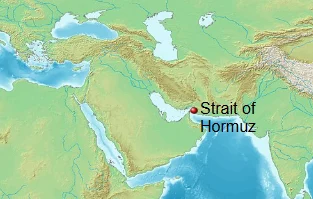

The Strategic Significance of the Strait of Hormuz
The Strait of Hormuz is a narrow waterway separating Iran and the Arabian Peninsula, serving as the sole sea passage from the Persian Gulf to the open ocean. It is arguably the most important energy chokepoint in the world. According to data from the U.S. Energy Information Administration (EIA), more than one-quarter of total global liquefied natural gas (LNG) trade and one-fifth of global petroleum liquids pass through this 21-mile-wide corridor.
The current conflict has not only threatened oil tankers but has also disrupted the infrastructure of neighboring states. Recent missile strikes on Qatari energy facilities have forced a significant curtailment of LNG production, directly impacting European and Asian markets that had become reliant on Qatari gas following the 2022 decoupling from Russian energy sources. This disruption creates a "ripple effect" where the crisis in the Gulf transcends the oil market, impacting global electricity costs, industrial manufacturing, and the agricultural supply chain.
A Chronology of the 2026 Energy Crisis
The path to the current market instability began in early January 2026, following a series of maritime disputes that rapidly escalated into kinetic warfare.
- January 12, 2026: Increased naval patrols in the Strait of Hormuz lead to the first seizures of commercial vessels, causing insurance premiums for tankers to rise by 400% in a single week.
- February 15, 2026: Formal declarations of hostilities lead to the partial closure of the Strait. Brent crude oil prices breach the $110 mark for the first time in years.
- March 2, 2026: Missile strikes are reported on critical processing plants in the region, including major LNG liquefaction terminals. Global natural gas prices in Europe (TTF) and Asia (JKM) spike by 50%.
- March 9, 2026: In a day of unprecedented volatility, oil prices experience a 30% intraday reversal. Initial reports of a ceasefire caused a massive sell-off, which was immediately retracted when the reports were revealed to be premature, trapping speculative "long" traders in a liquidity squeeze.
- March 10, 2026: Analysts identify a divergence in the market; while crude remains volatile, stocks with strong balance sheets and domestic production advantages begin to decouple from the chaotic spot market.
Devon Energy: The Domestic Shale Advantage
As international supplies become precarious, the focus of the energy sector has returned to the United States’ Permian Basin. Devon Energy (DVN), a leading independent oil and natural gas producer, has emerged as a primary beneficiary of this shift. Following its strategic merger with Coterra Energy, Devon has solidified its position as a diversified powerhouse with a low-cost production profile.
The investment thesis for Devon during this crisis rests on two pillars: low breakeven costs and infrastructure resolution. Devon’s current breakeven price—the point at which it can cover capital expenditures and dividends—is estimated to be well below $45 per barrel. This provides a massive margin of safety compared to international producers who face rising security and transport costs. Furthermore, Devon has historically struggled with "stranded gas" in West Texas, where a lack of pipeline capacity forced producers to flare gas or sell it at a steep discount.
However, the 2026 landscape is different. New pipeline capacity, including the completion of major conduits to the Gulf Coast, now allows Devon to transport its natural gas directly to LNG export terminals. As European demand for non-Middle Eastern gas reaches a fever pitch, Devon is no longer just an oil company; it is a critical supplier to the global LNG market. By locking in futures contracts at current elevated prices, Devon can guarantee record cash flows even if the Hormuz crisis finds a sudden diplomatic resolution.
Equinor: Europe’s Energy Shield
In Europe, the security of supply has become the paramount concern for policymakers and investors alike. Equinor (EQNR), Norway’s state-controlled energy giant, has effectively become the continent’s "lender of last resort" for natural gas. When Russian supplies were severed in 2022, Equinor stepped in to fill the void, and the current Hormuz crisis has only reinforced its dominance.
With Qatari LNG exports now curtailed due to regional instability, European gas prices have entered a new period of sustained elevation. Equinor’s advantage is its proximity and its infrastructure. Unlike LNG, which must be chilled, loaded onto tankers, and shipped across oceans, Equinor’s gas is moved via a vast network of subsea pipelines directly into the heart of Europe. This makes Norway’s production immune to the naval blockades and tanker shortages currently plaguing the Persian Gulf.
Despite these tailwinds, Equinor’s valuation remains attractive to value-oriented investors. As of early March 2026, the stock continues to trade nearly 20% below its 2022 peak, despite having increased its dividend for four consecutive years and maintaining a balance sheet that is arguably the strongest in the global integrated energy sector.
The Fertilizer Factor: Mosaic and the Agricultural Ripple
The most overlooked aspect of the Hormuz crisis is its impact on global food security. The Persian Gulf is not only an energy hub but also a massive exporter of nitrogen-based fertilizers, which require natural gas as a primary feedstock. The cessation of these exports has sent urea and ammonia prices to historic highs.
While nitrogen producers like CF Industries and Nutrien have seen immediate share price appreciation, Mosaic (MOS) represents a more nuanced opportunity. Mosaic is a leading producer of concentrated phosphate and potash—nutrients that are distinct from nitrogen but are essential for global crop yields.
Historically, there is a lag between the spike in nitrogen prices and the subsequent rise in phosphate and potash. As farmers face exorbitant costs for nitrogen, they often shift their planting decisions or increase their focus on soil health, which eventually drives demand for Mosaic’s products. Furthermore, the general "inflationary tailwind" in the agricultural sector typically benefits all major nutrient providers. Wall Street’s focus has remained on the immediate energy and nitrogen story, leaving Mosaic as a potential "catch-up" trade as the market realizes the longevity of the current supply chain disruptions.
Official Responses and Market Analysis
The International Energy Agency (IEA) has issued statements urging member nations to coordinate releases from Strategic Petroleum Reserves (SPR) to combat the extreme volatility seen on March 9. In a formal communique, the IEA stated, "The volatility in the energy markets does not reflect current physical inventories but rather the extreme uncertainty regarding maritime security in the Strait of Hormuz. We remain prepared to take collective action to ensure market liquidity."
Market analysts suggest that the current environment favors "defensive energy" over "speculative energy." Thomas Yeung, a CFA and markets analyst, notes that the real opportunity lies in companies that can maintain high margins even if the "war premium" evaporates from oil prices. The ability to hedge production and the possession of low-cost, geographically safe assets are the new metrics for success in a fractured global economy.
Broader Implications and Long-Term Outlook
The Hormuz crisis of 2026 is likely to accelerate several long-term trends in the global economy:
- Energy Regionalism: Nations are increasingly prioritizing "friend-shoring" energy supplies—sourcing oil and gas from politically stable and geographically accessible neighbors rather than relying on global spot markets.
- Infrastructure Resilience: The premium on pipeline capacity and domestic LNG processing will likely lead to a new wave of midstream investment in North America and the North Sea.
- Agricultural Inflation: The disruption in fertilizer components suggests that food price inflation will remain "sticky" throughout 2026 and 2027, regardless of how quickly the military conflict is resolved.
In conclusion, while the headlines remain focused on the daily fluctuations of crude oil and the tactical movements in the Persian Gulf, the structural shifts in the market favor a different set of winners. Companies like Devon Energy, Equinor, and Mosaic offer a combination of low-cost production, strategic geographic advantages, and exposure to secondary commodity cycles that are less prone to the "coin-flip" volatility of geopolitical speculation. For the disciplined investor, the current crisis represents a transition from trading the news to investing in the fundamental realities of a new energy landscape.