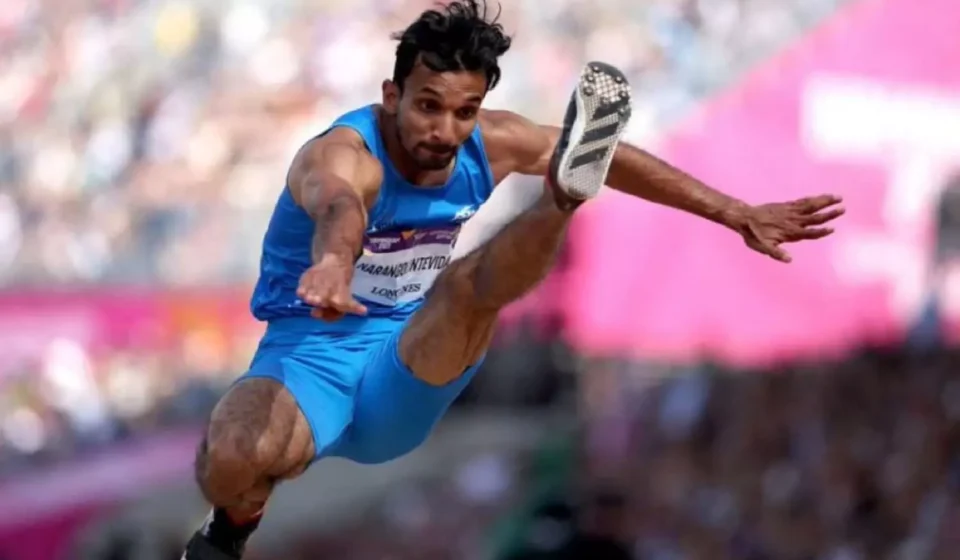
Abdulla Aboobacker Triumphs in Men’s Triple Jump at the Indian Open Jumps Competition 2026 in Bengaluru

The Indian Open Jumps Competition 2026 commenced with high-stakes drama at the Anju Bobby High Performance Centre in Bengaluru, as former Asian champion Abdulla Aboobacker reclaimed his position at the top of the podium in the men’s triple jump. In a discipline that has arguably become India’s most competitive field event over the last four years, Aboobacker’s victory over national record holder Praveen Chithravel highlighted a day of intense rivalry and significant athletic milestones. The event, which serves as a critical barometer for the domestic season, saw Aboobacker produce a season-defining performance to edge out his long-time rival in a contest decided by a mere five centimeters.
The Triple Jump Duel: Aboobacker vs. Chithravel
The centerpiece of the opening day was undoubtedly the men’s triple jump, featuring a lineup that included some of the finest horizontal jumpers in Asian history. Abdulla Aboobacker, known for his technical precision and big-game temperament, delivered a winning mark of 16.83m on his third attempt. This leap was sufficient to secure the gold medal and stave off a late-round surge from Praveen Chithravel.
Chithravel, who holds the Indian national record of 17.37m and claimed bronze at the Hangzhou Asian Games, opened his series with a promising 16.59m. Despite consistent efforts to find his rhythm on the runway, his best mark of the day came in at 16.78m. While Chithravel’s performance was formidable, it fell just short of Aboobacker’s peak effort. The bronze medal was claimed by Gailey Venister, who recorded a jump of 16.48m, further illustrating the depth of talent currently available in the Indian jumping circuit.
This meeting in Bengaluru marked the eighth time Aboobacker and Chithravel have faced each other in a major domestic or international final since the 2021 Federation Cup. Historically, Chithravel has held the upper hand, finishing ahead of Aboobacker in six of their previous seven encounters. However, Aboobacker’s victory on Saturday suggests a resurgence for the veteran jumper, who previously secured a silver medal at the 2022 Commonwealth Games. For Chithravel, the result provides a baseline for a season where he will look to replicate the form that saw him shatter the national record in Vivas, Cuba, last year.
Pole Vault: Dev Meena’s Pursuit of the Record
The men’s pole vault competition provided a different kind of excitement, centered on the rising star of Indian athletics, Dev Meena. Meena, who has rapidly ascended the ranks to become the nation’s premier vaulter, secured the gold medal by clearing a height of 5.25m. While the victory was secured relatively early in the competition, Meena’s subsequent decisions reflected the high ambitions of the modern Indian athlete.
After securing the title, Meena bypassed intermediate heights and set his sights on the national record. Having failed two attempts at 5.35m, he made the bold tactical decision to raise the bar to 5.41m—one centimeter higher than his own national record of 5.40m, which he established during a historic performance at the World University Games. Although he was unable to clear the 5.41m mark on this occasion, the attempt itself signaled his intent to push the boundaries of the sport in India.
The competition for the remaining podium spots was equally fierce. Kuldeep Kumar also cleared 5.25m, matching Meena’s winning height. However, Kumar was relegated to the silver medal position based on the countback rule, having required more attempts to clear the previous heights. M Gowtham rounded out the podium with a bronze-medal clearance of 5.10m. The technical proficiency displayed by the top three vaulters underscores the incremental progress being made in an event that has historically seen India struggle on the continental stage.
High Jump: Sarvesh Kushare’s Return to Action
In the men’s high jump, Paris 2024 Olympian Sarvesh Kushare made a successful return to competitive action, winning the gold medal with a clearance of 2.16m. For Kushare, the Indian Open Jumps Competition served as his season opener, a vital opportunity to shake off competitive rust and begin the buildup toward the international summer circuit.
Kushare’s performance was a masterclass in efficiency, though he remained well clear of the national record of 2.29m, currently held by Tejaswin Shankar. The competition for the minor medals was a tightly contested affair between Aditya Raghuvanshi and Swadhin Kumar Majhi. Both athletes successfully cleared 2.13m, with Raghuvanshi taking the silver and Majhi the bronze based on their respective jump sequences.
The absence of Tejaswin Shankar, who has recently balanced high jump with decathlon commitments, left Kushare as the clear favorite. His victory reinforces his status as the country’s leading specialist high jumper, though the gap between the domestic winning marks and the 2.30m+ heights required for global podiums remains a focal point for national coaches.
Women’s Triple Jump: Anusha Leads the Field
The women’s triple jump event showcased the burgeoning talent within the female jumping ranks. Mallala Anusha emerged victorious in a closely fought contest, securing the gold medal with a best effort of 13.18m. The podium was separated by a narrow margin of just ten centimeters, reflecting the parity among the top competitors.
Aleena T Saji took the silver medal with a leap of 13.12m, while Nimisha Dayma secured the bronze with a mark of 13.08m. While these distances remain some way off the international elite standards, the consistency shown by the podium finishers suggests a solid foundation for the upcoming National Inter-State Championships.
Context and Significance of the Venue
The choice of the Anju Bobby High Performance Centre in Bengaluru as the host venue is significant. Named after India’s first World Athletics Championship medalist, the facility has become a cornerstone of the country’s strategy to professionalize track and field. Bengaluru’s moderate altitude and temperate climate provide ideal conditions for explosive events like the triple jump and pole vault, where air resistance and athlete fatigue are critical factors.
The Indian Open Jumps Competition is part of a specialized series of events introduced by the Athletics Federation of India (AFI) to provide athletes with focused, high-quality competition outside of the traditional multi-event national championships. By isolating jumping events, the federation allows for better scheduling, more recovery time between attempts, and a concentrated atmosphere that benefits both athletes and technical officials.
Chronology of the Opening Day
The day began with the preliminary rounds of the horizontal jumps, where athletes sought to find their rhythm on the Bengaluru runways. The women’s triple jump was the first major final to conclude, setting a competitive tone for the afternoon. This was followed by the men’s pole vault, which saw Dev Meena dominate the early proceedings before his high-profile record attempts.
The late afternoon session featured the marquee event: the men’s triple jump. The tactical battle between Aboobacker and Chithravel unfolded over six rounds, with the lead changing hands in the early stages before Aboobacker’s 16.83m in the third round effectively shut the door on the competition. The day concluded with the men’s high jump, where Sarvesh Kushare’s experience proved decisive in the final stages of the vertical jump-off.
Analysis of Implications for the 2026 Season
The results from Bengaluru carry significant weight for the 2026 athletics calendar. For Abdulla Aboobacker, the victory is a psychological boost. After a period where Praveen Chithravel appeared to be the undisputed leader of Indian triple jumping, Aboobacker’s win restores the competitive tension that has historically pushed both athletes to greater heights. In 2022, this internal competition resulted in both men crossing the 17-meter barrier, a feat India hopes to see repeated in the coming months.
Dev Meena’s performance in the pole vault suggests that the national record of 5.40m is under immediate threat. His willingness to attempt 5.41m in his first major outing of the year indicates a high level of physical conditioning and confidence. If Meena can find consistency at the 5.30m-5.40m range, he will become a legitimate contender for medals at the Asian level.
For Sarvesh Kushare, the 2.16m clearance is a safe starting point. Having experienced the pressure of an Olympic Games, Kushare’s focus will likely be on peaking for the major championships later in the year. The depth in the high jump, with Raghuvanshi and Majhi both clearing 2.13m, suggests that the domestic circuit will provide enough pressure to keep the top-tier athletes motivated.
Conclusion and Outlook
As the Indian Open Jumps Competition 2026 prepares to conclude on Sunday, the opening day has already established several key narratives for the season. The dominance of established names like Aboobacker and Kushare, coupled with the record-breaking ambitions of younger talents like Dev Meena, paints a picture of a healthy and evolving athletic ecosystem.
The Athletics Federation of India’s investment in specialized high-performance centers and event-specific competitions appears to be yielding results in terms of athlete consistency. With the triple jump remains the "crown jewel" of Indian field events, the ongoing saga between Aboobacker and Chithravel will continue to be the primary focus of fans and selectors alike. As the athletes look ahead to the rest of the 2026 season, the marks set in Bengaluru provide a solid foundation for what promises to be a pivotal year for Indian track and field on the road to continental and global glory.