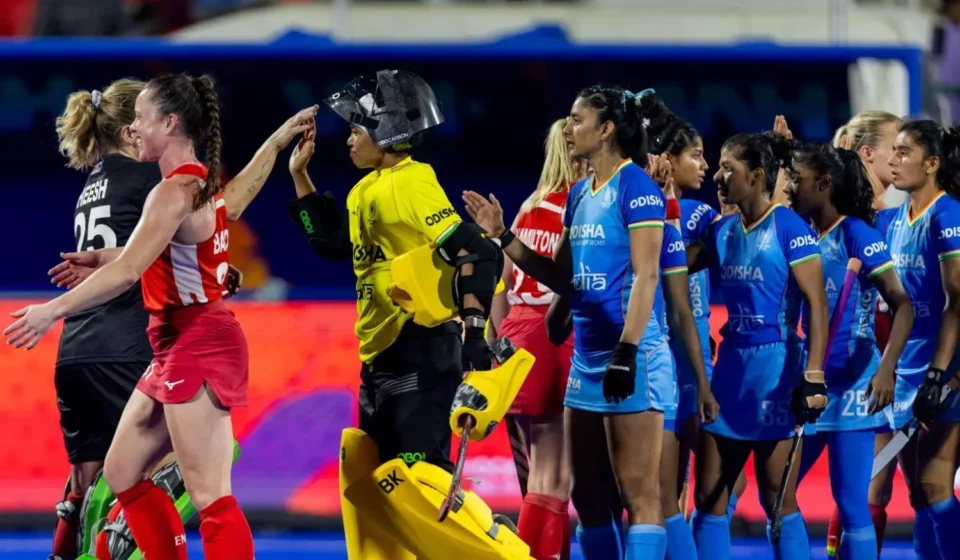
England Secures Victory Over India in Final of 2026 FIH Women’s Hockey World Cup Qualifiers in Hyderabad

The final of the 2026 FIH Women’s Hockey World Cup Qualifiers concluded on Saturday at the Gachibowli Stadium in Hyderabad, with England emerging as champions following a clinical 2-0 victory over the host nation, India. Despite a spirited performance from the Indian side, which saw them dominate early possession and create several scoring opportunities, the clinical efficiency of the English squad proved to be the deciding factor. Goals from veteran drag-flicker Grace Balsdon in the first quarter and a deflected strike from Elizabeth Neal in the third quarter ensured that England finished the tournament at the top of the podium. India, while disappointed with the loss in the final, secured a second-place finish, a result that remains significant in their journey toward the 2026 FIH Women’s World Cup, which is set to be co-hosted by the Netherlands and Belgium.
Match Overview and Tactical Breakdown
The final was characterized by a clash of styles: India’s high-pressing, flair-heavy attacking game against England’s structured, disciplined defensive organization. From the opening whistle, the Indian team, buoyed by a vocal home crowd in Hyderabad, sought to dictate the tempo. Forward Navneet Kaur was instrumental in the early exchanges, using her speed and stick-work to challenge the English backline. Within the first two minutes, India’s aggression paid off as they earned their first penalty corner. However, the English defense, led by their goalkeeper, remained composed, parrying away Navneet’s drag-flick to keep the scoreline level.
England, initially appearing content to absorb the pressure, gradually asserted themselves as the first quarter progressed. Their ability to transition from defense to attack was evident as they began to win battles in the midfield. With just two minutes remaining in the opening period, England earned their first penalty corner of the match. Grace Balsdon, who has been in exceptional form throughout the tournament, stepped up to the mark. Her powerful drag-flick found the back of the net in the 13th minute, marking her fifth goal from a penalty corner in the competition. This early breakthrough shifted the momentum, forcing India to chase the game.
Second Quarter: A Battle of Attrition
The second quarter saw both teams engage in a tactical stalemate. India continued to probe the English circle, recording eight circle penetrations in the first half alone. The Indian midfield, featuring the likes of Neha Goyal and Salima Tete, worked tirelessly to create openings. However, the final pass often lacked the precision required to dismantle a well-drilled English defense. England’s structural discipline meant that while India had the ball in dangerous areas, they rarely managed to test the goalkeeper with clear-cut shots on target.
England’s strategy in the second quarter was focused on maintaining their slim lead while looking for counter-attacking opportunities. They controlled the tempo by utilizing the width of the pitch and recycling possession through their experienced defenders. This approach frustrated the Indian attackers and ensured that the visitors went into the half-time break with a 1-0 advantage.
Third Quarter: England Extends the Lead
As the second half commenced, India increased their intensity, knowing that an equalizer was vital to their hopes of a comeback. They piled on the pressure, earning several free hits around the English circle. However, England’s defensive unit remained resolute, blocking passing lanes and winning crucial turnovers.
In the 43rd minute, against the run of play, England doubled their lead. The goal came through Elizabeth Neal, whose effort from within the circle took a significant deflection off an Indian defender. The change in trajectory left the Indian goalkeeper, Bichu Devi, with little chance to react as the ball trickled into the net. The 2-0 cushion provided England with a significant psychological advantage heading into the final fifteen minutes of the match.
Final Quarter: India’s Late Surge and English Resilience
The final quarter was a frantic affair as India threw everything forward in a desperate bid to salvage the match. The hosts adopted a high-risk strategy, leaving gaps at the back to flood the English half with players. This led to a free-flowing period of play where both sides had chances to score. India’s persistence earned them a penalty corner in the dying moments of the game, providing a glimmer of hope for a late revival.
Unfortunately for the home supporters, the execution fell short. The English defense once again stood firm, clearing the danger and effectively running down the clock. When the final whistle blew, England celebrated a hard-fought victory, while the Indian players were left to reflect on a match where they had plenty of opportunities but lacked the clinical edge shown by their opponents.
Tournament Context and Path to the Final
The 2026 FIH Women’s Hockey World Cup Qualifiers in Hyderabad featured a competitive field of international teams, all vying for a spot in the upcoming World Cup. India’s journey to the final was marked by several impressive performances in the group stages and the semi-finals. The Indian team had shown significant improvement in their defensive coordination and goal-scoring prowess leading up to the final, making them the favorites for many local analysts.
England’s path was equally dominant. Known for their tactical maturity and physical fitness, the English side navigated the tournament with a professional approach, consistently finding ways to win even when not at their free-flowing best. The final served as a rematch of sorts for several players who had faced each other in previous international fixtures, including the Commonwealth Games and the FIH Pro League.
Statistical Analysis of the Final
The statistics from the final highlight the narrow margins that often decide top-tier international hockey matches.
- Circle Penetrations: India led this metric with 18 penetrations compared to England’s 12, indicating that the hosts were more active in the attacking third.
- Possession: India held 54% of the possession, largely due to their dominance in the first and second quarters.
- Penalty Corners: India earned four penalty corners but failed to convert any. In contrast, England converted one of their three penalty corners, which proved to be the opening goal.
- Shots on Goal: Despite the high number of circle entries, India only managed three shots on target, whereas England had five.
This data suggests that while India was successful in moving the ball into dangerous areas, England’s defensive "bus" was effective in preventing high-quality scoring chances. The efficiency of Grace Balsdon in set-piece situations continues to be a primary weapon for England, underscoring the importance of specialized drag-flickers in the modern game.
Official Reactions and Post-Match Statements
Following the match, members of both camps shared their thoughts on the result. While official post-match press conferences provided the formal setting, the sentiments expressed reflected the intensity of the competition.
The Indian Head Coach acknowledged the team’s effort but pointed toward the lack of conversion as the primary reason for the defeat. "We played some excellent hockey today and controlled large parts of the game. However, at this level, you have to take your chances. We had the entries and the penalty corners, but we couldn’t find the finish. We will analyze this and work on our execution in the final third," the coach stated.
India’s captain, Salima Tete, echoed these sentiments, thanking the fans in Hyderabad for their support. "It is disappointing to lose in front of our home crowd. We gave it our all, but England was very disciplined today. We take the positives from this tournament and move forward toward our ultimate goal of the World Cup."
On the English side, the mood was one of jubilation and relief. The English captain praised her team’s defensive resolve. "Coming to India and playing in front of such a passionate crowd is always a challenge. I am incredibly proud of how the girls stuck to the game plan. Scoring early was key, and our defense was outstanding under pressure."
Broader Implications for Indian Women’s Hockey
The second-place finish in Hyderabad is a testament to the continued growth of women’s hockey in India. Over the past decade, the "Nabh Varna" (Women in Blue) have transitioned from being continental contenders to a team that can compete with the best in the world. The experience gained in this tournament, particularly the pressure of playing a final at home, will be invaluable as they prepare for the 2026 World Cup.
The performance of younger players like Bichu Devi in goal and the energy of the midfield suggests that the pipeline of talent in Indian hockey is robust. However, the final also highlighted areas for improvement, specifically in penalty corner conversion and clinical finishing. With the World Cup less than two years away, the coaching staff is expected to focus on these technical aspects to ensure India can turn dominant possession into goals against top-tier European opposition.
Looking Ahead to the 2026 FIH World Cup
The conclusion of the qualifiers in Hyderabad marks a significant milestone in the lead-up to the 2026 FIH Women’s World Cup. England’s victory cements their status as one of the favorites heading into the premier event, while India’s silver medal ensures they remain a formidable threat.
The 2026 World Cup, hosted by the Netherlands and Belgium, will feature 16 of the world’s best teams. For India, the focus now shifts to the FIH Pro League and various invitational tours, which will serve as the primary preparation grounds. The lessons learned from the 0-2 loss to England—most notably the need for defensive concentration and set-piece efficiency—will likely be the cornerstone of their training camps in the coming months.
As the international hockey calendar continues, both India and England have proven that they possess the tactical depth and individual talent to compete at the highest level. The final in Hyderabad was not just a match for a trophy, but a preview of the high-stakes drama expected when the world’s elite gather in 2026.