
The Emergence of CHAOS Economics and the Integration of Artificial Intelligence into Global Financial and Geopolitical Strategies

The global economic landscape is currently undergoing a structural transformation characterized by the convergence of rapid technological advancement and aggressive monetary policy, a phenomenon increasingly described by market analysts as CHAOS Economics. This framework—an acronym for Currency Hollowing And Overautomation Spiral—posits that two distinct but interconnected forces are fundamentally altering the middle-class economic experience: the systematic devaluation of fiat currency and the widespread displacement of human labor through artificial intelligence (AI). As corporations accelerate the adoption of automated systems to optimize margins, the resulting labor market disruptions are expected to prompt government interventions in the form of increased monetary expansion. This cycle threatens to widen the global wealth gap, favoring owners of technological infrastructure while eroding the purchasing power of traditional wage earners and cash-based savings.
The Geopolitical Imperative: AI as a National Security Asset
A critical component of the CHAOS framework is the recognition that AI development has transitioned from a commercial race to a paramount national security priority. Recent geopolitical tensions, specifically highlighted by the U.S.-Iran conflict and the deployment of "Operation Epic Fury," have served as a definitive demonstration of AI’s role in modern warfare. This operation utilized autonomous targeting systems, AI-driven logistics, and machine-learning algorithms to coordinate drone swarms at speeds exceeding human command capabilities.
Strategic analysts suggest that Washington now views AI supremacy as an existential requirement, similar to the nuclear arms race of the 20th century. This perception creates a "political accelerator" effect, where the fear of falling behind adversaries like Beijing overrides concerns regarding labor displacement or regulatory caution. Consequently, any legislative efforts to slow AI deployment are increasingly framed as threats to national defense readiness. This shift was underscored by the recent designation of certain AI developers as "supply chain risks" when they resisted unrestricted military integration, effectively forcing private tech entities to align with the military-industrial complex.
The First Wave of Structural Labor Displacement
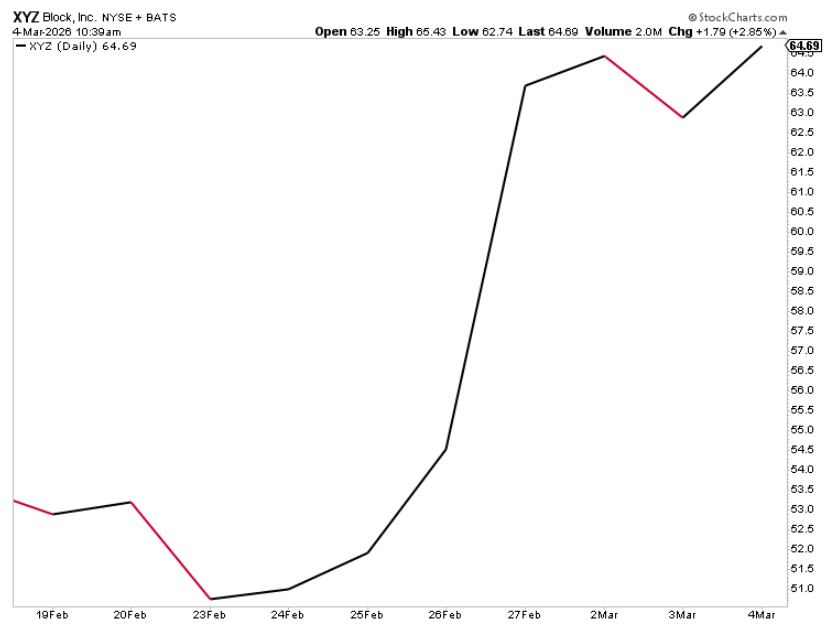
While the geopolitical implications of AI are unfolding in the defense sector, the private sector has begun a significant restructuring of the labor market. Block Inc., the fintech conglomerate led by Jack Dorsey, recently announced a reduction of approximately 40% of its workforce. Unlike traditional layoffs driven by financial distress, this maneuver was framed as a strategic pivot toward AI-driven efficiency. Internal documentation from the firm indicated that automated agents and AI systems would absorb the responsibilities previously held by human employees.
This event represents a shift in corporate behavior: the "ambition-based layoff." In this new model, workforce reductions are presented to shareholders not as a sign of weakness, but as a commitment to margin expansion and technological optimization. The market response to Block’s announcement—a notable increase in stock valuation—suggests that investors are increasingly rewarding companies that replace human overhead with scalable software.
Block is not an isolated case. Several high-profile technology firms have recently adjusted their headcounts to prioritize AI integration:

- Klarna: The Swedish fintech firm reported that its AI assistant is now performing the work equivalent to 700 full-time customer service agents.
- Duolingo: The language-learning platform reduced its contractor workforce as it shifted toward generative AI for content creation.
- Atlassian: The software giant eliminated approximately 1,600 roles while simultaneously increasing investment in AI-driven product features.
These actions align with data suggesting that millions of white-collar "knowledge worker" roles are at high risk of exposure to automation within the next decade.
The Disruption of Legacy Software-as-a-Service (SaaS) Models
The "Overautomation" force of the CHAOS spiral is also manifesting in the public markets through the aggressive repricing of legacy Software-as-a-Service (SaaS) companies. Historically, firms like Salesforce (CRM), Adobe (ADBE), and Intuit (INTU) were considered "blue-chip" technology investments due to their high switching costs and recurring revenue models. However, the advent of commoditized intelligence is challenging the fundamental value proposition of these platforms.
The market is currently evaluating a "deflationary tsunami" in the software sector. If an AI agent can autonomously manage customer interactions, log data, and forecast sales pipelines in real-time, the necessity of paying high annual per-seat licensing fees for traditional CRM platforms diminishes. Similarly, generative AI tools that can replicate complex creative tasks or automate tax preparation threaten the "moats" of Adobe and Intuit. When the marginal cost of producing software capability collapses toward zero, companies that package and sell specific versions of that intelligence face significant margin compression. This transition suggests a massive wealth rotation away from legacy software incumbents and toward the providers of the foundational "AI stack"—the chips, data centers, and large language models that power the new automation.
Currency Hollowing and the Monetary Response
The second pillar of CHAOS Economics is "Currency Hollowing," a process driven by the intersection of structural unemployment and fiscal policy. As AI-driven automation reduces the need for human labor, the resulting "Engels’ Pause"—a period where productivity and GDP grow while wages stagnate—is expected to create immense political pressure for government intervention.
Historically, the default policy response to large-scale economic disruption has been the expansion of the monetary base. Whether through direct stimulus, expanded social safety nets, or "Universal Basic Income" (UBI) experiments, the financing of these programs typically requires increased government borrowing and central bank intervention. With the U.S. federal deficit already at historic levels, further money printing risks a significant devaluation of the dollar.
In this environment, a distinct divergence occurs:
- Asset Inflation: The influx of new currency flows into scarce assets, including real estate, equities of AI-owning corporations, and physical commodities, driving their prices higher.
- Purchasing Power Erosion: Individuals who rely on fixed wages or cash savings find their relative wealth dwindling as the cost of living outpaces wage growth in an automated economy.
Chronology of the CHAOS Inflection Points
The progression of this economic theory into reality can be traced through several key milestones over the past year:
- Q3 2023: Initial introduction of the CHAOS Economics framework as a theoretical model for the 2020s.
- Q4 2023: Deployment of AI-integrated systems in regional conflicts, confirming the "national security" status of the technology.
- January 2024: Publication of labor market data identifying over 5 million high-risk white-collar roles in the U.S. financial and tech sectors.
- February 2024: Block Inc. executes a 40% workforce reduction citing AI-driven optimization, setting a precedent for the "efficiency layoff."
- March 2024: Broad market sell-off in legacy SaaS stocks as investors pivot toward infrastructure and physical layer assets.
- April 2026 (Projected): A anticipated "market shock" driven by capacity constraints in the physical infrastructure (energy and hardware) required to sustain AI growth.
The Shift Toward Physical Scarcity and "Golden Rivets"
As the digital layer of the economy becomes increasingly saturated with AI-generated abundance, economic value is migrating back to the physical world. This transition highlights the necessity of "Golden Rivets"—the irreplaceable physical inputs required for the digital revolution to function.
The infrastructure supporting the AI revolution requires unprecedented amounts of reliable baseload power. Data centers are projected to consume a growing percentage of global electricity, leading to a renewed interest in nuclear energy and utility infrastructure. Furthermore, the hardware requirements for AI training and inference have created a bottleneck in the supply of specialized semiconductors and high-bandwidth memory (DRAM).
Investors are increasingly focusing on:
- Energy Producers: Specifically those capable of providing 24/7 power to massive data center clusters.
- Raw Materials: Copper and other industrial metals essential for electrical grid expansion and hardware manufacturing.
- Hardware Infrastructure: Companies like Nvidia (NVDA), AMD, and Taiwan Semiconductor (TSM), which are now viewed as "dual-use" assets critical to both economic growth and national defense.
Broader Implications for Global Stability
The long-term implications of CHAOS Economics extend beyond portfolio management. The potential for a "hollowed-out" middle class poses significant risks to social cohesion and political stability. If the gains from AI productivity are concentrated among a small group of technology owners while the broader population faces labor displacement and currency devaluation, the resulting inequality could lead to radical shifts in governance and social contracts.
Furthermore, the integration of AI into military and national security frameworks ensures that the technological race will continue unabated, regardless of the domestic economic consequences. This creates a feedback loop where the need for national security drives automation, automation drives labor displacement, and labor displacement drives currency devaluation.
In summary, the CHAOS spiral is no longer a speculative theory but a present economic condition. The evidence from corporate boardrooms, geopolitical theaters, and stock market repricing suggests that the transition to an AI-dominated, currency-devalued economy is accelerating. For market participants and policymakers alike, the window to adapt to this new reality is narrowing, as the "Golden Rivets" of the physical world become the ultimate hedge against the volatility of the digital and monetary layers.