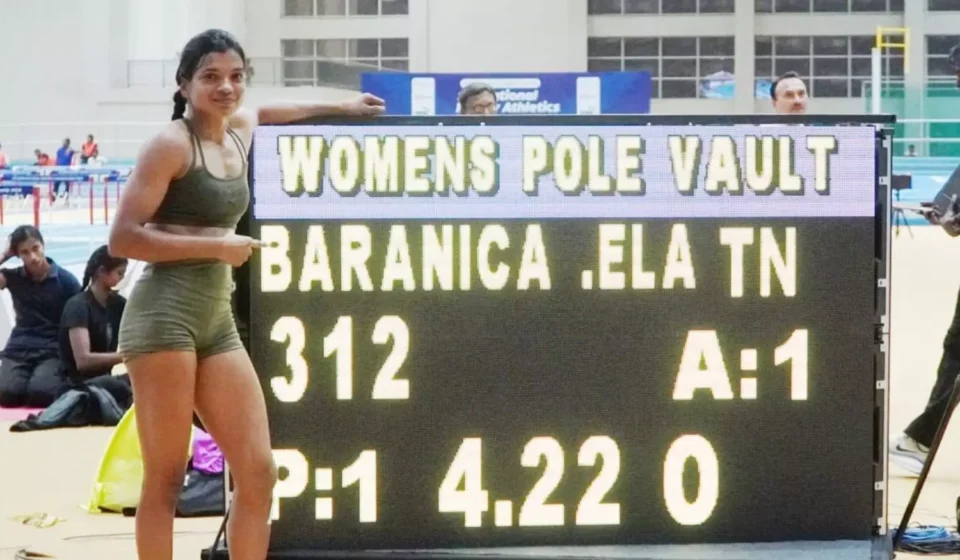
Baranica Elangovan Sets New National Record as Inaugural National Indoor Athletics Championships Commence in Style

The landscape of Indian track and field witnessed a historic milestone on Tuesday as the first-ever National Indoor Athletics Championships kicked off, headlined by a sensational record-breaking performance in the women’s pole vault. Baranica Elangovan, representing Tamil Nadu, etched her name into the annals of Indian sporting history by clearing a height of 4.22m, surpassing the previous national indoor mark and signaling a new era for technical disciplines in the country. The opening day of the championships was not merely a showcase of individual brilliance but a structural shift for the Athletics Federation of India (AFI), as it officially integrated indoor competition into the national calendar to align with global standards.
Baranica’s performance was the focal point of a day filled with high-intensity competition and unexpected results. Entering the competition with a clear focus on the 4.20m barrier—a height that has often proved elusive for Indian vaulters in indoor settings—she displayed remarkable composure. Her successful clearance of 4.22m bettered the previous record of 4.21m, which had been held by Rosy Meena Paulraj. Following her record-breaking vault, Baranica attempted to push the envelope further by setting the bar at 4.25m. While she was unable to clear the height in her three allotted attempts, the achievement of the national record provided a significant boost to her standing in the continental rankings.
Speaking after her victory, Baranica expressed a sense of relief and triumph. She noted that she had been working specifically on her approach and plant to handle the unique constraints of an indoor arena, where the lack of wind and controlled temperature can both aid and challenge an athlete accustomed to outdoor conditions. "It is a great day for me to enter my name in the record books," Baranica stated. "I’ve been trying hard to cross the 4.20m mark in the past, and today turned out to be the day everything clicked. While the 4.25m attempt didn’t go through, the confidence gained here is immense."
A Technical Evolution: The Significance of Indoor Competition
The launch of the National Indoor Athletics Championships represents a strategic move by Indian sports administrators. For decades, Indian athletes have primarily focused on the outdoor season, which typically runs from March to October. However, the global athletics circuit, particularly in Europe and North America, relies heavily on the indoor season (January to March) to maintain athlete rhythm and secure qualifications for major events like the World Indoor Championships and the Asian Indoor Athletics Championships.
Indoor athletics differs significantly from its outdoor counterpart. The standard track is 200 meters long with banked curves, as opposed to the 400-meter flat outdoor track. This requires middle-distance runners to adjust their pacing and cornering techniques. For field athletes, particularly in the pole vault and long jump, the indoor environment eliminates the variable of wind resistance, allowing for a pure test of technique and explosive power. Baranica’s record and the fast times in the 800m suggest that Indian athletes are adapting quickly to these nuances.
Middle Distance Dominance: Mohammed Afsal’s Record Run
While Baranica dominated the field events, Mohammed Afsal of the Air Force delivered a masterclass on the track. Competing in the men’s 800m, Afsal clocked a blistering 1:47.86s to set a new indoor national record. The race was a tactical demonstration of indoor running; Afsal took the lead early and managed the tight curves of the indoor circuit with precision. His time is particularly noteworthy as it places him among the top contenders for the upcoming Asian Indoor Championships.
Afsal’s performance was followed by Kalyan JR of Karnataka (1:53.98s) and Sayan Karmakar of West Bengal (1:56.98s). The gap between Afsal and the rest of the field highlighted his current form and the benefits of his specialized training regimen. In the U20 category, Lokesh Magendhiran of Tamil Nadu also showed great promise, winning the 800m in 1:53.92s, a time that would have placed him second in the senior category, marking him as a talent to watch for the future.
The Long Jump Duel: Payasingh Upsets Chithravel
One of the most anticipated events of the day was the men’s long jump, which featured a high-profile clash between Sarun Payasingh and the versatile Praveen Chithravel. Chithravel, primarily known for his exploits in the triple jump where he has achieved international acclaim, was testing his speed and explosive power in the long jump pit.
However, it was the 25-year-old Sarun Payasingh from Odisha who stole the spotlight. Payasingh produced a personal best leap of 7.80m to clinch the gold medal. The competition was incredibly tight, with Chithravel finishing just two centimeters behind at 7.78m. David P of Railway claimed the bronze with a jump of 7.69m. The duel between Payasingh and Chithravel underscored the rising depth in Indian jumping events, where domestic competition is now mirroring the intensity of international finals.
Comprehensive Day 1 Results and Data
The opening day saw a total of 12 finals across senior and U20 categories. The results reflected a wide geographical distribution of talent, with athletes from Karnataka, Odisha, Tamil Nadu, and Kerala featuring prominently on the podium.
Men’s Results
- 800m: Mohammed Afsal (Air Force) secured gold with a record 1:47.86s. Kalyan JR (Karnataka) took silver in 1:53.98s, followed by Sayan Karmakar (West Bengal) at 1:56.98s.
- 3,000m: Shivaji Parashuram (Reliance) displayed exceptional endurance to win in 8:09.88s. Vinod Singh (Madhya Pradesh) took second (8:16.93s), and Rahul Kumar Verma (Chhattisgarh) finished third (8:18.21s).
- 60m Hurdles: Krishik M of Karnataka dominated the sprint hurdles with a time of 7.71s. Rathish P (Reliance) followed in 7.84s, and Muhammed Lazan (JSW) took bronze in 8.00s.
- Long Jump: Sarun Payasingh (Odisha) took gold (7.80m), Praveen Chithravel (JSW) silver (7.78m), and David P (Railway) bronze (7.69m).
- Shot Put: Ravi Kumar (BSF) launched a throw of 17.17m to win gold. Adhish Ghildiyal (Uttarakhand) took silver with 16.92m, and Balaji (Tamil Nadu) earned bronze with 16.74m.
Women’s Results
- 3,000m: Priyanka C (Karnataka) clocked 9:42.05s to take the title. Kajal Rangnath (Gujarat) was close behind at 9:44.01s, while Sushmita Tigga (Odisha) finished in 10:22.30s.
- Shot Put: Rekha (NCOE Patiala) led the field with a 15.63m throw. Mayuri Arade (Karnataka) finished second with 9.15m.
- Pole Vault: Baranica Elangovan (Tamil Nadu) set the record at 4.22m. Blessy Kunjumon (Kerala) took silver (3.95m), and Mariya Jaison (Kerala) took bronze (3.80m).
- Long Jump: Anamika KA (JSW) won a tightly contested final with 6.05m, narrowly beating Manisha Merel (Odisha) who jumped 6.04m. Sherin A (JSW) finished third with 5.92m.
U20 Highlights
The junior categories provided a glimpse into the pipeline of Indian athletics. In the Men’s U20 Shot Put, Ommkar Prasad Nand of Odisha delivered a standout performance with a throw of 17.77m, outperforming many of his senior counterparts. In the Women’s U20 Shot Put, Dona Maria of Kerala took gold with 13.35m.
Implications for the International Calendar
The timings and distances recorded on Day 1 have significant implications for India’s international aspirations. With the Asian Indoor Athletics Championships approaching, the AFI will use these results to finalize the national squad. Historically, India has performed well at the Asian level in indoor competitions, but the lack of a domestic indoor championship often meant that athletes were selected based on outdoor performances, which do not always translate perfectly to the indoor environment.
By establishing this championship, the AFI is providing athletes with the specific competitive experience needed to handle the "boards" (the wooden-based indoor tracks). Furthermore, the national records set by Baranica and Afsal will likely meet the qualification standards for upcoming global meets, ensuring that India has a robust presence on the world stage.
Analysis: The Road Ahead
The success of the inaugural day suggests that indoor athletics has a bright future in India. The controlled environment of an indoor stadium allows for high-quality broadcasting and a more intimate spectator experience, which could attract more commercial interest to the sport. From a performance standpoint, the ability to compete in the winter months ensures that athletes do not suffer from a "competitive lull," keeping their bodies primed for the outdoor season that follows.
As the championships continue, the focus will shift to the sprint events and the high jump, where more records are expected to fall. The performance of the U20 athletes also suggests that the next generation is being trained with indoor technicalities in mind, which will be crucial as India seeks to become a more well-rounded powerhouse in global athletics.
The first day of the National Indoor Athletics Championships has done more than just crown winners; it has validated the necessity of indoor infrastructure in India. With Baranica Elangovan and Mohammed Afsal leading the charge, the message is clear: Indian athletics is no longer confined by the seasons or the traditional 400-meter track. The quest for excellence has moved indoors, and the results are already rewriting the history books.