CrankGPT: A Hand-Powered Chatbot Championing Sustainable and Private AI at the Edge

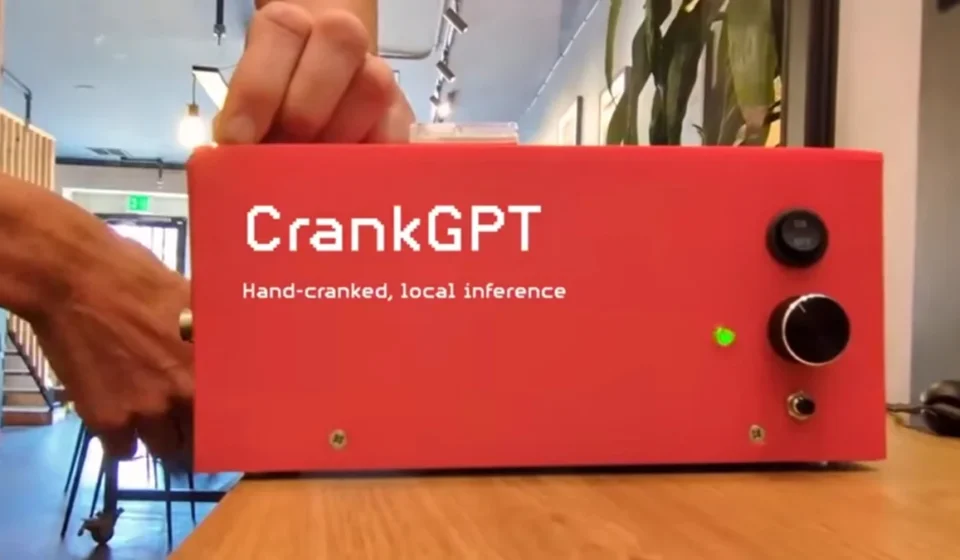
The rapid proliferation of generative artificial intelligence tools, from ubiquitous platforms like ChatGPT and Google Gemini to a host of specialized chatbots, has fundamentally reshaped digital interaction and workflow across countless industries. As these sophisticated AI models become increasingly embedded in modern life, the escalating demand for their computational power concurrently intensifies the strain on natural resources. In a notable departure from the prevailing trend of energy-intensive cloud-based AI, Squeez Labs, a Europe-based innovation company, has unveiled a compelling concept: CrankGPT. This pioneering chatbot aims to redefine generative AI by making it remarkably cost-effective, significantly less resource-intensive, and inherently private, all powered by the simple, tactile action of a hand crank.
The innovation arrives at a critical juncture for the technology sector, as global conversations increasingly focus on the environmental footprint of digital technologies. While the benefits of AI are undeniable, the colossal energy consumption associated with training and operating large language models (LLMs) has become a subject of growing concern among environmentalists, policymakers, and even within the tech community itself. CrankGPT directly confronts this challenge, proposing an alternative paradigm for AI accessibility and sustainability.
The Genesis of CrankGPT: A Response to AI’s Growing Footprint
The development of CrankGPT is best understood within the broader context of AI’s explosive growth and the subsequent scrutiny of its ecological impact. Over the past decade, advancements in machine learning, particularly deep learning, have led to the creation of increasingly complex neural networks. Large Language Models, capable of understanding, generating, and translating human language with unprecedented fluency, are at the forefront of this revolution. Companies like OpenAI, Google, Microsoft, and Meta have invested billions in developing and deploying these models, making them accessible to millions worldwide.
However, the computational resources required for these operations are staggering. Training a single large language model, such as OpenAI’s GPT-3, has been estimated to consume energy equivalent to what several European households use in a year, emitting hundreds of tons of carbon dioxide. This includes the energy for the massive data centers housing thousands of GPUs, as well as the intricate cooling systems necessary to prevent overheating. Even inference – the process of using a trained model to generate responses – when performed at scale for millions of users, contributes significantly to global energy consumption. For instance, a single query to a large cloud-based AI model might seem negligible, but aggregated over billions of interactions daily, the energy drain becomes immense.
Against this backdrop, Squeez Labs articulated a philosophical stance rooted in European sensibilities for efficiency and practicality, likening the prevailing AI trend to "throwing kilowatts and thousands of tokens at tasks small models could accomplish just as well as huge ones, for a fraction of the cost and energy." This sentiment underscores a growing movement towards "green AI" and "edge AI," where the focus shifts from ever-larger, cloud-centric models to more efficient, localized solutions. The motivation behind CrankGPT, therefore, is not merely to create a novel gadget but to serve as a tangible proof-of-concept for a more responsible and sustainable approach to artificial intelligence. It represents an experimental but potent counter-narrative to the prevailing "bigger is better" ethos in AI development.
Technical Deep Dive: How CrankGPT Works
At its core, CrankGPT is a testament to minimalist engineering applied to cutting-edge technology. The device, encased in a compact box, operates entirely without a battery, drawing all its operational power from a manually operated hand crank. This innovative power source feeds a 20W hand-crank generator, which in turn energizes a stock Raspberry Pi 5 with 8GB of RAM. The choice of the Raspberry Pi 5 is crucial. This single-board computer, renowned for its versatility, relatively low power consumption, and surprising computational prowess for its size, serves as the brain of the CrankGPT. Its 8GB RAM variant is capable of handling moderately complex tasks and running smaller AI models locally, making it an ideal candidate for an embedded AI solution.
The operational sequence is straightforward yet ingenious: a user speaks a query, the device recognizes the speech, processes it using a local language model, and then delivers the answer via speech synthesis. For the speech synthesis component, CrankGPT utilizes the Piper voice model, known for its efficiency and ability to run effectively on edge devices.
A critical aspect of CrankGPT’s design is its reliance on "small models." Unlike the multi-billion parameter LLMs that dominate the cloud, CrankGPT is optimized for more compact variants, such as the 350M and 1.2B versions of Liquid AI LFM2, or the 1B parameter Gemma model. These models, while less expansive than their larger counterparts, are specifically engineered for efficiency and can perform a surprising range of tasks effectively when fine-tuned for specific applications. Their smaller footprint allows them to reside entirely on the device, eliminating the need for constant data transmission to and from remote servers. This local processing capability is fundamental to CrankGPT’s energy efficiency and privacy features.
While the device’s operational noise is a recognized characteristic – "anything but quiet," as observed by its creators – it is presented as a minor trade-off for the significant benefits of privacy and energy efficiency. The developers have also incorporated a cooling fan to manage internal temperatures, acknowledging that simultaneous operations, particularly LLM inference and speech synthesis, can generate considerable heat and make the crank "a lot harder to turn." This detail highlights the real-world engineering challenges involved in creating a fully self-contained, manually powered AI system. The current iteration of CrankGPT is reportedly best suited for "small, everyday queries," performing admirably for basic questions but struggling with more complex tasks like generating images, poetry, or intricate code, which typically demand much larger models and greater computational overhead.
The Environmental and Ethical Imperative: Addressing AI’s Carbon Cost
The development of CrankGPT brings into sharp focus the increasingly urgent need to address the environmental impact of artificial intelligence. The sheer scale of data centers required to power the global AI infrastructure is astronomical. These facilities not only consume vast amounts of electricity – often sourced from fossil fuels – but also demand significant quantities of water for cooling and contribute to electronic waste (e-waste) as hardware rapidly becomes obsolete.
Estimates vary, but some studies suggest that the carbon footprint of training a single large LLM can be equivalent to the lifetime emissions of multiple cars, reaching hundreds of thousands of pounds of CO2 equivalent. This figure doesn’t even account for the ongoing energy demands of inference, which, as AI becomes pervasive, could far surpass the energy required for training over the long term. Beyond carbon emissions, the water footprint of data centers is also a growing concern, with facilities in arid regions placing additional strain on local resources.
CrankGPT offers a compelling counter-narrative to this resource-intensive model. By demonstrating that functional AI can operate entirely off-grid, with minimal external energy input, it serves as a powerful symbol for the "green AI" movement. This movement advocates for research and development into more energy-efficient algorithms, hardware, and deployment strategies. While the training of even small AI models still carries an environmental cost, the local, hand-cranked inference model of CrankGPT drastically reduces the energy consumption at the user end, potentially inspiring broader shifts in how AI is deployed and consumed. It forces a re-evaluation of whether every AI interaction truly requires the might of a global data center.
Privacy and Control: The Local AI Advantage
Beyond its environmental benefits, CrankGPT champions another critical aspect of responsible AI: user privacy and control. In an era dominated by cloud-based AI services, users often relinquish significant control over their data. Every query submitted to a cloud chatbot is transmitted to remote servers, processed, and then returned. This process inevitably involves data collection, storage, and potential exposure to various third parties, raising legitimate concerns about surveillance, data breaches, and the commodification of personal information.
CrankGPT, by contrast, operates on a "fully local model." This means that all processing – from speech recognition to LLM inference and speech synthesis – occurs directly on the device. No data leaves the box, and no internet connection is required. This fundamental design choice ensures that user interactions remain entirely private and under their direct control. For individuals and organizations concerned about data sovereignty, confidentiality, or operating in environments with unreliable or non-existent internet access, CrankGPT offers a robust solution.
The implications for sensitive applications are significant. Imagine healthcare professionals needing to query an AI without compromising patient data, or journalists in high-risk areas needing secure information retrieval. Furthermore, the absence of an internet connection makes the device immune to network outages, censorship, or external interference, providing a level of resilience that cloud-based solutions cannot match. CrankGPT thus stands as a practical embodiment of the decentralized AI paradigm, challenging the notion that advanced intelligence must always reside in the cloud.
Statements and Reactions: Squeez Labs’ Vision and Industry Outlook
Squeez Labs’ explicit statement regarding their "European small-practical-car sensibilities" is not merely an aesthetic preference but a foundational principle guiding CrankGPT’s design. It reflects a cultural emphasis on efficiency, sustainability, and thoughtful resource management, often seen in European engineering and design philosophy. The company’s decision to pursue such a concept can be interpreted as a proactive challenge to the tech industry to rethink its AI development trajectory.
While CrankGPT remains a concept, available for demo requests but without immediate information on a broader launch or price tag, its unveiling has resonated within specific segments of the tech and environmental communities. Tech enthusiasts often laud such projects for their ingenuity and demonstration of alternative possibilities. Environmental advocates are likely to view CrankGPT as a significant step towards practical, sustainable technology, offering a tangible example of how AI can be developed with ecological considerations at the forefront. For mainstream AI developers, it serves as a powerful reminder that performance is not the only metric; efficiency, accessibility, and environmental responsibility are equally vital, especially as AI permeates more aspects of daily life.
The project also implicitly encourages a broader discussion on the role of open-source hardware and software in fostering innovation. While Squeez Labs has not yet indicated plans for open-sourcing the design, the spirit of such a project aligns well with community-driven development that could further refine and democratize access to such sustainable AI solutions. The current status as a demo product allows for gathering feedback and gauging interest, which could inform future development, whether as a niche product or an inspiration for more widely adopted technologies.
Broader Implications: The Future of Edge AI and Sustainable Technology
CrankGPT, regardless of its commercial viability, represents a significant milestone in the evolving narrative of artificial intelligence. It serves as a potent harbinger of a future where AI is not exclusively confined to vast, energy-hungry data centers but can operate intelligently and autonomously at the edge, directly within user devices. This trend towards edge computing is already gaining momentum, driven by demands for lower latency, enhanced privacy, and reduced bandwidth consumption in applications ranging from smart home devices to industrial IoT. CrankGPT pushes this concept further by demonstrating complete energy independence.
The potential applications for such a device, or the principles it embodies, are diverse and impactful. In off-grid scenarios, disaster relief efforts, or remote educational settings, a hand-cranked, local AI could provide vital information, communication, or learning assistance without relying on external infrastructure. It could empower communities with limited access to reliable electricity or internet connectivity, bridging the digital divide in a sustainable manner.
Moreover, CrankGPT contributes to the ongoing quest for "AI for good" and responsible AI development. It highlights the importance of designing AI systems not just for intelligence and capability, but also for resilience, fairness, and environmental stewardship. The project underscores the idea that hardware innovation is as crucial as algorithmic advancements in shaping AI’s trajectory. By prompting a re-evaluation of AI’s power demands, CrankGPT encourages researchers and engineers to explore novel architectures, more efficient algorithms, and alternative energy sources for AI applications.
In conclusion, CrankGPT stands as more than just a clever gadget; it is a profound statement on the future direction of AI. While the challenge of making AI model training itself less resource-intensive remains a significant hurdle, the Squeez Labs concept vividly illustrates that the inference stage can be radically decentralized, democratized, and de-carbonized. As artificial intelligence continues its inexorable march into every facet of our existence, for better or worse, pioneering solutions like CrankGPT could very well be the spark that ignites a new era of truly sustainable, private, and accessible AI for all.