
Wall Street Earnings Projections Signal Robust Market Momentum Driven by AI Infrastructure Expansion and Domestic Economic Resilience

The United States equity markets are entering a pivotal phase as the second half of the year commences, characterized by a convergence of high-growth technology investment and surprisingly resilient macroeconomic indicators. Despite recent periods of heightened volatility triggered by geopolitical tensions in the Middle East and rapid fluctuations within the artificial intelligence (AI) sector, a broader analysis of corporate fundamentals suggests that the market is positioned for a significant period of earnings acceleration. Financial analysts and institutional investors are increasingly focusing on the upcoming earnings season, which many anticipate will mirror the transformative growth patterns observed during the late 20th-century technological expansion.
Historical Context and the Evolution of Technological Awe
The current market sentiment, often described as a mix of apprehension and wonder regarding the capabilities of generative AI, finds a historical parallel in the accounts of 13th-century explorers. Historical narratives recount the experience of European travelers, such as Marco Polo, encountering the early Chinese development of pyrotechnics. To observers of that era, the sight of gunpowder-packed bamboo and fire arrows was indistinguishable from magic. This technological leap represented centuries of refinement, evolving from simple combustible materials to complex devices used for both ceremonial and strategic purposes.
In the modern financial landscape, the "magic" of the 13th century has been replaced by the "magic" of large language models and high-performance computing. Just as early fireworks signaled a shift in chemical engineering and military technology, the current surge in AI investment signals a fundamental restructuring of global productivity. While historians may debate the specific details of ancient chronicles, the economic impact of today’s technological "fireworks" is becoming increasingly quantifiable through corporate balance sheets and capital expenditure reports.
Macroeconomic Resilience: The "Economic Oasis"
The United States economy has demonstrated a level of durability that many economists find notable relative to global peers. In the first quarter of the current fiscal year, Gross Domestic Product (GDP) grew at an annual rate of 2.1%. Although growth showed signs of a temporary cooling in the second quarter, leading indicators suggest a significant reacceleration is underway. Projections for the third quarter and the latter half of 2024 indicate that GDP growth could reach or exceed an annual pace of 5%, driven by robust consumer spending and a surge in industrial investment.
Several factors contribute to this "economic oasis" status. While the Eurozone has grappled with stagnant growth and China faces ongoing challenges in its property sector, the U.S. has benefited from a unique combination of fiscal stimulus effects, a tight labor market, and a leadership position in the global technology race. Furthermore, the anticipated productivity gains from AI integration are expected to act as a deflationary force over the long term, allowing for continued growth without the immediate pressure of runaway inflation.

Comparative Market Performance and the 1999 Parallel
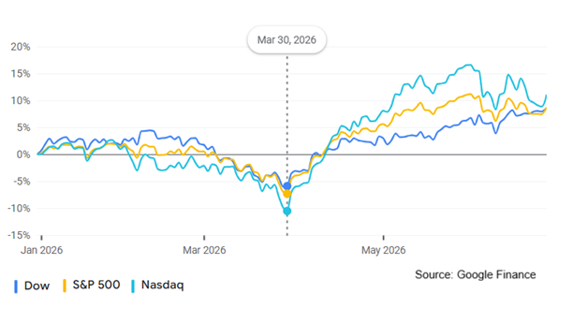
The performance of major indices in the first half of the year provides a statistical foundation for the current optimistic outlook. The second quarter represented the strongest performance for the NASDAQ and the S&P 500 in six years. During this period, the S&P 500 recorded a 15% rally, while the Dow Jones Industrial Average climbed 13%. The tech-heavy NASDAQ led the pack with a 21% surge, a figure matched by the small-cap Russell 2000, indicating that the rally began to broaden beyond just the "Magnificent Seven" tech giants.
Market historians frequently compare the current environment to 1999. During that era, the buildout of the internet infrastructure unleashed a massive wave of business investment and corporate profit growth. However, analysts point out a key distinction: whereas the 1999 boom was often fueled by speculative fervor and companies with limited revenue, the current AI boom is backed by companies with massive cash reserves and tangible earnings. The "AI buildout" is currently estimated to involve approximately $750 billion in capital expenditures this year alone, as firms race to secure the semiconductors, data centers, and energy infrastructure required to power the next generation of computing.
The Earnings Surprise Phenomenon
The most critical catalyst for the current market trajectory is the disparity between analyst expectations and actual corporate performance. During the first-quarter earnings season, initial consensus estimates suggested an average earnings growth of 13% for the S&P 500. However, the final aggregated result reached 28.6%, as a wide array of companies across various sectors reported significant positive surprises.
As the second-quarter results begin to materialize, FactSet data indicates that analysts are projecting S&P 500 earnings growth of approximately 24.7%. Given the historical trend of conservative forecasting, market experts suggest that actual growth could once again exceed 30%. This "earnings gap" is significant because it forces institutional investors to recalibrate their valuation models. When a company beats earnings estimates and subsequently raises its forward-looking guidance, it typically triggers a wave of institutional buying as funds adjust their portfolios to account for the improved fundamental outlook.
Sector Rotation and the Impact of Geopolitics
While the overarching trend remains bullish, the market has not been without its "queasy" moments. Sharp swings in AI and data center stocks have tested investor resolve, often exacerbated by headlines regarding geopolitical instability, particularly involving Iran and the broader Middle East. These events have historically led to short-term "risk-off" sentiment, where capital flows out of equities and into perceived safe havens like gold or Treasury bonds.
However, the resilience of the current market is evidenced by the speed at which it has recovered from these shocks. The underlying "buying pressure" remains high, particularly for companies that demonstrate "fundamentally superior" traits. This includes strong sales growth, expanding profit margins, and a dominant position within their respective niches. The recent volatility is viewed by many professional traders not as a sign of a market peak, but as a necessary "digestion" of gains before the next leg of the rally.
The Role of "Precursor Intelligence" in Modern Investing
In an environment where information moves at the speed of light, the challenge for investors is identifying market leaders before their success becomes common knowledge. This has led to the development of sophisticated quantitative systems, such as "Precursor Intelligence," designed to track early signals of accelerating sales and institutional accumulation.
These systems focus on several key metrics:
- Accelerating Sales and Earnings: Identifying the inflection point where a company’s growth rate begins to outpace historical norms.
- Institutional Buying Pressure: Tracking large-block trades that indicate pension funds, endowments, and mutual funds are establishing significant positions.
- Revision Trends: Monitoring how often and how aggressively analysts are raising their price targets and earnings estimates.
The goal of such systematic approaches is to move away from speculative "chasing" of stocks that have already peaked and instead focus on companies whose "growth stories" are still in the early stages of development.
Broader Implications and Future Outlook
Looking toward the end of 2024 and into 2025, the convergence of economic strength and technological innovation suggests a sustained period of market expansion. The AI buildout is not merely a tech-sector event; it has profound implications for the energy sector (as data centers require massive amounts of power), the real estate sector (demand for specialized facilities), and the industrial sector (manufacturing of hardware and cooling systems).
The "fireworks" expected in the coming months are likely to be driven by these cross-sector synergies. As corporate profits continue to accelerate, the foundation of the stock market appears increasingly solid. Investors are encouraged to look past short-term trading "gyrations" and focus on the structural shifts occurring within the global economy. The transition from a speculative AI narrative to a fundamental earnings reality marks a new chapter in the post-pandemic economic recovery, one that promises to deliver substantial rewards for those aligned with the market’s strongest growth drivers.
In conclusion, while the night sky of the financial markets may occasionally be clouded by geopolitical smoke or volatility sparks, the underlying trajectory of corporate earnings suggests that a spectacular display of growth is only just beginning. The focus remains on identifying the next wave of earnings leaders who will define the market’s performance in the years to come.