The Strategic Framework for Scaling Global Influencer Marketing and Multi-Market Creator Operations

Influencer marketing has transitioned from an experimental line item to a fundamental pillar of global consumer brand infrastructure, with recent data from the World Federation of Advertisers (WFA) indicating that 99% of surveyed multinational brands now integrate creators into their marketing mix. As the medium matures, the challenge for Chief Marketing Officers (CMOs) has shifted from proving the efficacy of influencer partnerships to managing the immense operational complexity of executing these campaigns across diverse geographical and cultural landscapes. Currently, 66% of major brands deploy influencer strategies frequently across multiple markets, and 60% have established dedicated influencer marketing budgets. This professionalization is further evidenced by the fact that 79% of brands working with external partners now opt for specialist influencer agencies over generalist firms.
The rapid institutionalization of creator marketing has created a new set of management hurdles. A global brand operating across dozens of countries must synchronize strategy, creator selection, budgeting, measurement, and brand standards while remaining sensitive to local cultural nuances and varying platform behaviors. Each additional market introduces a new layer of decision-making regarding contracting, usage rights, and reporting. Industry leaders have found that the most successful programs address these challenges through a centralized operating model that balances global strategic frameworks with local execution. In this model, global teams establish measurement standards and strategic goals, while local teams translate those frameworks into culturally relevant content. Performance data then flows back into a unified system, allowing leadership to compare market performance and refine investment decisions.
The Evolution of the Global Influencer Landscape
To understand the current state of multi-market creator marketing, it is necessary to look at the chronology of its development. Between 2018 and 2020, influencer marketing was largely treated as a tactical, campaign-by-campaign endeavor. During this period, only 29% of multinational brands engaged in extended, long-term relationships with creators. However, the global pandemic accelerated digital transformation, pushing social media to the center of the consumer journey. By 2024, the percentage of brands favoring extended relationships rose to 40%, with 38% of brands now working with influencers on an "always-on" basis.
This shift toward long-term partnerships reflects a broader realization within the industry: sustained relationships yield richer performance data and stronger brand affinity. However, this evolution has also exposed structural weaknesses in how international programs are managed. Many programs suffer from fragmentation as they scale. A campaign that succeeds in a single market may fail to generate global value if local teams use inconsistent creator-selection criteria or if reporting frameworks vary by region. According to research from WFA and Ebiquity, while 80% of advertisers utilize marketing mix modeling (MMM) and brand lift studies, only 13% believe they are capable of moving quickly from data to actionable insight. Furthermore, fewer than 3% of marketers feel fully confident in their ability to distinguish between short-term performance and long-term brand-building impact.
Addressing Structural Fragmentation in Multi-Country Programs
The breakdown of international influencer programs typically stems from three primary issues: unclear accountability, weak coordination between headquarters and local offices, and fragmented measurement systems. When accountability is poorly defined, the speed and quality of decision-making suffer. Creator marketing is inherently dependent on local knowledge; teams on the ground understand which creators are rising in relevance and how local audiences interpret specific content styles. If a global team does not have a clear process for who evaluates cultural fit or who approves creator shortlists, the resulting "hand-off" delays can lead to missed trends and inefficient spend.
Furthermore, a study of 56 major companies representing $52 billion in annual media spend found significant capability gaps in multinational marketing organizations. Only 25% of respondents felt they possessed the necessary resources and capabilities to manage global media effectively, while 26% cited a lack of adequate technological infrastructure. For influencer marketing, this means that a global strategy must be supported by a deliberate "decision architecture" that specifies which rights belong to headquarters and which belong to local markets.
The Four Pillars of a Scalable Global Model
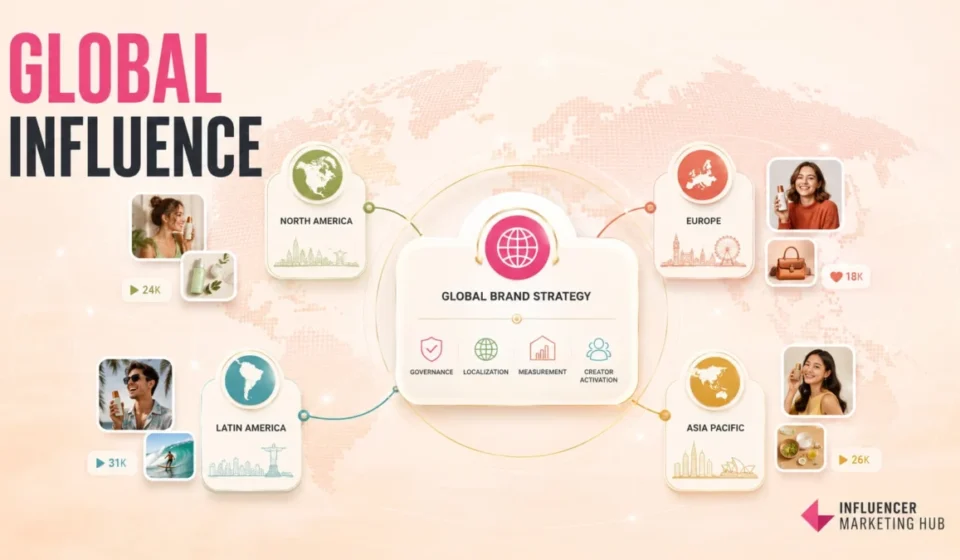
To overcome these structural barriers, enterprise-level brands are increasingly adopting a four-pillar approach to scalability:
1. Embedded Local-Market Expertise
While AI-driven discovery tools can identify creators based on demographics and engagement rates, they cannot replace the context provided by local specialists. These experts understand the "creator ecosystem" of a specific country—how a creator’s pricing compares to their peers, whether their content style aligns with local social norms, and how they are perceived by the target audience. For example, a creator viewed as an aspirational figure in one market might be seen as inauthentic in another. Establishing clear ownership for discovery and cultural validation in each priority market transforms local knowledge into a repeatable operational asset.
![How Global Consumer Brands Should Structure Influencer Marketing in 2026 [+ Free Checklist]](https://influencermarketinghub.com/wp-content/uploads/2026/07/27e78c49-chatgpt-image-jul-29-2026-02_47_11-pm.jpg)
2. Centralized Strategy with Distributed Execution
The most effective global programs maintain strategic consistency while allowing for local flexibility. Global teams typically retain control over brand positioning, creative platforms, measurement methodologies, and budget governance. Local teams, conversely, shape the platform mix, language, and content execution. This ensures the campaign retains a unified strategic identity while adapting to the realities of each market. A formal governance model is essential to clarify these roles before execution begins, covering areas such as creator approval, local messaging, and optimization.
3. Cross-Market Measurement Infrastructure
A global dashboard is only as effective as the data feeding into it. Standardization is required across several layers:
- Business Impact: Incremental revenue, sales lift, and return on influencer investment (ROII).
- Brand Health: Awareness, consideration, and purchase intent.
- Campaign Performance: Reach, engagement quality, and video completion rates.
- Operational Efficiency: Lead times, cost per deliverable, and content reuse rates.
Operational performance is often overlooked but is critical for senior leadership. By tracking metrics like approval cycles and creator retention, brands can measure the efficiency of their internal systems. The goal is to create a reporting view that connects the market to the platform, the creator to the content, and the investment to the outcome.
4. Platform-Native Localization
Localization involves more than just translating language; it requires adapting to the native behaviors of different platform ecosystems. While Instagram and TikTok are global, their usage patterns vary significantly. In China, for instance, strategies must incorporate platforms like Xiaohongshu and Douyin, which have pioneered social commerce behaviors distinct from Western platforms. In other regions, LinkedIn may be the primary driver for B2B-adjacent consumer categories. Successful global programs recognize both cultural localization (how the message is expressed) and platform localization (where the message belongs).
Case Studies in Operational Excellence: MINI and Nespresso
The practical application of these pillars can be seen in the long-term strategies of brands like MINI and Nespresso. MINI has maintained a sustained international creator presence since 2018, operating across the United States, Europe, and Asia. By working with a consistent partner, the brand has generated over 150 million impressions through more than 200 creator collaborations. This longitudinal approach has allowed MINI to build an evidence base of which creator profiles work for specific segments, such as MINI Automotive versus MINI Fashion, and which creative concepts translate effectively across borders.
Similarly, Nespresso’s influencer model demonstrates the value of operational integration. By unifying more than 62 markets under a single global strategy while maintaining local execution, the brand reportedly reduced campaign lead times by 40%. In a global context, reducing lead times is not merely an administrative success; it enhances a brand’s ability to respond to real-time trends and allows for more agile budget reallocation between markets.
Industry Implications and the Path Forward
As the influencer marketing sector continues to formalize, the role of procurement and legal teams has become more prominent. WFA’s 2025 research shows that 70% of brands now always sign formal contracts with influencers, and 66% have established formal influencer policies. Nine in ten brands ensure proper partnership disclosure, reflecting a move toward total compliance and transparency.
For CMOs, the ultimate strategic advantage of a scaled influencer program is "cross-market learning." When an organization is structured to capture data from every campaign, it creates a proprietary knowledge system. A successful creator archetype identified in Germany can inform discovery in Brazil; a pricing benchmark established in the UK can sharpen negotiations in France.
The ongoing redesign of agency models—with two-thirds of multinational brands changing their agency structures in the last four years—suggests that the industry is moving away from fragmented, local-only executions. The future belongs to global brands that can successfully bridge the gap between global strategic oversight and the granular, high-speed reality of local creator culture. The strongest programs are those that leave the organization with better data, sharper intelligence, and more confident investment capabilities after every campaign cycle. This compounding effect of knowledge and efficiency is what will ultimately separate market leaders from their competitors in the increasingly crowded creator economy.