
The landscape of digital advertising has undergone a seismic shift as brands increasingly move away from high-gloss, studio-produced creative in favor of authentic, creator-led content. By August 2026, the integration of influencer-generated assets into paid social frameworks has become a standard industry practice, with carousel ads emerging as the primary vehicle for this transition. This strategic pivot allows brands to leverage the trust and relatability of creators while utilizing the multi-slide format of carousels to drive higher conversion rates and lower customer acquisition costs.
The Convergence of Creator Authenticity and Paid Media
The contemporary marketing ecosystem is defined by a "trust deficit" in traditional advertising. According to industry data from the first half of 2026, over 74% of consumers report "ad fatigue" when presented with standard corporate promotional materials. In contrast, content produced by independent creators—often categorized as User-Generated Content (UGC) or Creator-Generated Content (CGC)—retains a significantly higher engagement floor.
Carousel ads, which allow users to swipe through a series of up to ten images or videos, provide the ideal structural framework for repurposing this content. Unlike single-image ads, carousels offer a narrative progression. Brands are now systematically deconstructing long-form creator videos or series of social posts to populate these slides, creating a cohesive "storyboard" that guides the consumer from product discovery to the final purchase decision.
Chronology of the Shift: From Static Posts to Dynamic Repurposing
The evolution of creator content repurposing has followed a distinct timeline over the last five years:
- 2021–2022: The Rise of Whitelisting. Brands began "whitelisting" or "dark posting," where they gained access to a creator’s account to run ads behind their handle. This was the first step in merging organic creator appeal with paid reach.
- 2023–2024: The UGC Gold Rush. Companies began hiring "UGC creators" specifically to film raw, unpolished content for ads. This period saw the realization that "lo-fi" content often outperformed "hi-fi" studio content in social feeds.
- 2025: Integration of Multi-Asset Formats. Meta, TikTok, and LinkedIn optimized their algorithms to favor carousel formats, recognizing that the "active" participation of swiping increased user dwell time.
- 2026: The Modular Content Era. Brands now approach influencer partnerships with a "modular" mindset, ensuring that every piece of content commissioned can be sliced, diced, and reorganized into various ad formats, with carousels being the highest-performing iteration.
Supporting Data: The Performance Gap
Recent performance benchmarks highlight why the repurposing of creator content into carousels has become a priority for Chief Marketing Officers (CMOs).
- Click-Through Rates (CTR): Carousel ads featuring creator content average a 1.8% to 2.5% CTR, compared to the 0.9% average for standard brand-shot single-image ads.
- Cost Per Acquisition (CPA): Internal reports from leading e-commerce aggregators suggest that repurposing creator assets into carousels reduces CPA by an average of 22% due to higher relevance scores on platforms like Instagram and TikTok.
- Dwell Time: Users spend an average of 12 seconds interacting with a creator-led carousel, nearly triple the time spent on static image ads.
This data underscores a fundamental reality: consumers are more likely to engage with a product when they see it being used, reviewed, or styled by a person they perceive as a peer or a trusted authority, rather than a faceless brand entity.
Strategic Implementation: How Brands Structure the Carousel
The transition from a single creator video to a high-performing carousel ad requires a systematic approach to creative direction. Market leaders are currently employing a "Three-Act Structure" within their carousel slides to maximize impact.
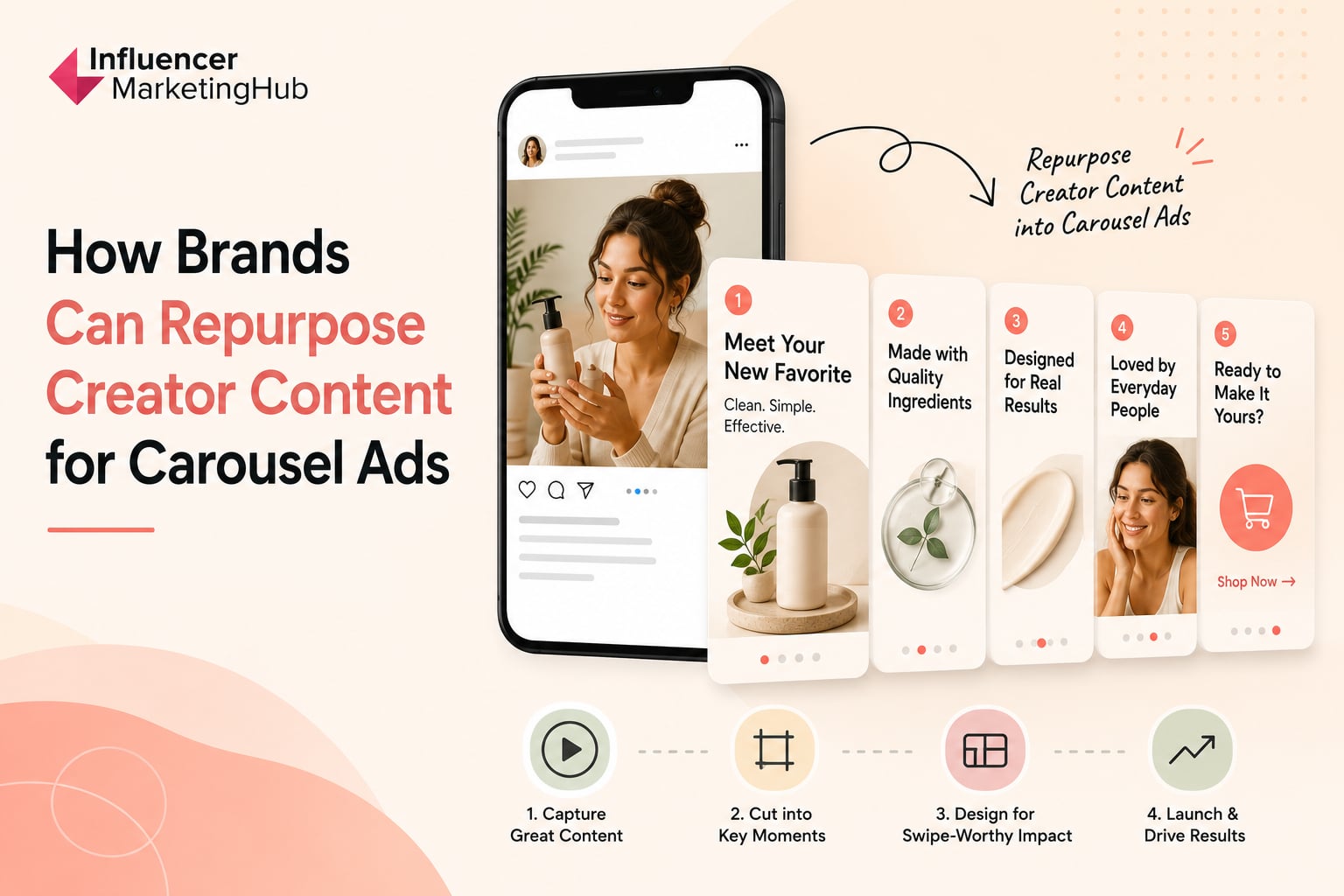
Slide 1: The Hook (The "Pattern Interrupt")
The first slide typically features the creator’s face or a high-energy action shot. The goal is to stop the scroll. By using the creator’s authentic aesthetic rather than a brand logo, the ad blends seamlessly into the user’s organic feed.
Slides 2–4: The Value Proposition and Education
Middle slides are repurposed from the creator’s "how-to" or "unboxing" segments. These slides break down product features, show the item in different lighting, or demonstrate its utility. This segment addresses consumer skepticism by providing visual proof of performance.
Slides 5–6: Social Proof and "The Result"
The final slides often showcase the creator’s end results—such as a finished makeup look, a styled room, or a software dashboard. This is frequently paired with a text overlay of the creator’s testimonial, reinforcing the "why" behind the purchase.
Legal and Operational Frameworks: Rights and Whitelisting
The shift toward repurposing requires a more sophisticated legal approach than traditional influencer "shout-outs." In 2026, the standard for influencer contracts has evolved to include "Usage Rights for Paid Media" as a non-negotiable clause.
Industry analysts note that brands are now moving toward "Partnership Ads" (formerly known as Branded Content Ads). This allows the brand to take the creator’s organic post and turn it into a carousel ad that appears to come from the creator’s handle but is funded by the brand. This transparency, mandated by updated FTC and global regulatory guidelines, ensures that consumers are aware of the paid nature of the content while maintaining the creator’s "halo effect."
Industry Responses and Expert Analysis
"The era of ‘one-and-done’ influencer posts is effectively over," says Marcus Thorne, a digital media strategist. "Brands can no longer afford to pay for a single Instagram Story that disappears in 24 hours. They are now buying ‘assets,’ not just ‘access.’ The carousel format allows those assets to live longer and work harder."
Technological advancements have also facilitated this trend. AI-driven creative tools now allow brands to automatically resize and color-grade creator videos to fit the specific dimensions of carousel slides across different platforms. This reduces the manual labor previously required to adapt raw creator footage into polished ad units.
Furthermore, the rise of "Social Commerce" has tightened the link between creator content and the checkout page. By tagging products directly within the carousel slides, brands are shortening the customer journey, moving from "inspiration" to "transaction" in a matter of seconds.

Broader Implications for the Creator Economy
The move toward repurposing content for carousel ads has significant implications for the creator economy at large.
First, it has changed the "creator persona." Creators are now expected to be part-videographer, part-model, and part-direct-response marketer. Those who understand how to film content specifically for the "modular" needs of a carousel—ensuring there are clear stopping points for slide transitions—are commanding higher fees.
Second, it has led to the "democratization of influence." Micro-influencers (those with 10,000 to 50,000 followers) are seeing a surge in demand. Because their content often feels more authentic and "raw" than that of mega-celebrities, their assets frequently perform better in carousel ad formats. For brands, this means a more diversified and cost-effective influencer portfolio.
Finally, there is a growing emphasis on "Creative Diversification." To avoid ad fatigue, brands are using carousels to test multiple creators simultaneously. A single ad campaign might feature five different creators, each occupying two slides of a carousel, allowing the brand to see which aesthetic resonates most with specific audience segments through A/B testing.
Conclusion: The New Standard in Digital Advertising
As the digital landscape becomes increasingly crowded, the ability to repurpose creator content into engaging, multi-slide carousel ads is no longer an optional tactic; it is a core competency for modern marketing departments. This approach successfully bridges the gap between the human-centric appeal of social media and the data-driven precision of paid advertising.
By leveraging the storytelling potential of carousels and the inherent trust of the creator community, brands are finding a sustainable way to capture attention and drive revenue in an era where traditional commercials are increasingly ignored. The data is clear: the future of social advertising is not just about who is talking, but how their message is structured, repurposed, and delivered to a swiping audience.