
Historical Market Trends and Federal Reserve Policy Decisions Shape Investor Expectations for September

The transition into September has historically introduced a period of heightened caution for global financial markets, as investors navigate a convergence of seasonal volatility, institutional rebalancing, and critical macroeconomic data releases. While the month is traditionally associated with the return to academic schedules, on Wall Street, it is recognized as the historically weakest month for equities. Statistical data spanning over a century indicates that September often challenges the momentum established during the summer months, a phenomenon frequently referred to as the "September Effect." In the current fiscal landscape, this seasonal pressure is compounded by the proximity of a midterm election cycle and a complex interest rate environment managed by the Federal Reserve.
The Historical Precedent of the September Effect
The reputation of September as a difficult month for the stock market is supported by extensive historical data. Since the 1890s, the Dow Jones Industrial Average has recorded an average monthly decline of 1.1% during September. Furthermore, the index has managed to finish the month in positive territory only 43% of the time, making it a statistical outlier compared to the rest of the calendar year.
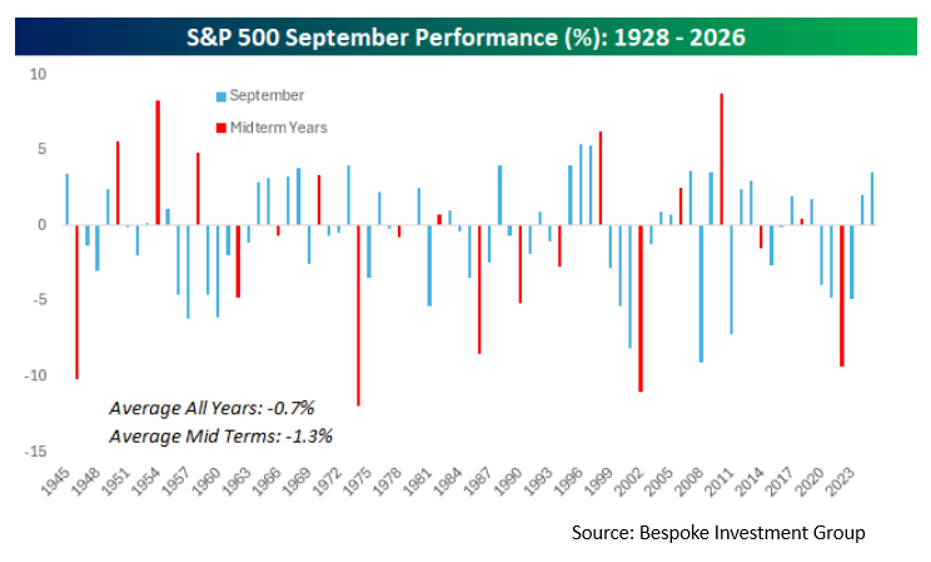
The S&P 500 exhibits a similar pattern. Data compiled since 1945 shows that the benchmark index has declined by an average of 0.7% during this period. These figures suggest that the seasonal downturn is not merely a modern anomaly but a persistent characteristic of market cycles. Market analysts attribute this trend to several structural factors, including the conclusion of summer vacations for institutional traders, which often leads to increased trading volume and the reassessment of portfolio holdings.
Midterm Election Year Volatility
The historical complexity of September is amplified during midterm election years. Projections for the 2026 midterm cycle suggest that investors should prepare for significant price swings, as political uncertainty often translates into market turbulence. Historical analysis of the post-World War II era reveals a striking correlation: the four best and four worst September performances for the S&P 500 all occurred during midterm election years.
During these cycles, the S&P 500 has seen an average September decline of 1.3%, nearly double the average loss seen in non-midterm years. This increased volatility is often driven by shifting expectations regarding legislative priorities, tax policy, and regulatory changes that may follow a change in the composition of Congress. Consequently, while the month carries a risk of significant drawdowns, it also possesses the historical capacity for robust recoveries, depending on the prevailing political and economic sentiment.
Institutional Drivers and Tax Obligations
Beyond historical sentiment, several tangible financial activities contribute to September’s reputation for volatility. One primary driver is the fulfillment of tax obligations. The first half of the month often sees increased selling pressure as both individual and institutional investors raise cash to meet estimated tax payments, which are typically due on September 15.

Additionally, the end of the third quarter prompts institutional investors to engage in portfolio rebalancing. This process involves selling outperforming assets to lock in gains or offloading underperforming securities to align with specific risk mandates. For mutual funds, September often marks the approach of the fiscal year-end. This timeline encourages "tax-loss harvesting," a strategy where funds sell losing positions to offset capital gains, thereby reducing the tax burden for shareholders. These collective actions create a natural headwind for equity prices regardless of the underlying health of the economy.
The Federal Reserve and Inflationary Pressures
In the current environment, the most significant "wild card" for market performance remains the Federal Reserve’s monetary policy. The Federal Open Market Committee (FOMC) is scheduled to meet in mid-September to determine the trajectory of interest rates. Market participants are closely monitoring whether the central bank will maintain current rates or implement another hike to curb persistent inflation.
Recent economic indicators have provided a mixed outlook. The Personal Consumption Expenditures (PCE) price index, the Federal Reserve’s preferred gauge of inflation, showed a 0.2% increase in July. On an annual basis, headline PCE rose by 3.7%, while the "core" PCE—which excludes volatile food and energy costs—increased by 3.3%. Both figures remain notably above the Federal Reserve’s long-term inflation target of 2%.
During the recent Jackson Hole economic symposium, Federal Reserve leadership emphasized a commitment to the 2% goal, describing the target as "firm and fixed." Officials indicated that while progress has been made, inflation has not slowed to a degree that would allow for a definitive pause in restrictive policy. However, the central bank has also stressed that future decisions will be "data-dependent," relying on upcoming reports regarding labor market strength, supply chain stability, and geopolitical developments.
Corporate Earnings as a Counterweight to Volatility
Despite the seasonal and macroeconomic concerns, the fundamental health of the corporate sector remains a primary source of optimism for many analysts. The market enters September following a strong performance in August, where major indices showed resilience. Data from the second quarter indicates that the S&P 500 achieved an average earnings growth of 52%, with revenue increasing by 15.5%.
The quality of these earnings is also noteworthy; approximately 86% of S&P 500 companies exceeded analyst estimates during the last reporting cycle. Looking forward, consensus estimates remain robust, with Wall Street analysts projecting average earnings growth of 28.2% for the third quarter and 25.8% for the fourth quarter. This suggest that while price volatility may increase, the underlying profitability of American corporations continues to expand, providing a potential floor for equity valuations.
The Artificial Intelligence Expansion and Supply Chain Constraints
The ongoing boom in Artificial Intelligence (AI) continues to serve as a significant driver of market activity, transcending seasonal trends. NVIDIA Corporation (NVDA), a bellwether for the AI sector, recently reported a 106% year-over-year increase in revenue. The company’s data center segment, which provides the infrastructure necessary for large-scale AI models, saw revenue jump by 117%, while total earnings surged by 118%.
However, the AI sector is facing its own set of challenges, primarily related to the global supply chain. NVIDIA leadership has noted that revenue growth could be even more pronounced if not for a critical shortage of memory chips. This supply constraint highlights a broader trend: the demand for AI infrastructure—including advanced semiconductors, high-speed networking, and data center capacity—is currently outstripping the industry’s ability to produce these components.
This supply-demand imbalance suggests that the AI cycle is still in an expansionary phase. As companies like Tesla and various aerospace and technology firms under the leadership of figures such as Elon Musk accelerate their AI buildouts, the need for specialized hardware and enormous amounts of electricity is creating new opportunities across the technology supply chain. Analysts are increasingly looking beyond mega-cap software companies to find value in the firms providing the physical infrastructure and energy solutions required to power the next generation of computing.
Labor Market Indicators and the Path Forward
The final piece of the September puzzle will be the release of the August jobs report. Following a July report that saw a decline of 23,000 payrolls, economists are anticipating a modest recovery with the addition of approximately 53,000 jobs. A weaker-than-expected labor report could influence the Federal Reserve to adopt a more dovish stance, as it would signal that previous interest rate hikes are successfully cooling the economy. Conversely, a strong labor market might embolden the Fed to continue its restrictive policy to ensure inflation does not become entrenched.
Broader Impact and Market Implications
The convergence of these factors suggests that September will likely live up to its reputation for volatility, but the context of this volatility is unique. Unlike previous downturns driven by systemic economic failure, current market jitters are characterized by a "tug-of-war" between restrictive monetary policy and exceptional corporate earnings growth.
For institutional and retail investors alike, the month of September serves as a period of price discovery. The expected swings in the S&P 500 and the Dow provide a mechanism for the market to price in the realities of the "higher-for-longer" interest rate environment while accounting for the transformative potential of AI. While the "anxieties" of the market are well-documented, the prevailing strength in corporate fundamentals suggests that any seasonal weakness may be viewed by long-term investors as a recalibration rather than a reversal of the broader bullish trend.
As the fiscal year progresses toward the final quarter, the focus will remain on the Federal Reserve’s ability to navigate a "soft landing" and the capacity of the technology sector to overcome supply chain hurdles. In the interim, the historical data remains clear: September requires a disciplined approach to risk management, as the market navigates its most traditionally turbulent window.