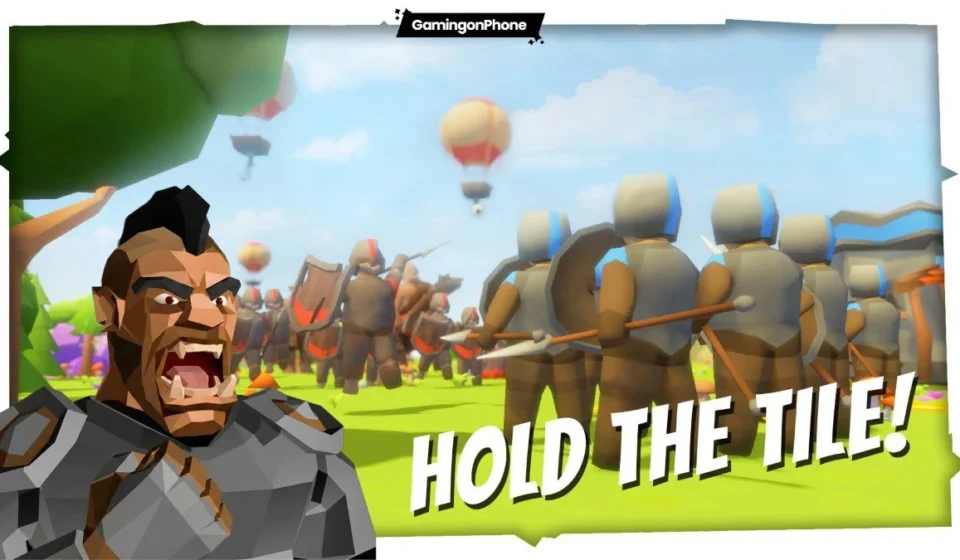
Hold the Tile! challenges you to outsmart rivals in fast-paced medieval RTS battles, now live on mobile

Kamen Studio has officially announced the global launch of its latest title, Hold the Tile!, a low-poly medieval real-time strategy (RTS) game now broadly accessible on both Android and iOS platforms. This release marks a significant entry into the competitive mobile gaming market, promising a sophisticated blend of traditional RTS mechanics—including intricate base-building, dynamic resource management, and tactical squad combat—seamlessly integrated with RPG-style progression systems designed for the modern mobile gamer. The game aims to provide a fast-paced, engaging experience that challenges players to strategize, adapt, and outmaneuver their opponents in a visually distinctive medieval setting.
Strategic Depth Unveiled: Core Gameplay Mechanics
At the heart of Hold the Tile! lies a meticulously crafted gameplay loop that emphasizes strategic decision-making and real-time adaptation. Each match unfolds across expansive strategic regions, initially shrouded by a "Fog of War." This mechanic necessitates proactive exploration and scouting, compelling players to actively uncover the map, locate vital resource nodes, identify enemy base locations, and meticulously plan their offensive and defensive maneuvers. The Fog of War is not merely a visual obfuscation but a core strategic layer, ensuring that intelligence gathering is as crucial as military might.
A key element of early-game progression involves engaging with Barbarian camps scattered across the map. These areas, protected by formidable indigenous forces, offer access to rare and valuable resources upon their subjugation. The risk-reward dynamic of confronting these camps introduces an immediate strategic choice: allocate resources and units for early territorial expansion and resource acquisition, or focus on internal development before venturing into dangerous territories. These rare resources are pivotal for strengthening a player’s burgeoning army and advancing their technological capabilities, providing a clear incentive for aggressive early-game exploration.
Resource management forms the backbone of economic progression in Hold the Tile!. Players are tasked with gathering essential resources such as wood, iron, and gold, which are indispensable for expanding their base infrastructure. Wood is typically utilized for basic structures and early-game units, while iron becomes crucial for more advanced fortifications and elite military units. Gold, often the most versatile and valuable resource, facilitates accelerated research, unit recruitment, and the deployment of powerful magical abilities. The efficient allocation and protection of these resources are paramount for sustaining a robust economy and funding continuous military expansion.
Base construction extends beyond mere functionality, incorporating strategic defensive elements. Players can erect walls to cordon off vital areas, construct defensive towers to provide ranged fire support, and build bridges to create strategic pathways or chokepoints. The intelligent design of a base, considering terrain, resource nodes, and potential enemy approach vectors, can significantly influence the outcome of battles, transforming a well-fortified position into an impenetrable stronghold. This emphasis on defensive architecture adds another layer of strategic depth, requiring players to balance offensive expansion with robust protection of their assets.
Evolving Your Command: Generals and Squads
A distinctive feature of Hold the Tile! is its RPG-inspired General classes. Players choose from different archetypes, including the Warrior, Builder, and Mage, each possessing a unique set of skills and a dedicated Talent Tree. This system allows for substantial player customization and strategic diversification.
- Warrior Generals typically excel in direct combat, boasting enhanced unit statistics, combat-oriented abilities, and leadership bonuses that bolster their armies’ offensive capabilities. Their Talent Trees might focus on increasing troop health, damage output, or unlocking powerful battlefield maneuvers.
- Builder Generals specialize in economic development and defensive fortifications. Their skill trees could offer bonuses to resource gathering rates, reduce construction costs, accelerate building times, or enhance the resilience of defensive structures. A Builder’s presence can transform a nascent settlement into a formidable economic and defensive hub.
- Mage Generals harness arcane powers, offering powerful spellcasting abilities that can turn the tide of battle. Their Talent Trees would likely focus on increasing spell potency, reducing mana costs, unlocking new magical effects, or enhancing the magical capabilities of their supporting units.
The choice of General fundamentally shapes a player’s strategy, influencing their preferred playstyle and tactical approaches. Furthermore, players recruit various unit types to form combat squads. The game offers the flexibility to either manually control these squads, allowing for intricate micro-management and precise tactical execution, or to opt for auto-battles, which provide a more streamlined experience for those who prefer to focus on macro-level strategy and base management. This dual control system caters to a broad spectrum of RTS players, from hardcore strategists to those seeking a more accessible experience.
Arcane Warfare: The Power of Spells
Beyond conventional unit combat, Hold the Tile! integrates a dynamic magic system that adds a crucial layer of tactical depth. Players can unleash powerful spells, such as devastating fireballs, strategically summoned trees to block enemy paths or create defensive perimeters, and slowing effects to impede enemy advances. Crucially, the ability to cast these spells is directly tied to a player’s territorial expansion. The more territory a player controls, the greater their magical reserves and the more frequently they can deploy these game-changing abilities. This mechanic fosters a continuous push for territorial dominance, as control over the map not only provides resources but also fuels a player’s magical arsenal. Strategic deployment of spells can turn a losing battle around, disrupt enemy formations, or provide the necessary burst damage to eliminate key threats.

Kamen Studio’s Vision and Development Journey
Kamen Studio’s development of Hold the Tile! appears to stem from a clear vision: to deliver a compelling, yet accessible, real-time strategy experience optimized for mobile platforms. The choice of a low-poly medieval aesthetic is a deliberate one, offering several advantages. Visually, it provides a distinct and charming art style that stands out in a crowded market often dominated by hyper-realistic or cartoonish graphics. Operationally, the low-poly design is inherently less graphically intensive, ensuring smoother performance across a wider range of mobile devices and contributing to a more stable and enjoyable gameplay experience. This approach also allows the development team to focus more on core gameplay mechanics and strategic depth rather than being bogged down by ultra-high fidelity asset creation.
The development journey for any mobile RTS is fraught with challenges. Adapting the intricate controls and complex interfaces of traditional PC RTS games to touchscreens requires significant innovation. Kamen Studio likely invested considerable effort into designing intuitive touch controls, streamlined menus, and clear visual feedback to ensure that players can execute complex commands with ease. Balancing the depth required for strategic engagement with the need for shorter, mobile-friendly play sessions is another common hurdle. Hold the Tile!‘s fast-paced nature and distinct match structure suggest an attempt to address this, offering a full RTS experience without demanding extensive time commitments per session. The integration of RPG elements and various General classes also speaks to a desire for long-term player engagement and replayability, allowing players to experiment with different strategies and character builds.
The Mobile RTS Landscape: Context and Competition
The mobile gaming market has witnessed an exponential surge in popularity, with strategy games consistently ranking among the most lucrative and downloaded genres. Real-time strategy, in particular, has seen a fascinating evolution on mobile. Early mobile RTS titles often simplified mechanics drastically to fit the platform’s limitations. However, as mobile hardware capabilities advanced, developers began to push the boundaries, introducing more complex titles that attempted to replicate the depth of their PC counterparts. Games like Clash Royale, Rise of Kingdoms, and the recent Age of Empires Mobile demonstrate the vast potential and diverse approaches within the mobile strategy genre.
Hold the Tile! enters this dynamic ecosystem, aiming to carve out its niche. Its differentiation lies in the specific combination of low-poly aesthetics, a medieval setting, and a robust blend of base-building, resource management, tactical combat, and RPG progression within a fast-paced match structure. Many mobile RTS games tend towards city-building with long timers or simplified lane-based combat. Hold the Tile!‘s emphasis on real-time, on-map tactical engagements and direct unit control positions it closer to classic RTS experiences, but tailored for mobile. The inclusion of a Fog of War, Barbarian camps, and a strategic magic system underscores a commitment to delivering genuine strategic depth that may appeal to a segment of players looking for more than just passive progression or simplified combat. The success of Hold the Tile! will likely depend on its ability to strike a delicate balance between accessibility for casual mobile gamers and strategic depth for seasoned RTS enthusiasts.
Implications and Future Outlook
The launch of Hold the Tile! by Kamen Studio carries several implications for both the studio and the broader mobile gaming market. For Kamen Studio, this title represents a significant step, potentially establishing their reputation as a developer capable of delivering nuanced strategic experiences on mobile. Its performance will undoubtedly inform future development directions, influencing decisions on potential expansions, sequels, or new intellectual properties.
For the mobile RTS genre, Hold the Tile! contributes to the ongoing trend of increasing complexity and strategic depth on touch devices. If successful, it could inspire other developers to explore more intricate RTS mechanics, further blurring the lines between traditional PC gaming and mobile experiences. The fast-paced nature of its battles, coupled with deep strategic layers, could also hint at potential for competitive play. While not explicitly positioned as an esports title, the real-time decision-making, unit counter-play, and strategic diversity inherent in Hold the Tile! lay a foundation for potential future competitive scenes, attracting players who thrive on high-skill ceiling gameplay.
Looking ahead, the longevity and success of Hold the Tile! will depend on continuous developer support. This typically includes regular content updates introducing new units, General classes, maps, game modes, and seasonal events. Community engagement, through consistent communication and responsiveness to player feedback, will also be crucial for fostering a dedicated player base. As the game matures, Kamen Studio may explore various monetization strategies, such as cosmetic customizations, battle passes, or optional convenience items, though these would ideally be implemented in a manner that respects player experience and avoids "pay-to-win" mechanics.
In conclusion, Hold the Tile! presents itself as a promising new contender in the mobile real-time strategy arena. With its distinctive low-poly medieval aesthetic, a robust blend of base-building and tactical combat, and RPG-inspired progression, it offers a refreshing take on the genre. Available now on Android via the Google Play Store and on iOS via the App Store, the game challenges players to delve into a world of strategic exploration, military conquest, and magical warfare, proving that deep strategic experiences are not only possible but thriving on mobile platforms.