
The Architect of Modern Cinematic Sound
Ray Dolby, born in 1933, did not set out to become a Hollywood mogul. A physicist by training with a Ph.D. from Cambridge University, his early career was defined by rigorous scientific inquiry rather than artistic expression. In the 1950s, while still a student, he played a pivotal role in the development of the first video tape recorder at Ampex Corporation. However, it was his founding of Dolby Laboratories in London in 1965 that set the stage for his transformation of the film industry.
At the time, audio recording was plagued by "tape hiss"—a high-frequency background noise inherent in magnetic tape. For the film industry, which was attempting to compete with the rising popularity of television by offering a superior sensory experience, this technical limitation was a significant hurdle. Dolby’s first major breakthrough was the Dolby A-type noise reduction system, a sophisticated signal processing technology that suppressed background noise without compromising the integrity of the original recording.
The adoption of Dolby technology followed a strategic trajectory. Initially utilized by professional recording studios for music, it eventually caught the attention of film producers. The 1971 release of Stanley Kubrick’s A Clockwork Orange marked the first use of Dolby noise reduction on all aspects of the film’s audio. However, the true "Dolby Revolution" occurred in 1977 with the release of Star Wars. George Lucas utilized Dolby Stereo, a four-channel format that allowed for immersive surround sound. This technology didn’t just improve the audio; it changed the way stories were told, allowing sound to move through the theater in synchronization with the action on screen.
A Chronology of Innovation and Market Dominance
The growth of Dolby Laboratories serves as a masterclass in establishing a global standard. Following the success of Star Wars, the demand for Dolby-equipped theaters skyrocketed. By the early 1980s, the company had transitioned from a niche hardware provider to a ubiquitous brand.
- 1965: Ray Dolby founds Dolby Laboratories in London, focusing on noise reduction for professional music recording.
- 1971: A Clockwork Orange becomes the first film to use Dolby noise reduction, though it remains in mono.
- 1975: Introduction of Dolby Stereo, providing a highly efficient way to encode four channels of audio onto a two-channel optical soundtrack.
- 1977: Star Wars and Close Encounters of the Third Kind demonstrate the commercial and artistic power of surround sound.
- 1982: Dolby Surround is introduced for the home market, bringing the cinema experience to the burgeoning home video industry.
- 1992: Batman Returns debuts Dolby Digital, a 5.1-channel digital surround sound format that became the industry standard for DVDs and digital cinema.
- 2012: The Academy Awards venue is renamed the Dolby Theatre, symbolizing the company’s permanent status in the heart of the industry.
- Present Day: Dolby Atmos, an object-based audio technology, allows sound to be treated as individual entities in a 3D space, utilized in everything from high-end cinemas to mobile devices.
By the time of his death in 2013, Ray Dolby’s net worth was estimated at roughly $2.4 billion. His wealth was built not on box office points or residuals, but on a licensing model that ensured nearly every piece of high-quality audio equipment and every major motion picture theater in the world paid a fee to use his technology.
The "Pick-and-Shovel" Strategy in the Digital Age
The story of Ray Dolby is a classic example of the "pick-and-shovel" investment strategy. During the California Gold Rush of the mid-1800s, it was rarely the miners who became wealthy; rather, it was the entrepreneurs who sold the picks, shovels, and denim jeans required for the work. In the context of modern technology, this strategy involves identifying the critical infrastructure required for a megatrend to flourish.
Currently, the global economy is witnessing a shift comparable to the transition from silent film to "talkies" or from analog to digital: the rise of Artificial Intelligence (AI). Just as filmmakers required Dolby’s hardware to deliver a premium experience, the current "hyperscalers"—companies like Google, Microsoft, and Meta—require a massive, physical infrastructure to facilitate AI computation.

Market analysts suggest that the AI boom is entering a second phase. While the first phase was dominated by chipmakers like Nvidia, the second phase focuses on the "physical layer" of AI. This includes data center construction, power generation, and high-capacity telecommunications.
Infrastructure as the Backbone of Artificial Intelligence
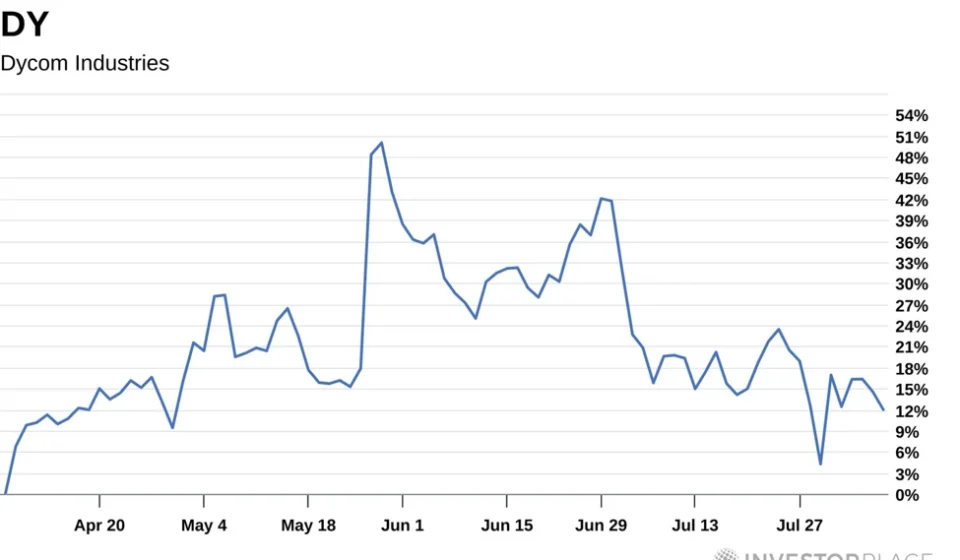
One company that exemplifies this infrastructure-first approach is Dycom Industries. While not a household name like the AI companies it supports, Dycom is a dominant player in the design, installation, and maintenance of the fiber-optic networks that make the internet—and by extension, AI—possible.
The technical requirements for AI are significantly higher than those for traditional web browsing. Every query processed by a Large Language Model (LLM) requires low-latency, high-bandwidth connectivity. As AI models move from simple text generation to real-time video and autonomous agentic workflows, the strain on existing telecommunications networks increases.
According to industry data, the demand for fiber-optic densification is expected to grow at a compound annual growth rate (CAGR) of over 10% through 2030. Companies like AT&T, Verizon, and the major data center operators rely on contractors like Dycom to lay the physical "tracks" for digital data. In the first half of 2024, Dycom reported strong earnings, reflecting a surge in contract awards as telecommunications firms rush to upgrade their infrastructure to meet AI-driven demand. This mirrors the period in the late 1970s when theaters rushed to install Dolby processors to remain competitive.
Musk’s Multi-Platform Integration: The Next Industrial Frontier
The principle of supplying the "indispensable piece" is now being applied to what many analysts consider the most ambitious technological undertaking of the decade: Elon Musk’s integrated AI and robotics vision. Musk’s various enterprises—Tesla, SpaceX, xAI, and X—are increasingly operating as a singular ecosystem built around advanced computation.
The scale of this project is unprecedented. Reports indicate plans for a massive semiconductor and data center complex in Texas, often referred to as the "Gigafactory of Compute." This facility is expected to house hundreds of thousands of advanced GPUs to train the next generation of AI. Furthermore, Musk’s vision extends beyond the Earth’s atmosphere. SpaceX’s Starlink satellite constellation is being positioned not just as a provider of consumer internet, but as a potential backbone for orbital data centers, which would benefit from the natural cooling of space and the absence of atmospheric interference for laser-based data transmission.
However, the execution of such a vision requires a vast supplier pipeline. Musk’s companies, despite their high degree of vertical integration, remain dependent on specialized third-party providers for several critical components:
- Aerospace Hardware: High-precision components capable of withstanding the rigors of space travel and long-term orbital deployment.
- Semiconductor Manufacturing Equipment: The tools required to maintain and operate massive on-site chip-testing and integration facilities.
- Advanced Materials: Rare earth elements and high-performance permanent magnets, such as Neodymium-Iron-Boron (NdFeB), which are essential for the electric motors in Tesla’s Optimus robots.
The Material Requirements of the New Tech Empire
The transition to a robotic and AI-driven economy is fundamentally a materials-science challenge. For instance, the deployment of millions of humanoid robots—as Musk has predicted for the 2030s—would require a global supply chain for permanent magnets that currently does not exist at scale.

"The bottleneck for the next phase of the industrial revolution isn’t just code; it’s the physical components," says Dr. Elena Rossi, a senior industrial analyst. "If you want to build an army of robots or a constellation of data satellites, you need a reliable supply of specialized magnets and aerospace-grade alloys. The companies providing these are the Ray Dolbys of the 21st century."
As of 2024, the market for rare earth magnets is heavily concentrated, leading to a strategic push by Western firms to develop independent supply chains. Companies that can provide these materials, or the equipment to process them, are seeing increased interest from institutional investors who recognize that the "finished product" (the robot or the AI) cannot exist without these fundamental inputs.
Strategic Implications for the Global Supply Chain
The broader impact of this shift is a revaluation of the industrial sector. For decades, software was considered the high-margin "king" of the market, while hardware and infrastructure were seen as low-margin "commodities." The legacy of Ray Dolby, and the current trajectory of AI infrastructure, suggests this view may be outdated.
When a technology becomes a global standard—as Dolby’s audio processing did—the provider of that technology gains immense pricing power and market stability. In the AI era, the providers of the "physical layer" are beginning to occupy a similar position.
For the global economy, this implies a period of massive capital expenditure (CAPEX). In their recent quarterly earnings, tech giants like Alphabet and Microsoft signaled that their CAPEX would remain elevated for the foreseeable future as they build out the infrastructure for AI. This capital does not vanish; it flows directly into the accounts of the suppliers, the builders, and the engineers who provide the necessary components.
Conclusion: The Value of the Indispensable Component
Ray Dolby’s journey from an electrical engineer to a billionaire was predicated on his ability to solve a universal problem for a growing industry. He did not need to be a storyteller to profit from the movies; he simply needed to ensure that the stories sounded better than they ever had before.
Today, as Elon Musk and other tech leaders attempt to build a future defined by artificial intelligence and autonomous machines, the same economic rules apply. The most lucrative opportunities may not lie in the headlines generated by the latest AI chatbot or the launch of a new rocket, but in the quiet success of the companies providing the fiber-optic cables, the specialized magnets, and the aerospace hardware. These suppliers represent the foundation upon which the next technological empire will be built, proving once again that in the world of high-stakes innovation, the most valuable player is often the one who provides the piece the world cannot do without.