

The landscape of mobile device performance evaluation has long relied on synthetic benchmarks to gauge a device’s potential under simulated real-world and gaming conditions. Tools like Geekbench and 3DMark have served as industry standards, providing comparative scores that help analysts and consumers understand how new smartphones stack up against their predecessors. For reviewers tasked with assessing a high volume of new devices annually, these benchmarks offer a streamlined method for quantitative performance measurement. However, a new benchmarking tool, Evolve, is poised to elevate this analysis by moving beyond aggregate scores to offer granular insights into mobile GPU performance, pinpointing specific strengths and bottlenecks in modern workloads.
The Evolution of Mobile Benchmarking
For years, synthetic benchmarks have been the cornerstone of mobile hardware evaluation. These applications run a series of predefined tests designed to push various components of a smartphone’s system-on-a-chip (SoC) – primarily the CPU and GPU – to their limits. Geekbench, for instance, focuses on CPU performance, offering single-core and multi-core scores that reflect a processor’s ability to handle everyday tasks and demanding applications. 3DMark, conversely, targets the graphics processing unit, simulating intense gaming scenarios to provide a comprehensive gaming performance score. The utility of these benchmarks lies in their consistency; by running the same test across different devices, they offer a standardized, repeatable way to compare performance. This is particularly valuable in a rapidly evolving market where dozens of new phones are released each year, each promising enhanced capabilities.
Despite their widespread use, traditional synthetic benchmarks often present a simplified view of performance. An overall score, while indicative, can obscure the nuances of how a GPU handles specific types of graphical computations. As mobile gaming grows in complexity, incorporating advanced rendering techniques like ray tracing and neural rendering, a more detailed understanding of GPU architecture and its efficiency in handling these workloads becomes crucial. The introduction of techniques such as frame generation, aimed at boosting framerates in mobile titles, further necessitates benchmarks that can dissect performance beyond a single, overarching number. This gap in granular analysis is precisely where Evolve aims to make its mark, offering a diagnostic approach to GPU evaluation.
Evolve: A Deeper Dive into GPU Metrics
Evolve distinguishes itself by providing a comprehensive breakdown of GPU performance across five distinct metrics, allowing for a more precise understanding of how a mobile GPU tackles contemporary graphics demands. Developed to address the growing complexity of mobile graphics, Evolve’s methodology aligns with the latest advancements in rendering technology, including the nascent integration of ray tracing on mobile platforms and the increasing focus on AI-driven rendering techniques from industry giants like Arm and Qualcomm.

The benchmark’s core strength lies in its specialized scores:
-
Ray Tracing Workloads: This dedicated score assesses a GPU’s capability in handling hardware-accelerated ray tracing. Ray tracing is a sophisticated rendering technique that simulates the physical behavior of light, producing highly realistic lighting, shadows, and reflections. Evolve evaluates performance using industry-standard APIs like Vulkan Raytracing and DXR, providing a clear indicator of a phone’s proficiency in rendering these visually intensive effects. As ray tracing becomes more prevalent in mobile gaming, this metric offers a forward-looking assessment of a device’s graphical prowess.
-
Acceleration Structure: Complementing the ray tracing score, this metric evaluates the GPU’s efficiency in building the complex data structures essential for real-time ray tracing calculations. The speed and effectiveness with which a GPU can construct these structures directly impact the overall fluidity and responsiveness of ray-traced visuals. A high score here indicates a well-optimized GPU architecture for advanced lighting effects.
-
Rasterization Score: Rasterization remains a fundamental technique in 3D graphics rendering, converting vector graphics into pixel-based images for display. Evolve’s rasterization score specifically tests the hardware rasterizer, a dedicated component within the GPU, evaluating its efficiency in rendering traditional 3D graphics. This metric is crucial for understanding a GPU’s baseline performance across a vast library of existing mobile games that rely heavily on rasterization.
-
Animation, Graphics Effects, and Post-Processing: This combined test assesses a GPU’s ability to handle various visual embellishments that enhance the gaming experience. It measures performance in rendering animations, complex graphical effects, and post-processing filters that add polish and realism to game environments. A strong showing in this area suggests a GPU capable of delivering rich, dynamic visual experiences.
-
Driver Score: Beyond raw computational power, the efficiency of the GPU driver plays a significant role in overall performance. Evolve’s driver score measures how effectively the CPU is utilized in conjunction with the GPU. An optimized driver ensures that the CPU can feed instructions to the GPU without creating bottlenecks, leading to smoother performance and better resource management.
While Evolve offers a free version for general users, a professional version provides advanced features, including the ability to export detailed charts and all testing data. This enhanced functionality is particularly valuable for hardware manufacturers, developers, and professional reviewers who require in-depth analysis for product development, optimization, and comprehensive performance reporting.

Rigorous Testing and Initial Findings
To demonstrate Evolve’s capabilities, a series of tests were conducted on a selection of recent flagship Android devices, encompassing the last two generations of Qualcomm and MediaTek chipsets. The devices under scrutiny included the Oppo Find X9 Ultra, Find X9 Pro, Find X8 Pro, and the Xiaomi 15 Ultra. These devices represent the cutting edge of mobile hardware, featuring the following GPUs:
- Snapdragon 8 Elite Gen 5 (Oppo Find X9 Ultra): Equipped with the Adreno 840 GPU.
- Dimensity 9500 (Oppo Find X9 Pro): Featuring the Mali G1 GPU.
- Snapdragon 8 Elite (Xiaomi 15 Ultra): Powered by the Adreno 830 GPU.
- Dimensity 9400 (Find X8 Pro): Utilizing the Mali-G925 GPU.
The objective of this comprehensive testing was to meticulously chart the performance evolution of mobile GPUs over a two-year period, leveraging Evolve’s granular metrics to highlight specific areas of improvement and identify potential architectural bottlenecks. The results provided compelling evidence of the significant advancements made in mobile graphics processing.
Performance Analysis: Qualcomm’s Dominance and Generational Leaps
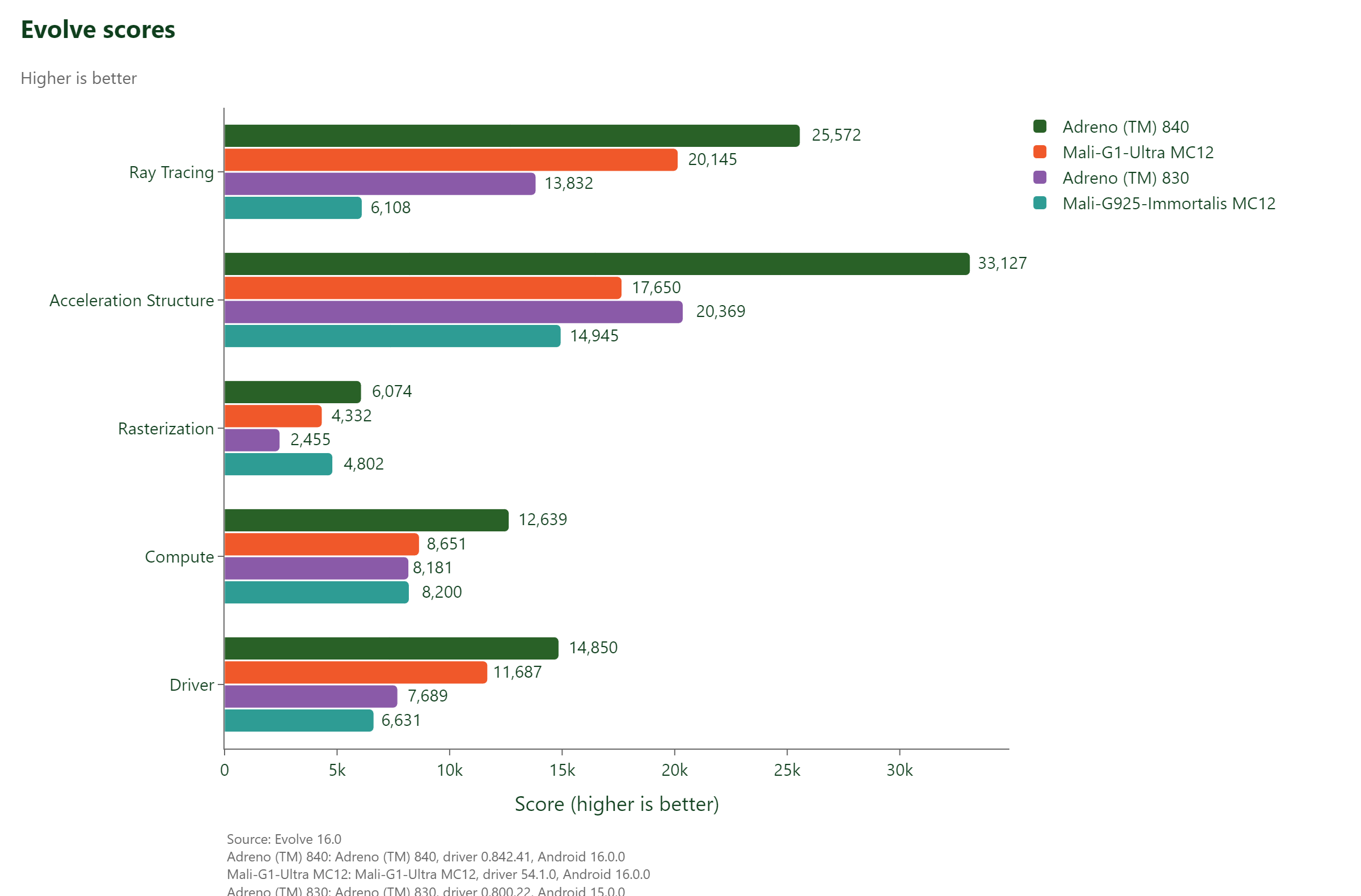
The testing unequivocally demonstrated Qualcomm’s continued dominance in the mobile GPU sector, with its Adreno GPUs consistently outperforming competitors across multiple metrics. The Adreno 840, found in the Snapdragon 8 Elite Gen 5, exhibited a substantial lead:
- Ray Tracing: The Adreno 840 was found to be 27% faster than the Mali G1 in ray tracing workloads. This significant advantage underscores Qualcomm’s commitment and architectural efficiency in handling the computationally intensive demands of modern lighting and reflection effects.
- Rasterization: In traditional 3D graphics rendering, the Adreno 840 showed a 40% performance lead over the Mali G1, indicating superior capabilities in rendering animation, textures, and geometric shapes.
- GPU Compute: The Adreno 840 also maintained a considerable advantage in GPU compute tasks, showcasing a 46% lead. GPU compute is vital for a wide range of tasks beyond graphics, including parallel processing for AI, physics simulations, and general-purpose computing.
While these percentage differences highlight a considerable performance gap in synthetic benchmarks, it is important to note that real-world gaming scenarios often show a closer margin due to various factors such as game optimization, thermal throttling, and display refresh rates. Nevertheless, the substantial headroom offered by the Adreno 840 suggests greater potential for sustained high performance, especially in graphically demanding titles and future-proof applications.
Beyond inter-brand comparisons, Evolve’s data revealed impressive year-on-year improvements within Qualcomm’s Adreno lineup. The Adreno 840 demonstrated a remarkable 1.47 times improvement in rasterization workloads compared to its predecessor, the Adreno 830. More strikingly, its ray tracing performance saw an 85% improvement. These figures underscore the rapid pace of innovation within Qualcomm’s GPU division, delivering substantial generational gains that directly translate to enhanced gaming experiences.

Arm’s Mali G1 also showcased notable progress against its predecessor, the Mali G925-Immortalis. Arm had previously touted a two-fold increase in ray tracing performance for the G1, a claim that Evolve’s scores largely corroborated. This indicates a focused effort by Arm to bolster its ray tracing capabilities. However, the G1’s improvements in other areas, such as rasterization and GPU compute, were not as dramatic as those observed with Qualcomm’s Adreno 840, suggesting a more targeted enhancement rather than a broad-spectrum performance leap.
Granular Insights: GPU Time Utilization
One of Evolve’s most valuable features is its ability to detail how much GPU time is utilized per frame for each specific workload. This granularity offers critical insights into where a particular GPU might be excelling or struggling, providing a diagnostic view of performance.
For instance, the Adreno 840 allocated its processing time as follows:
- Ray Tracing: 27.7%
- Rasterization: Just over 17%
- GPU Compute: 45.7%
This distribution suggests a balanced architecture, with significant resources dedicated to GPU compute, indicative of its versatility beyond pure graphics. The relatively lower percentage for ray tracing and rasterization, despite high performance scores, implies highly efficient processing units for these tasks.
In contrast, the Mali-G925 dedicated over 50% of its GPU time to ray tracing. This disproportionate allocation, despite its lower overall ray tracing score compared to the Adreno 840, strongly indicates that the Mali-G925 may lack the requisite specialized cores or architectural optimizations to handle ray tracing workloads efficiently. Such a high percentage suggests the GPU is working considerably harder to render ray-traced effects, potentially leading to performance bottlenecks and reduced efficiency in other areas. These detailed charts are invaluable for developers seeking to optimize their games for specific GPU architectures and for manufacturers aiming to refine future hardware designs.
Challenges in Energy Efficiency Measurement
Evolve also incorporates an energy score, designed to measure the power consumption of the GPU during workload execution. This metric is particularly crucial for mobile chipsets, where energy efficiency directly impacts battery life and thermal management – two critical considerations for portable devices. However, this feature was not available on all the tested phones.
Jasper Bekkers, the founder of Evolve, clarified the reason behind this limitation: "To calculate the energy score, Evolve reads actual power data from the device through Android’s Power Stats HAL. Some manufacturers don’t expose this, and rather than guess based on the battery API, we leave the score out on those devices.” This statement highlights a broader industry challenge concerning hardware transparency. While manufacturers often tout energy efficiency, the underlying data required for independent verification is not always made accessible through standard Android APIs. This lack of uniform data exposure can hinder comprehensive energy performance comparisons and underscore the varying approaches manufacturers take to system-level telemetry.
Broader Implications and Future Outlook
The introduction of Evolve marks a significant advancement in mobile GPU benchmarking, moving beyond simplified scores to offer an analytical tool that can precisely dissect performance. For hardware manufacturers, Evolve provides a clear framework for identifying areas of strength and weakness in their GPU designs, driving targeted innovation. Developers can leverage these detailed insights to optimize their games for specific hardware, ensuring better performance and visual fidelity across a wider range of devices. For consumers and tech reviewers, Evolve offers a more informed perspective on device capabilities, helping to demystify the complex world of mobile graphics and make more educated purchasing decisions.
The ongoing advancements in mobile SoC technology, particularly the shift to more advanced manufacturing nodes like 2nm, promise further generational leaps in GPU performance. Both Qualcomm and MediaTek have announced significant GPU gains for their upcoming flagship chipsets. The Dimensity 9600 Pro, already being tested, is described as a "beast" in early assessments, signaling MediaTek’s continued push to close the performance gap. Similarly, Qualcomm’s forthcoming 2027 flagship chipset, expected to feature the Snapdragon 8 Elite Extreme Gen 6, is anticipated to bring substantial improvements. The detailed diagnostic capabilities of Evolve will be instrumental in evaluating these next-generation processors, providing unprecedented clarity into how these architectural advancements translate into real-world performance.
As mobile gaming continues its trajectory toward console-quality experiences, the need for sophisticated tools like Evolve will only intensify. Its ability to provide granular data on ray tracing, rasterization, GPU compute, and driver efficiency positions it as an indispensable asset for understanding and fostering the future of mobile graphics. The detailed insights it offers are not merely numbers; they are a roadmap for the ongoing evolution of mobile device performance.