Google Rolls Out Motion Assist on Android 17, Targeting Motion Sickness in Moving Vehicles

Google has commenced a gradual rollout of its innovative Motion Assist feature within Android 17, initially targeting its Pixel smartphone lineup. This advanced functionality is engineered to mitigate the pervasive issue of motion sickness experienced by users interacting with their devices while in transit. The introduction of Motion Assist marks a significant step in Google’s ongoing efforts to enhance user comfort and accessibility, addressing a common discomfort that affects millions globally.
The Pervasive Challenge of Motion Sickness in the Digital Age
Motion sickness, scientifically known as kinetosis, is a common condition resulting from a conflict between the senses. When a person is in a moving vehicle, their inner ear (vestibular system) detects motion, while their eyes, if focused on a stationary object like a smartphone screen, perceive a lack of motion. This sensory mismatch sends conflicting signals to the brain, leading to symptoms such as nausea, dizziness, cold sweats, and headaches. Studies have indicated that a significant portion of the population, ranging from 25% to 40%, is susceptible to motion sickness, with some estimates placing the figure even higher for specific demographics or under particular conditions. The proliferation of smartphones and tablets has exacerbated this issue, as individuals increasingly spend their travel time engaged with digital content, inadvertently intensifying the sensory conflict.
Historically, remedies for motion sickness have ranged from pharmacological interventions like antiemetic drugs to behavioral adjustments such as focusing on the horizon or simply abstaining from reading in a moving vehicle. However, these solutions often come with side effects or severely limit a user’s ability to utilize their devices for productivity, entertainment, or communication during commutes or longer journeys. The advent of Motion Assist represents a technological solution, embedded directly into the operating system, aiming to offer a seamless and effective countermeasure without requiring users to alter their habits or rely on external aids.
The Genesis and Evolution of Motion Assist
The journey of Motion Assist from a conceptual idea to a deployable feature began to surface in late 2024. It was in December of that year that Android Authority‘s diligent teardowns and deep dives into early software builds first uncovered traces of a feature then dubbed "Motion Cues." These initial findings provided a glimpse into Google’s ambition to tackle motion sickness, revealing preliminary designs for visual indicators intended to synchronize with a vehicle’s movement. The early iterations suggested a system that would project subtle visual elements onto the screen, designed to provide the eyes with a stable, albeit artificial, external reference point, thereby reducing the sensory dissonance.
Following these initial reports, Google continued to refine and develop the concept. The transition from "Motion Cues" to the officially named "Motion Assist" signifies a matured approach, indicative of comprehensive testing and user experience considerations. The integration into Android 17, the latest iteration of Google’s mobile operating system, underscores the feature’s importance and its foundational role in the evolving Android ecosystem. Android 17 itself has introduced a suite of enhancements focusing on performance, privacy, and user well-being, making it a fitting platform for the debut of such a user-centric feature. The timeline from discovery to rollout reflects Google’s typical development cycle for significant new functionalities, involving extensive internal validation and iterative improvements based on engineering and design feedback.
Technical Architecture and User Experience
Motion Assist’s core functionality revolves around displaying dynamic visual cues around the periphery of the smartphone screen. These cues, often presented as subtle moving dots or patterns, are designed to mimic or respond to the motion detected by the device’s internal sensors, such as accelerometers and gyroscopes. By providing a consistent, albeit peripheral, visual stimulus that aligns with the physical motion of the vehicle, the feature aims to re-establish congruence between the visual and vestibular inputs, thereby alleviating the symptoms of motion sickness.
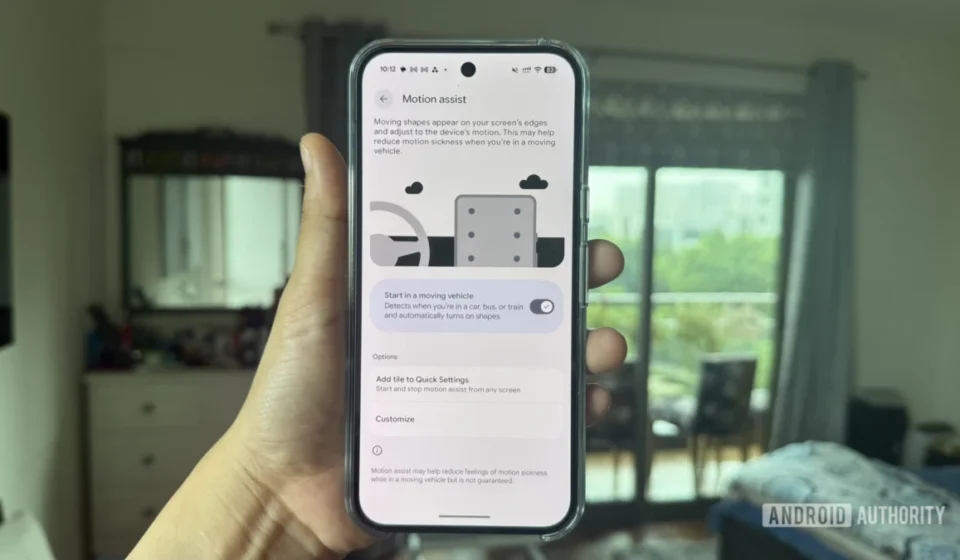
Accessing Motion Assist is straightforward for users fortunate enough to have received the update. The feature is nestled within the Google Play Settings, requiring users to navigate to Settings > Your profile > All services, then scroll down to the "Personal & device safety" section and select "Motion Assist." This hierarchical placement suggests that Google views Motion Assist not just as a convenience feature, but as a component contributing to overall user well-being and safety.
Upon accessing the Motion Assist screen, users are presented with a primary toggle that enables automatic activation of the feature whenever the phone detects it is in a moving vehicle. This intelligent automation leverages the device’s contextual awareness capabilities, ensuring that the feature is seamlessly integrated into the user’s travel experience without requiring manual intervention each time. For those who prefer direct control, Google has also incorporated a Motion Assist Quick Settings tile, allowing for rapid manual toggling of the feature directly from the notification shade, bypassing the need to delve into the full Settings menu.
When Motion Assist is actively engaged, Android provides a persistent notification, informing the user that the feature is running. This notification serves multiple purposes: it confirms the feature’s operation, provides transparency, and crucially, offers a direct pathway to deactivate Motion Assist with a single tap, granting users immediate control over their experience.
A significant aspect of Motion Assist’s design is its robust customization options. Users can personalize the visual cues by altering their color, shape, and opacity. This level of customization is not merely aesthetic; it acknowledges that individuals may have different preferences or sensitivities regarding visual stimuli. For instance, some users might find high-contrast, distinct shapes more effective, while others may prefer subtle, transparent dots that blend into the background. The inclusion of a "Randomization" option further enhances this personalization, allowing the system to automatically vary these settings, potentially optimizing the effect for different types of motion or user preferences over time. This adaptive approach highlights Google’s commitment to creating a truly user-centric solution.
Perhaps the most significant technical advancement within Motion Assist lies in its improved handling of Android’s system-level restrictions on screen overlays. In its nascent "Motion Cues" phase, the feature was constrained by relying on the standard "Display over other apps" permission. This older implementation had a critical limitation: the motion indicators could not appear over crucial system UI elements, including the Settings app itself, the status bar, incoming notifications, the Quick Settings panel, the lock screen, or the volume panel. This fragmented coverage would have undermined the feature’s effectiveness, as the sensory conflict could persist or re-emerge whenever these system elements became active.
Recognizing this limitation, Google engineers dedicated considerable effort to developing OS-level API changes specifically for Motion Assist. This fundamental shift in implementation means that the motion cues can now seamlessly overlay all elements of the Android user interface, including system UI components. This breakthrough ensures a consistent and uninterrupted visual reference across the entire screen, regardless of what app is open or what system overlay is active. It signifies a deeper integration into the Android framework, elevating Motion Assist beyond a simple overlay app to a core operating system functionality, thereby maximizing its potential to effectively combat motion sickness. This engineering feat underscores Google’s dedication to solving complex user experience challenges at a foundational level.
Phased Rollout and Device Availability
The deployment of Motion Assist is currently unfolding through a phased rollout strategy, a common practice for Google when introducing significant new features. This controlled release allows the company to monitor performance, collect real-world feedback, and identify any unforeseen issues in a limited environment before a broader distribution. Evidence of this staggered approach is visible in early user reports. Some members of the Aseemble Debug Telegram group have confirmed seeing Motion Assist on their Pixel devices, yet the feature’s availability is not universal. For instance, while it has been confirmed on the latest Pixel 11 Pro XL, it remains absent on some Pixel 10 Pro XL units, even those running Android 17.
This selective availability suggests that the rollout might be tied to specific device models, regional markets, or even user accounts within Google’s extensive ecosystem, rather than solely dependent on the Android 17 update itself. It is unlikely to be a hardware limitation, given that the underlying principles of motion detection and screen overlay are well within the capabilities of recent Pixel generations. Instead, it points to a deliberate, methodical approach to ensure stability and gather diverse data points.
Industry analysts predict that this phased rollout will continue over several weeks, gradually expanding to encompass more Pixel devices running Android 17. While the initial focus is on Pixel phones, given their role as Google’s flagship hardware for showcasing Android innovations, there is an expectation that such a beneficial feature could eventually become available to a wider array of Android devices. However, this would likely depend on OEMs adopting the necessary OS-level API changes in their own Android 17 implementations or through future Google Play Services updates. For users who do not yet see Motion Assist on their compatible devices, patience is advised, as the feature is likely to reach them in due course as Google expands its distribution waves.
Broader Implications and Future Outlook
The introduction of Motion Assist holds significant implications across several dimensions, from enhancing individual user experience to shaping the competitive landscape of mobile technology.
Enhanced User Experience and Productivity: For millions of commuters, frequent travelers, and ride-share users, Motion Assist promises a transformative improvement in their daily routines. The ability to comfortably read, work, watch videos, or engage in social media without the debilitating effects of motion sickness can unlock vast periods of previously unproductive or uncomfortable time. This not only boosts personal productivity but also makes travel itself a more pleasant and accessible experience. Students can study, professionals can catch up on emails, and individuals can simply enjoy entertainment, all while in motion.
Accessibility and Inclusivity: Beyond general comfort, Motion Assist also stands as a significant step forward in digital accessibility. Motion sickness disproportionately affects certain individuals, including pregnant women, children, and those with specific medical conditions. By mitigating this issue, Google is making smartphone usage more inclusive, ensuring that a broader segment of the population can fully engage with their devices in any environment. This aligns with a growing industry trend towards designing technology that caters to a wider spectrum of human needs and abilities.
Competitive Landscape and OEM Adoption: As a proprietary feature debuting on Pixel phones, Motion Assist could provide Google’s hardware an edge in the highly competitive smartphone market. The "Pixel-exclusive" nature of such an innovative feature often serves as a differentiator, enticing users seeking cutting-edge functionalities. It is highly probable that other Android OEMs will take note of this development. Given the widespread nature of motion sickness, it would not be surprising to see other manufacturers explore similar software-based solutions or even integrate Google’s APIs into their custom Android skins in future updates, potentially leading to a broader standardization of such features across the Android ecosystem.
Google’s AI/ML Strategy: While not explicitly stated, the underlying technology enabling Motion Assist likely leverages Google’s advanced capabilities in artificial intelligence and machine learning. Detecting vehicle motion accurately, predicting its patterns, and dynamically adjusting visual cues in real-time requires sophisticated algorithms. This feature can be seen as another manifestation of Google’s broader strategy to embed intelligent, context-aware AI into its core products and services, creating a more "ambient" and responsive computing experience that anticipates and addresses user needs proactively.
Future Developments: The foundational technology behind Motion Assist could open doors for further innovations. Future iterations might include more personalized algorithms that learn individual user sensitivities, integration with augmented reality (AR) for more immersive and effective visual cues, or even cross-device synchronization with in-car entertainment systems. The potential for this technology to evolve and adapt to new forms of mobility, such as autonomous vehicles, is substantial, positioning Google at the forefront of user comfort in future transportation paradigms.
While Google has yet to issue a formal press release detailing the Motion Assist rollout or its broader strategic implications, the careful engineering and phased deployment suggest a strong commitment to user well-being and an intent to gather robust performance data. Industry observers infer that the company aims to solidify Android’s position as a platform that not only offers powerful functionalities but also prioritizes the comfort and health of its users.
Conclusion
Motion Assist, rolling out with Android 17 on Pixel devices, represents a thoughtful and technologically advanced solution to a long-standing problem. By intelligently countering motion sickness through dynamic visual cues and leveraging deep OS-level integration, Google is poised to significantly enhance the mobile experience for millions of users. This feature underscores Google’s continued innovation in user-centric design and its dedication to making technology more accessible, comfortable, and productive for everyone, regardless of their physical environment. As the rollout progresses, Motion Assist is set to redefine how individuals interact with their smartphones while on the move, transforming what was once a source of discomfort into an opportunity for seamless digital engagement.