
Huang returns, stocks explode higher… is the AI selloff over? … where Brian’s three warnings stand … Eric Fry on what comes next

Global financial markets experienced an extraordinary surge on Monday as Nvidia Corp. (NVDA) announced the immediate reinstatement of its co-founder, Jensen Huang, as president and chief executive officer. The decision, which comes just 11 days after Huang’s abrupt resignation, triggered a massive relief rally across major indices, effectively halting a multi-week selloff that had plagued the technology sector since early October. Nvidia shares soared by 31% in intraday trading, a move of such magnitude that it triggered exchange-level circuit breakers and pulled the broader S&P 500 and Nasdaq Composite indices into significant positive territory.
The board of directors at Nvidia confirmed the unanimous vote to reinstate Huang following an intensive 11-day review period. The initial resignation had been prompted by reports regarding Huang’s personal conduct, which purportedly carried implications for national security. However, in a statement released Monday morning, the board noted that after "a series of discussions and meetings" and receiving "input from senior levels of the United States government," it was determined that Huang’s leadership poses no risk to national security. The move received public support from President Donald Trump, who had previously advocated for Huang’s return to the helm of the world’s leading AI chipmaker.
The Reinstatement and Immediate Market Impact
Nvidia’s influence on modern equity markets cannot be overstated. As of Monday, the company accounts for approximately 8% of the S&P 500’s total weighting. The 31% jump in its share price acted as a primary engine for the broader market: the Nasdaq Composite rose nearly 7%, the S&P 500 climbed almost 5%, and the Dow Jones Industrial Average gained 3%.

The volatility was so intense that market analysts reported "limit up" conditions for certain derivatives and individual stocks. Limit up refers to a maximum price increase permitted by an exchange during a single trading session, designed to prevent extreme volatility but often resulting in a temporary halt in trading as buy orders far outstrip sell orders. Legendary investor Louis Navellier, editor of Growth Investor, noted during an emergency briefing that the market appeared "locked to the upside," suggesting that the velocity of the rebound was making it difficult for institutional traders to execute orders at stable prices.
In his first official statement since returning, Huang emphasized the pivotal moment facing the technology industry. "I am honored to return to NVIDIA and lead one of the most consequential technology companies in the world at the beginning of a new industrial revolution," Huang stated, referring to the ongoing expansion of generative artificial intelligence and high-performance computing.
Chronology of the 11-Day Crisis
The period between Huang’s departure and return was marked by intense speculation and a rapid deterioration of investor confidence in the "AI trade."
- October 1–5: Markets begin to show signs of exhaustion following a year of record highs. Concerns over AI ROI (return on investment) begin to surface among institutional investors.
- The Resignation: Eleven days prior to Monday’s announcement, Huang resigned amid a cloud of uncertainty. Reports suggested that the U.S. government had raised concerns regarding personal conduct that intersected with sensitive national security protocols, particularly given Nvidia’s role in the global semiconductor supply chain and its dominance in AI hardware.
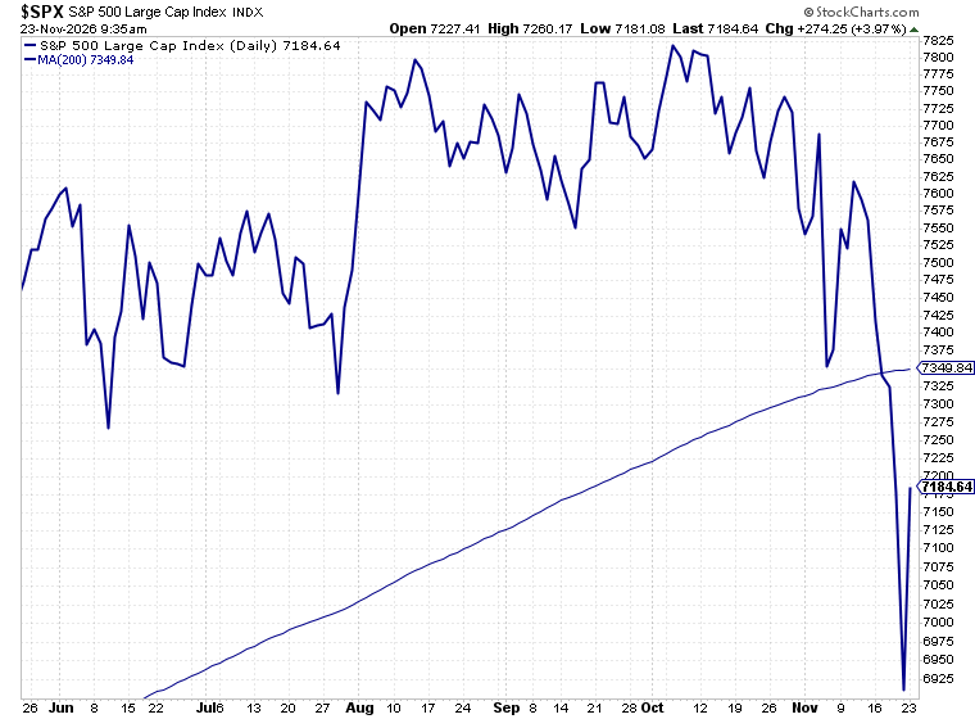
- The Market Rout: In the absence of Huang, Nvidia shares and the broader tech sector plummeted. By the close of the following Friday, the S&P 500 had broken through key technical support levels, closing at 6,910.39—a 5% drop below its previous six-month low.
- Government Consultation: Throughout the weekend preceding the reinstatement, Nvidia’s board engaged with high-ranking federal officials to clear the path for Huang’s return.
- The Reinstatement (Monday): The board announces the unanimous vote, citing a lack of security risk, leading to the current market explosion.
Technical Analysis: The A, B, C Framework
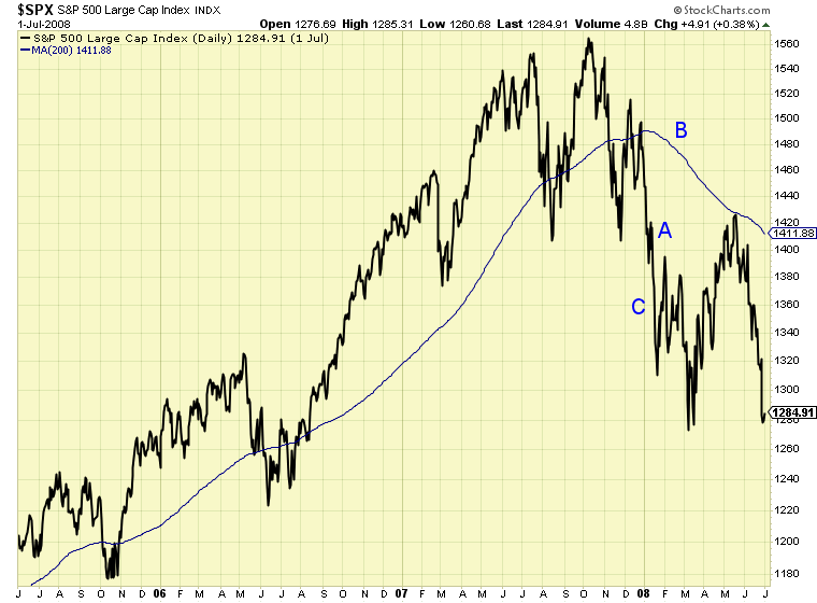
Despite the euphoria of Monday’s rally, market technicians are urging a disciplined approach to the recovery. Brian Hunt, editor of Money & Megatrends, utilizes a specific "A, B, C" framework to determine if a market is experiencing a temporary correction or a fundamental breakdown into a bear market. This system, modeled after the 2000 dot-com crash and the 2008 financial crisis, focuses on three distinct signals.
Signal A: The Six-Month Downside Breakout
Signal A is triggered when the S&P 500 closes below its lowest level of the previous six months. This signal was officially triggered last Thursday when the index closed at 7,175.83, breaking the previous June 10 low of 7,266.99. Friday’s further slide to 6,910.39 confirmed the breach. While Monday’s rally pushed the index back above 7,200, the technical "warning" remains on the record, as the system relies on closing prices to filter out intraday noise.
Signal B: The 200-Day Moving Average
Signal B occurs when the market trades below a 200-day moving average that is itself declining. As of Monday, this signal has not been fully triggered, though it remains under heavy watch. The S&P 500 closed below the 200-day average last week. Currently, the 200-day average sits near 7,350. While the index is trading slightly below this line, the average itself has gone flat rather than turning downward. For Signal B to trigger, the S&P 500 would likely need to sustain levels below 6,900 for a period long enough to drag the long-term trendline lower.
Signal C: Lower Highs and Lower Lows
The final signal is a series of lower highs and lower lows leading to a new 12-month low. This pattern is currently "taking shape" but is not yet complete. The market has seen a series of lower peaks since the record high on October 6. Friday’s close established a clear lower low. However, a new 12-month low would require the S&P 500 to drop below the late-March trough of approximately 6,350—a level still roughly 12% below current trading prices.
Historical Context: Lessons from March
The current volatility bears a striking resemblance to market action seen in March. During that period, the S&P 500 dipped below its 200-day average and set a new six-month low (triggering Signal A) amid escalating conflict in the Middle East and rising oil prices.
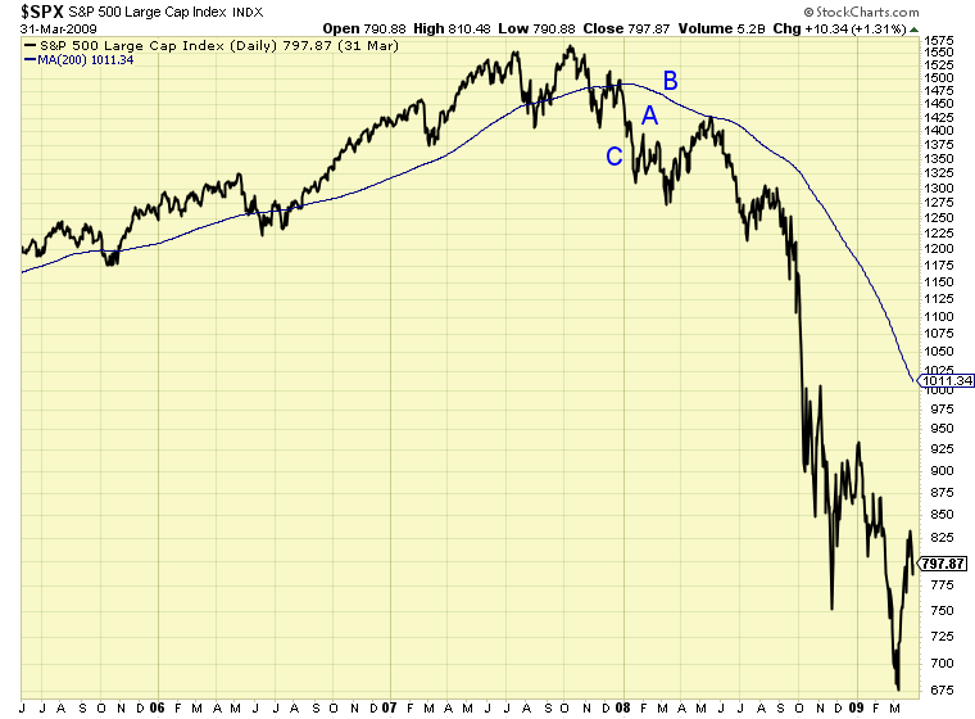
However, because the 200-day moving average never turned lower and the index never approached a 12-month low, the full A, B, C system never confirmed a bear market. Investors who panicked and sold based solely on the first signal missed a subsequent 23% rally that took the S&P 500 to its October highs. The current "Huang Rally" suggests a similar "snap-back" potential, though the underlying catalyst is different. While the March volatility was driven by external geopolitical factors, the current instability is rooted in the "AI trade" itself—the core engine of the 2024 bull market.
Broader Implications: "The Crossing" in AI Leadership
While the return of Jensen Huang has stabilized Nvidia, some analysts suggest that the leadership of the technology sector may be shifting. Eric Fry, a global macro expert and editor of The Speculator, argues that the market is entering a phase he calls "The Crossing."
Fry posits that the first phase of the AI revolution was dominated by infrastructure providers—the companies building the chips, data centers, and hardware necessary to run large language models. Nvidia was the undisputed leader of this phase. However, Fry warns that historical precedents, such as the internet boom of the late 1990s, show that infrastructure winners eventually give way to "application" winners.
In October 2000, Fry famously recommended selling Cisco Systems, the networking giant that provided the "pipes" for the internet. Despite Cisco beating earnings expectations throughout that year, the stock eventually fell 75% as the market shifted its focus to companies that used the internet to transform their business models. Fry suggests that while AI adoption is accelerating, the next stage of explosive growth may come from companies effectively integrating AI to improve margins and productivity, rather than those simply manufacturing the components.
Market Outlook and Investor Strategy
The reinstatement of Jensen Huang has undoubtedly removed a significant "black swan" risk from the equity markets. However, the fundamental damage sustained during the October selloff remains visible in the technical charts.
Financial advisors suggest that the coming weeks will be critical in determining if Monday’s rally is the start of a sustainable "Santa Claus rally" or a "dead-cat bounce"—a temporary recovery in a declining trend. For a full recovery, the S&P 500 must not only reclaim its 200-day moving average but also break the current pattern of lower highs by exceeding the October 6 peaks.
For now, the consensus among institutional analysts is one of "cautious optimism." The A, B, C framework suggests that while the market is "badly damaged," it has not yet entered a terminal decline. Investors are being advised to maintain a clear plan: identifying which core positions to hold through volatility, setting firm stop-loss prices, and preparing to rotate capital into the next generation of AI leaders as the "infrastructure phase" matures.
As the trading day concludes, the focus remains on Nvidia’s upcoming quarterly guidance and whether the return of its visionary leader can translate into the sustained earnings growth required to support current valuations. For at least one day, however, the "Jensen Huang effect" has succeeded in pulling the global markets back from the brink.