
Market Cycles and the Strategic Case for Boring Investments in an Era of High Tech Volatility

The concept of strategic monotony often clashes with the human instinct for excitement, yet historical market data suggests that financial discipline frequently yields superior long-term results compared to speculative fervor. While the phrase "stay boring" lacks the cinematic flair of more aggressive mandates, it reflects a fundamental truth in capital preservation: markets have a documented habit of rewarding stability and valuation long after the momentum of hype has dissipated. In 2025, consumer data indicated that vanilla remained the most-purchased ice cream flavor, and millions of commuters continued to rely on established, predictable news programs. This preference for the reliable over the novel is not merely a sign of risk aversion; it is a calculated response to the inherent volatility of "exciting" trends.
In the current investment landscape, dominated by the rapid advancement of artificial intelligence and the massive valuations of the "Magnificent Seven," the lessons of previous boom-bust cycles have become increasingly relevant. Investors are once again faced with a choice between chasing the exponential growth of high-flying technology stocks or pivoting toward the overlooked, "boring" sectors that provide the foundational infrastructure of the global economy. To understand the risks of the present, one must examine the mechanics of the past—specifically the dot-com era—and the mathematical reality of overpaying for future growth.

The Dot-Com Precedent: A Case Study in Valuation Traps
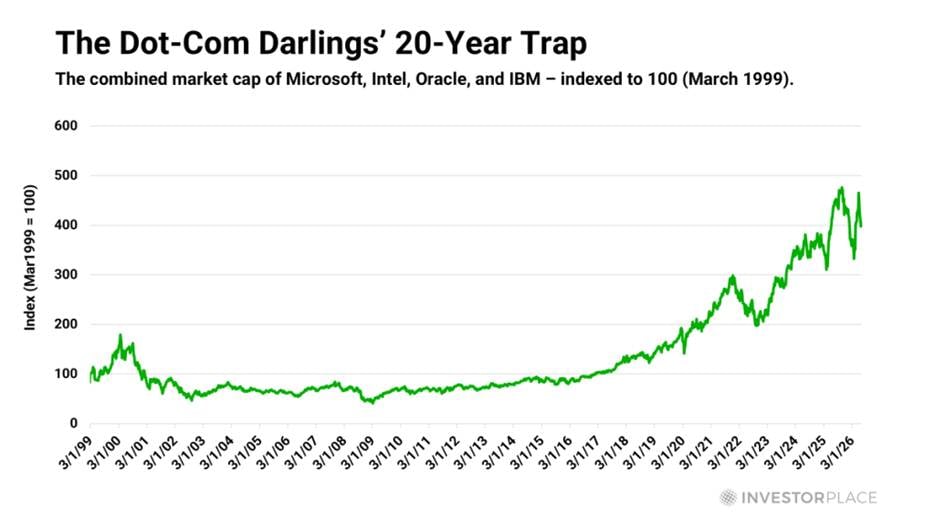
The period leading up to the March 2000 market peak serves as the definitive template for modern speculative cycles. In the late 1990s, the "New Economy" narrative convinced a generation of investors that traditional valuation metrics, such as price-to-earnings (P/E) and price-to-sales (P/S) ratios, were obsolete in the face of the internet’s transformative power. By March 1999, the five largest companies in the U.S. stock market—Microsoft Corp. (MSFT), Cisco Systems, Intel Corp. (INTC), Oracle Corp. (ORCL), and IBM Corp. (IBM)—represented the pinnacle of technological dominance. Collectively, these five entities held a market capitalization of approximately $1 trillion.
As the speculative mania intensified over the following twelve months, the combined market cap of these five companies doubled to $2 trillion. Investors were not necessarily wrong about the technology; they correctly identified that the internet would redefine commerce, communication, and industry. However, they were catastrophically wrong about the price required to capitalize on that future. The expansion of valuation multiples far outpaced the actual growth of earnings, creating a fragile equilibrium that could not be sustained by fundamental performance.
The subsequent "reappraisal" was swift and unforgiving. Within one year of the peak, the $1 trillion in gains had entirely evaporated, returning the group’s valuation to its March 1999 level. However, the decline did not stop there. The combined market capitalization of these former darlings continued to erode for a decade, eventually bottoming near $470 billion in early 2009—less than half of the value they held ten years prior. For an investor who entered the market at the "reasonable" point of March 1999 and held through the crash, the journey to break even took 15 years, lasting until mid-2014. A full recovery to the March 2000 peak was not achieved until early 2020, two decades after the initial investment. This twenty-year stagnation illustrates the "investment trap"—a scenario where even high-quality companies fail to provide returns because the entry price was decoupled from reality.
Comparative Analysis: The AI Boom vs. The Dot-Com Peak
Current market conditions mirror the late 1990s in several key metrics, particularly regarding the concentration of market cap in a few select technology leaders. As of mid-2024, the "Magnificent Seven"—comprising Apple, Microsoft, Alphabet, Amazon, Meta, Nvidia, and Tesla—have seen their valuations swell on the promise of an AI-driven industrial revolution.
Analytical data suggests that today’s valuations are approaching, and in some cases exceeding, the extremes of the dot-com peak. In March 2000, the top five tech stocks traded at an average of 11 times sales and 54 times earnings. In the current cycle, the Magnificent Seven are trading at an average of nearly 11 times sales and 70 times earnings. Some outliers within the group exhibit even more aggressive pricing; for instance, Tesla has recently traded at multiples exceeding 300 times earnings, driven by its dual identity as an automaker and an AI/robotics firm.
The similarity in these figures suggests that the market may be entering a phase of "irrational exuberance," a term famously coined by former Federal Reserve Chairman Alan Greenspan. While the AI revolution is fundamentally real—much like the internet revolution was real in 1999—the risk lies in the "capex dilemma." Major tech firms are currently engaged in an arms race, spending billions on AI infrastructure and specialized semiconductors to ensure they are not left behind. This massive capital expenditure can depress near-term profits and lead to overcapacity, similar to how the over-building of fiber-optic cables led to a massive supply glut in the early 2000s.

The EV Playbook and the Rise of "Good Enough" Technology
A critical component of the current market shift is the global competition for AI dominance, particularly between the United States and China. While U.S. firms focus on building the most powerful and sophisticated large language models (LLMs), Chinese competitors are adopting a strategy previously seen in the electric vehicle (EV) market. This "EV Playbook" focuses on making technology that is "good enough" for mass adoption at a significantly lower price point.
In the EV sector, China leveraged domestic subsidies and supply chain control to become the world’s leading exporter of affordable electric cars. A similar pattern is emerging in AI, where Chinese firms are exporting AI applications and hardware that prioritize cost-efficiency over raw computational power. For investors, this suggests that the biggest opportunities may not lie with the companies building the most expensive models, but with the "boring" companies that provide the power, cooling systems, and basic components required to keep these systems running. These infrastructure-level investments often lack the volatility of front-end software companies and offer a more stable entry point into the AI theme.
The Psychology of the Market Exit
One of the greatest challenges for investors is the psychological pressure to remain in high-performing sectors during the final stages of a boom. History shows that the stocks leading a boom rarely lead the following decade. As enthusiasm peaks, the opportunity cost of "staying at the party" increases, yet the social and professional pressure to participate in the hype is at its highest.

Exiting a high-growth sector early is rarely an enjoyable experience. It involves watching peers generate rapid gains in speculative assets while one’s own "boring" portfolio of value-oriented stocks or defensive sectors (such as utilities, consumer staples, or healthcare) remains stagnant. However, this discipline is what prevents the 15-to-20-year recovery periods seen after the 2000 crash. The transition from growth to value is a recurring feature of market cycles, and the current disparity between tech valuations and the rest of the market suggests that a rotation may be imminent.
Implications for Long-Term Portfolio Strategy
The broader implications of these cycles suggest that the next decade of market leadership will likely emerge from areas that are currently overlooked or considered unexciting. This includes:
- Reasonably Valued Infrastructure: Companies involved in the physical reality of technology—power grid modernization, data center cooling, and specialized logistics—often trade at lower multiples than the software firms they support.
- The "Post-Hype" Secondary Market: Historically, the greatest fortunes in technology are often made not by the first movers who build the infrastructure, but by the second wave of companies that find ways to monetize that infrastructure efficiently.
- Sector Rotation to Defensive Value: As interest rates and economic conditions fluctuate, the reliability of cash-flow-positive, dividend-paying companies becomes more attractive relative to high-growth firms that require constant capital infusion.
The current enthusiasm for AI is not unfounded, but the history of the dot-com era serves as a stark reminder that even the most revolutionary technology cannot protect an investor from the consequences of overpaying. By prioritizing "boring" investments—those with sustainable valuations, clear paths to profitability, and essential roles in the global economy—investors can insulate themselves from the inevitable "reappraisal" that follows every period of market mania. Strategy, in its most effective form, often looks like patience, and in the world of high finance, fortune often favors the monotonous.