
Mastering Local Search in the Era of Artificial Intelligence A Strategic Blueprint for Modern Businesses

The landscape of local search engine optimization (SEO) is undergoing a fundamental transformation as artificial intelligence and conversational search models redefine how consumers interact with digital marketplaces. In an industry where precision and consistency are the primary drivers of visibility, local businesses are finding that traditional "shortcut" tactics are increasingly met with algorithmic suppression. As Google integrates AI Overviews and consumers shift toward natural language queries, the requirements for maintaining a competitive digital presence have evolved from simple keyword density to a complex integration of brand authenticity, technical accuracy, and cross-channel user experience.
Industry veteran Bill Ross, a strategist with two decades of experience managing SEO for global brands, recently outlined the critical shifts currently dictating success in this space. His analysis suggests that while the fundamentals of local SEO—such as Google Business Profiles (GBP), citations, and reviews—remain essential, the methodology for executing these strategies must adapt to a more sophisticated, conversion-oriented environment. The modern local SEO framework is no longer just about appearing in the "Map Pack"; it is about feeding the data ecosystems that power AI-driven answers.
The Evolution of Local Search: From Directories to Conversions
The historical trajectory of local search has moved through several distinct eras. In the early 2010s, local SEO was largely a volume game, focused on the quantity of directory listings and the density of localized keywords. However, the current era is defined by the quality of engagement and the veracity of data. According to Ross, the most significant shift is the transition from vanity metrics—such as raw traffic and search rankings—to tangible conversion data.
For a business starting from zero, the initial phase of digital entry is now more labor-intensive than technical. The process begins with the establishment of a Google Business Profile, which serves as the primary data source for Google’s local algorithm. This is followed by the creation of a mobile-optimized website and the acquisition of foundational citations. Ross notes that for resource-strapped businesses, the strategy should prioritize high-value, industry-specific citations over a scattergun approach. Tools such as Moz Local are frequently utilized to manage "boilerplate" citations, allowing human capital to be redirected toward acquiring hyper-local links from regional publications, news outlets, and community organizations.
Data-Driven Decision Making and the Metric Shift
As digital marketing budgets face increased scrutiny, the ability to track and interpret the right data has become a differentiator for successful firms. The industry is seeing a move away from "directional metrics" like likes or views. Instead, strategists are focusing on conversion actions: lead form submissions, newsletter signups, phone calls, and direction requests.
Data from Google Business Profile Analytics provides a granular look at user behavior that many businesses overlook. Specifically, the ability to see the exact keywords that triggered a business listing allows for a feedback loop that informs content strategy. Analysts suggest that segmenting data into four distinct buckets—conversion, brand-building, reach, and directional—is necessary to understand the true ROI of SEO efforts. Without this segmentation, businesses risk chasing high-volume search terms that do not result in actual revenue.

The Rise of Conversational AI and Natural Language Queries
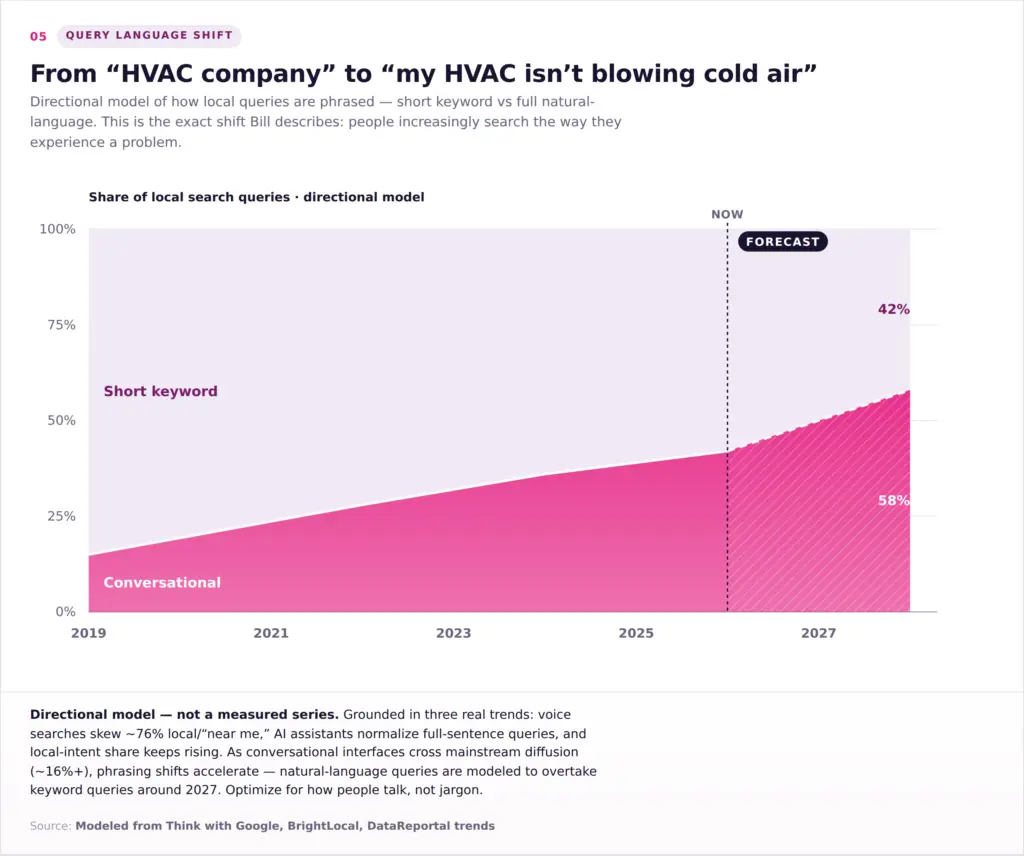
One of the most profound changes in the search environment is the rise of conversational queries. The proliferation of AI tools like ChatGPT and the implementation of Google’s AI Overviews have changed the syntax of search. Users are moving away from shorthand phrases like "HVAC repair" and toward descriptive problem-solving queries such as "Why is it hot upstairs but cool downstairs?"
This shift necessitates a change in content production. Professional journalistic standards in web copy now require addressing the "experience of the problem" rather than just the technical specifications of the solution. If a business website only uses industry jargon, it fails to capture the natural language patterns that AI systems use to match solutions to user problems. AI systems do not generate information in a vacuum; they aggregate data from the open web. Therefore, local SEO serves as the primary "food source" for these AI models. To be recommended by an AI assistant, a business must have clear, authoritative, and conversational content that mirrors how real people speak.
Strategic Nuances: Service-Based vs. Brick-and-Mortar
The strategy for local SEO diverges significantly depending on the business model. Location-based businesses, such as restaurants or retail stores, have a physical "signal" that Google uses to anchor them in a geographic area. Service-based businesses, such as plumbers or consultants who travel to clients, face a higher hurdle because they lack this physical anchor.
To counter this, service-based entities must maintain a "living" Google Business Profile. This includes a constant stream of fresh photos, active responses to reviews, and the use of specific features like "Google Updates." Furthermore, the practice of creating "location pages" on a website has become a standard, though Ross warns against "neighborhood stuffing." Over-targeting every minor suburb without proof of work in those areas can trigger spam filters and negatively impact rankings. The consensus among experts is that a business should only target a new geographic market once they have documented proof of service in that area.
The Integrity of the Review Ecosystem
Review management has evolved from a passive task to a core SEO pillar. However, the value of a review is no longer just in the star rating. Google’s algorithms are increasingly capable of parsing the text within reviews to determine the relevance of a business to a specific query. Generic reviews like "great job" provide minimal SEO value compared to detailed accounts that mention specific services or problems solved.
Effective review management now requires a two-pronged approach:
- Qualitative Acquisition: Encouraging customers to leave detailed feedback that describes the specific work performed.
- Active Engagement: Responding to every review in a professional and helpful manner. This activity signals to both the user and the search engine that the business is operational and values customer feedback.
Statistics indicate that a high percentage of consumers now demand recent reviews—often within the last 90 days—to consider a business "trustworthy." A dormant review section is often interpreted by algorithms as a sign of a declining or inactive business.
Addressing the "Zero-Click" Search Phenomenon
A growing challenge for local businesses is the "zero-click" search, where a user finds all the information they need—phone number, address, hours, and reviews—directly on the search results page without ever clicking through to the business’s website. While this may seem like a loss of website traffic, it is often a win for conversion.
The implication for strategy is that the Google Business Profile must be treated with as much, if not more, importance than the actual website. If the profile is incomplete or inconsistent with the website, the user experience breaks down. Ross points out that the biggest mistake businesses make is a lack of consistency across customer touchpoints. If a user sees a professional image on a search result but arrives at a poorly designed website or experiences a disconnected offline interaction, the resulting "bounce" tells Google that the recommendation was poor, eventually eroding the business’s rankings.
Broader Impact and Future Implications
As we look toward the future of local search, the convergence of the digital and physical worlds will only tighten. The "Map Pack" may eventually be replaced by a fully integrated AI interface that handles bookings and inquiries through voice and text. For businesses, this means that "brand authority" is the ultimate safeguard against algorithmic shifts.
The broader implication for the market is a "flight to quality." As AI makes it easier to generate generic content, the value of authentic, localized, and expert-driven information increases. Businesses that invest in real-world community engagement, high-quality local link building, and a seamless online-to-offline customer journey will be the ones that survive the transition to an AI-first search economy.
In conclusion, the current state of local SEO is a move toward holistic brand management. It requires a quarterly review of strategy, an agile response to data, and a relentless focus on the user experience. The "silver bullet" in SEO does not exist; instead, success is found in the disciplined execution of fundamentals and an embrace of the conversational future of the internet. By aligning digital presence with real-world excellence, local businesses can ensure they remain visible, relevant, and profitable in an increasingly automated world.