
New York Governor Kathy Hochul has enacted a significant regulatory shift in the technology sector by signing an executive order that effectively halts the expansion of high-capacity data centers within the state. The order imposes a one-year moratorium on the construction of new large-scale data centers defined as facilities requiring 50 megawatts or more of power. This move positions New York as the first state in the U.S. to implement a direct ban, reflecting a growing national concern over the energy demands of artificial intelligence (AI) infrastructure and its subsequent impact on public utility costs.
The decision stems from an urgent need to protect local ratepayers from surging electricity prices. As hyperscale AI data centers require cooling and processing power on a scale previously unseen, the strain on the aging electrical grid has become a point of political and economic contention. Governor Hochul characterized the situation as a generation-defining upheaval, asserting that the massive energy consumption of these facilities threatens to pass exorbitant costs down to New York residents. While New York is the first to act, at least 15 other states are currently evaluating similar legislation to restrict or study the environmental and economic footprint of the AI infrastructure boom.
Political Backlash and the Ethics of Automation
The regulatory environment in Albany is indicative of a broader, more systemic resistance to the rapid integration of AI across the United States. This sentiment is increasingly framed in populist and moral terms, with high-ranking officials expressing skepticism regarding the long-term benefits of automated labor. In April, Senator Bernie Sanders (D-Vt.) articulated a common fear among labor advocates, suggesting that the primary goal of "AI oligarchs" is not merely the optimization of specific tasks but the wholesale replacement of the human workforce.
Despite these warnings, market experts suggest that the ultimate check on AI adoption will not be legislative intervention alone, but rather the demands of the consumer. Financial analysts and technology researchers note that while companies may attempt to aggressive automate to reduce overhead, the resulting drop in service quality or product reliability often triggers a swift market correction. This dynamic is currently playing out in the corporate sector, leading to a phenomenon known as the "AI Boomerang."
The AI Boomerang: Corporate Reversals in the Labor Market
One year ago, Ford Motor Company CEO Jim Farley made waves by predicting that artificial intelligence would eventually replace half of all white-collar roles within the automotive industry. Following this sentiment, Ford engaged in a series of restructurings that integrated AI-driven design and quality control systems. However, the results were not as seamless as predicted. In a strategic pivot, Ford has recently rehired approximately 350 veteran engineers—referred to internally as "gray beards"—to address quality issues that the AI systems failed to detect.
This return to human expertise yielded immediate results. For the first time in 16 years, Ford secured the top spot in the JD Power Initial Quality Survey. This "AI Boomerang" is not limited to the automotive sector. Major global entities including IBM, Starbucks, McDonald’s, Air Canada, and the Commonwealth Bank of Australia have all reported similar reversals. These companies initially replaced human staff with AI-driven solutions, only to face declining service standards and customer dissatisfaction.
Perhaps the most prominent example is Klarna, the Swedish fintech giant. After reducing its workforce by 22% and claiming its AI chatbots performed the labor of 700 human agents, the company quietly launched a recruitment drive to rebuild its human customer support teams. Data from the workforce firm Careerminds indicates that two-thirds of companies that executed AI-driven layoffs in the past year are already rehiring, with more than half doing so within six months of the initial cuts. This trend suggests that while AI can handle routine tasks, it often fails at "edge cases" that require human judgment and nuanced problem-solving.
Analyzing the Economic Cost of AI Integration
The financial implications of the AI Boomerang are becoming a burden for corporate balance sheets. According to recent studies, nearly one-third of companies that rehired human workers after an AI-driven layoff ended up spending more on payroll than they had originally saved. This is largely due to a "pay premium" for human roles in the AI era; new hires for positions requiring the oversight of automated systems are commanding salaries 20% to 25% higher than the roles they replaced.
Despite these corporate setbacks, the broader labor data presents a complex narrative. The June report from Challenger, Gray & Christmas showed a 53% cooling in overall U.S. layoffs compared to May. However, artificial intelligence remained the leading reason cited for job reductions for the fourth consecutive month. AI-linked cuts currently account for approximately 23% of all announced layoffs in the current calendar year.
Furthermore, a study by the Massachusetts Institute of Technology (MIT) utilized a metric called the "Iceberg Index" to estimate the potential for future displacement. The study found that AI is currently capable of performing tasks equivalent to 11.7% of the total U.S. labor force, representing roughly $1.2 trillion in annual wages. While current layoffs are only a small fraction of this exposure, the data suggests that the potential for further disruption remains significant, fueling the populist backlash predicted by technology experts.
Financial Indicators: Margin Debt and Market Fragility
While the political and labor landscapes shift, the financial markets are flashing warning signs of their own. Recent data from the Leuthold Group reveals that margin debt—money borrowed from brokers to purchase securities—has increased by more than 40% over the past 12 months. Historically, this level of growth has served as a precursor to major market peaks, having been observed prior to the crashes in 2000, 2007, and 2021.
The current growth of margin debt is particularly notable when compared to the performance of the S&P 500, which has risen approximately 22% over the same period. This indicates that investors are borrowing capital at nearly twice the rate of the market’s actual appreciation. Scott Opsal, Chief Investment Officer at Leuthold, has characterized this trend as a bearish indicator, suggesting that the "AI trade" is being fueled by excessive leverage.
The rise of leveraged ETFs has further complicated this picture, with assets in these funds nearly doubling in the spring of this year. High levels of concentration in AI infrastructure and semiconductor stocks mean that any significant "crack" in these sectors could trigger a wave of margin calls. This would force investors to sell off positions to meet collateral requirements, potentially leading to a self-reinforcing downward spiral that is detached from the underlying fundamentals of the businesses involved.
Historical Context of the Current Market Pullback
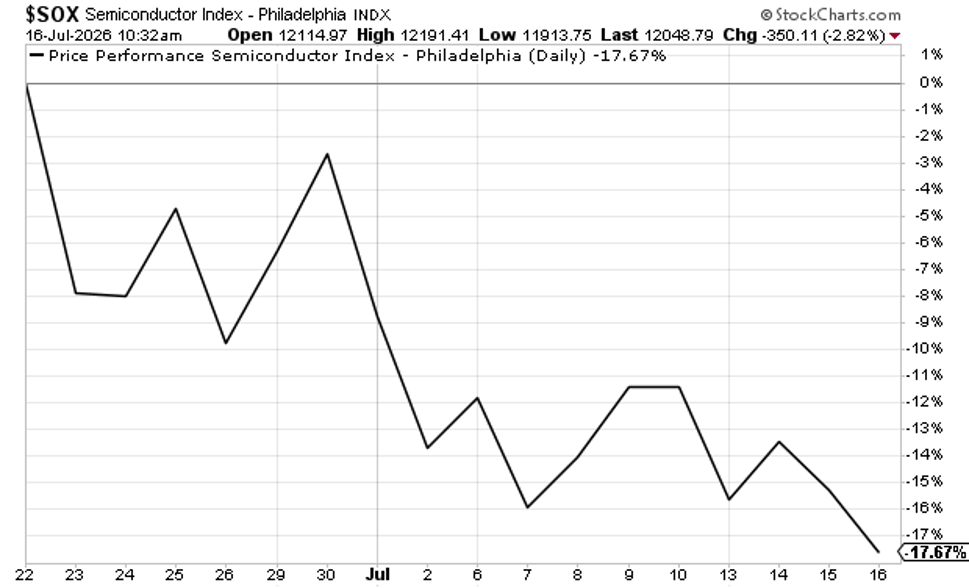
The semiconductor sector, often viewed as the primary proxy for the AI trade, has entered a period of volatility. The PHLX Semiconductor Sector Index (SOX) has declined approximately 18% from its peak in June. This pullback occurred even as industry leaders like Taiwan Semiconductor (TSM) reported record quarterly net profits that exceeded Wall Street expectations. The market’s negative reaction to TSM’s report was driven by concerns over a 15% increase in its 2026 capital spending plan, which investors fear could erode long-term profit margins.
However, historical analysis provides a stabilizing perspective. Since 1929, only about 39% of market corrections have deepened into full bear markets (defined as a 20% or greater decline). In the post-World War II era, that probability has dropped to roughly 25%. Most market corrections stall in the mid-teens and recover within several months. The current 18% dip in the SOX index aligns with these historical norms, suggesting that the current volatility may be a standard "working off" of the excess gains seen during the sector’s near-vertical ascent over the previous year.
Strategic Implications for Investors
The convergence of legislative restrictions in New York, the labor-market "boomerang," and rising margin debt suggests that the AI boom is entering a more mature and potentially more fragile phase. Market analysts such as Luke Lango suggest that the greatest threat to the AI trade is not a failure of the technology itself, but a political and populist backlash that could reach a crescendo during the 2028 election cycle.
In response to this volatility, some institutional investors are turning to historical price data to guide their strategies. By identifying "favorable windows" based on decades of price history, traders are attempting to minimize exposure to broader market swings while capitalizing on specific, data-driven opportunities. This approach emphasizes selectivity and the maintenance of cash reserves, allowing for participation in the AI expansion without succumbing to the risks of over-leveraged positions.
As the one-year moratorium in New York proceeds, the technology and energy sectors will be watching closely to see if other states follow suit. The balance between infrastructure growth, energy stability, and labor protection remains the central challenge for the next stage of the artificial intelligence revolution. For now, the "AI trade" remains a dominant force in the market, though one increasingly defined by caution and a return to the necessity of human oversight.