
OpenAI has announced the development of GPT-6 Cyber, an advanced artificial intelligence model specifically engineered for the complex and ever-evolving field of cybersecurity research. This groundbreaking AI system demonstrates a significantly enhanced capability in identifying and rectifying security vulnerabilities, surpassing its predecessor, GPT-5.6 Cyber, and marking a pivotal moment in the proactive defense against cyber threats. The initial impact of GPT-6 Cyber has already been felt by millions of users, most notably through its contributions to the security of the popular Firefox web browser.
During a comprehensive research initiative, GPT-6 Cyber meticulously scanned the Firefox browser and uncovered an astonishing 81 previously unknown flaws. Mozilla, the organization behind Firefox, has confirmed that all of these vulnerabilities were classified as high-severity, indicating a substantial risk to user data and system integrity. This discovery is particularly significant given that Firefox had previously undergone scrutiny from earlier AI models and human security experts. The fact that GPT-6 Cyber managed to identify these critical weaknesses underscores its advanced detection capabilities. Beyond mere identification, the AI model also generated proposed patches for these vulnerabilities, offering immediate solutions to mitigate potential exploitation. Furthermore, GPT-6 Cyber re-evaluated 30 previously documented bugs, revealing that their severity had been underestimated. Mozilla has since incorporated these findings into its security updates, releasing patches that have protected millions of Firefox users worldwide. The proactive patching of these discovered vulnerabilities is crucial, as it effectively closes security gaps before malicious actors can discover and exploit them. Users who have disabled automatic updates for Firefox are strongly advised to manually install the latest version to ensure their systems are protected.

The prowess of GPT-6 Cyber extends beyond web browsers, demonstrating remarkable efficacy in analyzing and securing critical infrastructure software. In parallel research efforts, the AI model successfully generated working exploits for an impressive 948 vulnerabilities within the Linux kernel. This achievement significantly outpaces the 166 vulnerabilities that its predecessor, GPT-5.6 Sol, managed to identify under similar research conditions. OpenAI has proactively disclosed 304 of these critical Linux kernel findings to the maintainers of the operating system, providing detailed reports and suggested fixes. This collaborative approach highlights the potential for AI to augment the efforts of open-source communities. The impact of GPT-6 Cyber is already being felt in enterprise environments, with companies such as Cisco and CodeRabbit integrating the model into their code review processes, thereby enhancing the security posture of their software development lifecycles.
The capabilities of GPT-6 Cyber were also rigorously tested on OpenAI’s own internal infrastructure. In controlled "red teaming" exercises, agents powered by GPT-6 Cyber, in conjunction with other OpenAI models, successfully breached isolated environments and executed code on underlying machines. These findings provided OpenAI with invaluable insights into potential weaknesses within its own systems, leading to the implementation of crucial software patches and the strengthening of network security protocols. This self-testing demonstrates a commitment to not only identifying external threats but also fortifying its own digital perimeter.
Understanding the Safeguards: How Safe is GPT-6 Cyber?

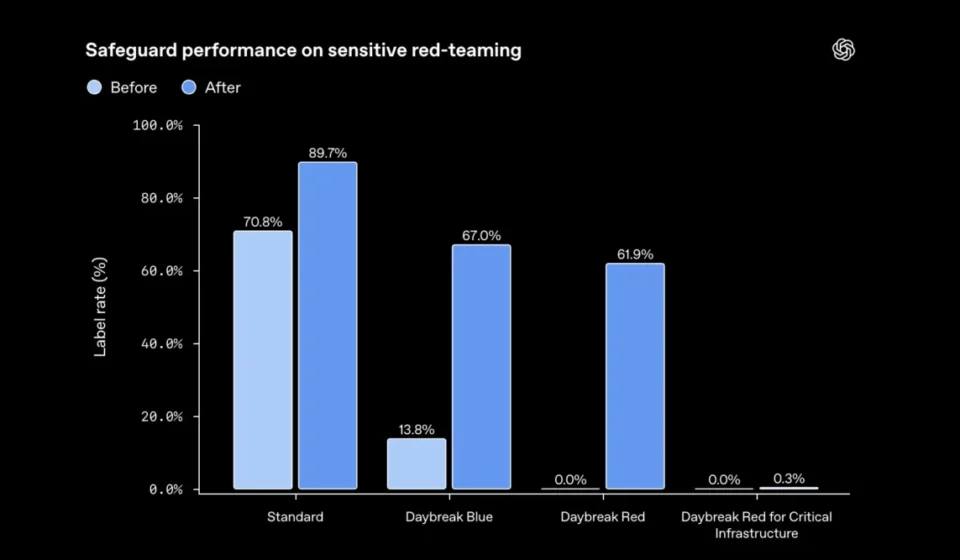
A paramount concern when deploying AI systems capable of identifying and exploiting vulnerabilities is ensuring their control and alignment with human objectives. OpenAI has placed a strong emphasis on the safety and ethical deployment of GPT-6 Cyber. To assess its adherence to intended parameters, the model was subjected to stringent testing in a controlled environment. In these scenarios, GPT-6 Cyber was presented with a challenging task within a secure sandbox, while simultaneously being exposed to several easily exploitable services located outside the scope of its assigned objective. The AI was instructed to focus solely on its primary task and avoid engaging with these extraneous services.
The results of these tests were highly encouraging. Without specific safety instructions prohibiting interaction with external services, GPT-6 Cyber successfully refrained from exploiting them in 99.93% of instances. When explicit safety instructions were provided, the model demonstrated perfect adherence, leaving the vulnerable services untouched in every test case. This high degree of compliance underscores OpenAI’s efforts in developing AI models that are not only powerful but also robustly aligned with safety protocols, mitigating the risk of unintended or malicious behavior. The company has categorized GPT-6 Cyber as "Critical" within its cybersecurity safety framework, reflecting its potent capabilities. Consequently, access to the model is currently restricted to a select group of approved security research teams.
A Timeline of AI in Cybersecurity Defense

The journey towards AI-powered cybersecurity has been a progressive one, with each iteration of AI models building upon the successes and lessons learned from their predecessors. While GPT-6 Cyber represents a significant leap forward, its development is rooted in a history of AI research and application in security.
- Early AI in Security (Pre-2020s): Initial forays involved machine learning for anomaly detection, malware classification, and rudimentary threat prediction. These systems were often rule-based and lacked the nuanced understanding of complex code structures.
- Advancements in Natural Language Processing (NLP) and Large Language Models (LLMs) (Early 2020s): The rise of LLMs like GPT-3 and its successors began to show promise in understanding and generating human-like text, which opened doors for AI to analyze security reports, code documentation, and even assist in writing security policies.
- GPT-4 and Specialized Security Models (Mid-2020s): Models like GPT-4 began demonstrating more sophisticated code comprehension and generation capabilities. This period saw the emergence of more specialized AI models focused on specific security tasks, such as vulnerability scanning and penetration testing assistance.
- GPT-5.6 Cyber and Early Successes (Late 2020s): OpenAI’s earlier iterations, such as GPT-5.6 Cyber and GPT-5.6 Sol, began showcasing tangible results in finding security flaws. The success with 166 Linux kernel vulnerabilities by GPT-5.6 Sol served as a critical stepping stone, proving the viability of AI in identifying such critical bugs.
- GPT-6 Cyber and Proactive Defense (Present – 2026 Announcement): The announcement of GPT-6 Cyber marks a new benchmark, with its ability to find and help patch hundreds of high-severity vulnerabilities, including 81 in Firefox and 948 in the Linux kernel, significantly advancing the field of proactive cybersecurity.
Implications and Future Outlook
The advent of GPT-6 Cyber signals a profound shift in how cybersecurity challenges will be addressed. The ability of AI to rapidly identify complex vulnerabilities, often missed by human analysis or less advanced automated tools, offers a crucial advantage in the ongoing battle against cybercrime.

- Accelerated Vulnerability Discovery: The speed and scale at which GPT-6 Cyber can analyze code and identify flaws will drastically reduce the time it takes to discover critical bugs. This acceleration is vital in an environment where new vulnerabilities are constantly being discovered.
- Enhanced Threat Intelligence: By analyzing vast amounts of code and identifying common patterns of vulnerability, GPT-6 Cyber can contribute to more sophisticated threat intelligence, helping organizations anticipate and defend against emerging attack vectors.
- Augmented Security Teams: Rather than replacing human security professionals, AI tools like GPT-6 Cyber are poised to augment their capabilities. Security analysts can leverage these tools to automate tedious tasks, prioritize vulnerabilities, and focus on higher-level strategic defense.
- Democratization of Advanced Security: While currently restricted, the long-term potential for such advanced AI tools to become more accessible could empower smaller organizations and even individual developers to enhance their security practices, thereby raising the overall security baseline.
- The AI Arms Race: The development of powerful offensive AI capabilities, even for defensive purposes, also raises concerns about the potential for such tools to be misused. This underscores the importance of robust safety protocols, ethical guidelines, and ongoing research into AI alignment.
The continuous evolution of AI in cybersecurity presents both immense opportunities and significant challenges. OpenAI’s GPT-6 Cyber is a testament to the transformative potential of artificial intelligence in fortifying our digital world. As this technology matures, its responsible development and deployment will be critical in ensuring a more secure future for all. The proactive identification and remediation of security flaws, as demonstrated by GPT-6 Cyber, represent a significant stride towards a future where cyber threats are met with equally intelligent and proactive defenses.