
The Bottleneck Theory: How Supply Constraints are Shifting the Power Dynamics of the Global AI Revolution

The economic concept of a "bottleneck"—a single point of congestion in a production system that stops or slows the entire process—has historically determined the rise and fall of empires, a phenomenon now repeating itself within the multi-trillion-dollar artificial intelligence sector. History provides a stark precedent for this dynamic in the 19th-century Dutch monopoly over cinchona bark. Cultivated on the plateaus of Java, cinchona was the sole source of quinine, the only effective treatment for malaria at the time. Because European colonial expansion and military operations in tropical climates were entirely dependent on the health of their personnel, the Dutch East Indies controlled a strategic lever that dictated global movement. By the 1920s, the Dutch controlled 90% of the world’s supply, creating a bottleneck that remained unnoticed by the masses until World War II, when Japanese occupation of Java instantly severed the Allied supply chain. This historical disruption led to thousands of casualties and forced a massive, desperate pivot in medical research and military logistics, proving that the entity controlling the bottleneck possesses more leverage than the entity managing the final product.
In the contemporary landscape, investment analysts are observing a parallel transition within the AI revolution. While the initial phase of the boom was defined by the scarcity of high-end graphics processing units (GPUs), the bottleneck is currently migrating down the supply chain. This shift was most recently evidenced in the August 26 earnings report from Nvidia Corp. (NVDA). Despite projecting a revenue growth of approximately 70% for the upcoming fiscal year—a figure that significantly outperformed Wall Street consensus—Nvidia also signaled a projected decline in gross margins. In a typical market scenario, declining margins for a dominant player might suggest a loss of pricing power or a cooling of demand. However, in the context of the AI infrastructure build-out, analysts suggest this indicates that Nvidia is now paying a premium to its own suppliers to secure the specialized components necessary to meet overwhelming demand.
The Chronology of AI Resource Constraints
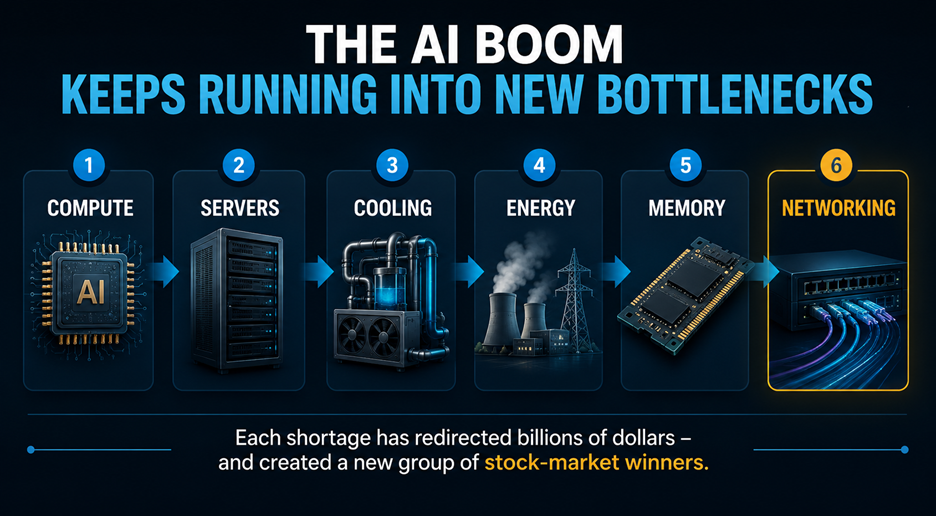
The progression of the AI market can be viewed as a sequential series of solved and emerging bottlenecks. The timeline began in late 2022 with the public release of generative AI models, which triggered an immediate shortage of compute power.
- Phase One (The Compute Bottleneck): Between early 2023 and mid-2024, the primary constraint was the availability of Nvidia’s H100 and A100 chips. During this period, Nvidia’s valuation skyrocketed as tech giants like Microsoft, Meta, and Alphabet competed for limited allocations.
- Phase Two (The Physical Infrastructure Bottleneck): As chips became more available, the constraint shifted to the physical environment. Data center space, specialized cooling systems to manage the intense heat of AI servers, and massive electricity requirements became the new limiting factors.
- Phase Three (The Memory Bottleneck): More recently, High Bandwidth Memory (HBM) became the critical shortage. AI systems require vast amounts of specialized memory to feed data into processors at high speeds, leading to significant price increases and revenue growth for memory manufacturers like Micron Technology Inc. (MU).
- Phase Four (The Networking and Optical Bottleneck): Market data now suggests the industry has entered a phase where the speed of data transmission between chips is the primary hurdle. As data centers scale to house 100,000 or more GPUs, the ability of these processors to communicate as a single unit is limited by traditional copper-based networking.
Technical Analysis of the Networking Constraint
The current bottleneck in networking is a matter of physics. To function as a coherent "supercomputer," tens of thousands of GPUs must exchange data with near-zero latency. Traditional electrical signals traveling over copper wires encounter resistance and heat, which limits distance and speed. To overcome this, the industry is pivoting toward optical networking, which uses light (photons) instead of electricity (electrons) to move data.

Nvidia’s recent financial commitments underscore the urgency of this transition. The company has reportedly committed billions of dollars to secure long-term supplies from optical-component specialists such as Lumentum Holdings Inc. (LITE) and Coherent Corp. (COHR). These companies produce the transceivers, lasers, and fiber-optic technologies that allow AI clusters to scale. When a dominant market leader like Nvidia makes multi-billion-dollar pre-payments to suppliers, it serves as a definitive signal to the market that those suppliers now hold the strategic "quinine" of the digital age.
Elon Musk and the Strategy of Vertical Integration
While Nvidia navigates its supply chain challenges, Elon Musk’s portfolio of companies—Tesla, SpaceX, and xAI—represents a different approach to the bottleneck problem. Musk has historically favored vertical integration to eliminate the leverage held by outside suppliers. Tesla brought battery management and software in-house; SpaceX manufactures its own rocket engines and operates the Starlink satellite constellation to control its own global communications network.
However, even the most vertically integrated companies face indispensable dependencies. For Musk to achieve his goals in autonomous driving (FSD), robotics (Optimus), and large language models (Grok), his companies must consume astronomical amounts of high-performance computing hardware and networking infrastructure. Analysts have identified a specific subset of suppliers that Musk continues to rely upon, suggesting these firms occupy "un-bypassable" positions in the AI production stack.
For instance, xAI recently brought the "Colossus" supercomputer online in Memphis, Tennessee. The facility utilizes 100,000 Nvidia H100 GPUs, making it one of the most powerful AI training clusters in the world. The sheer scale of this project necessitates a massive influx of secondary components—ranging from power transformers to high-density liquid cooling and advanced optical interconnects—that even Musk’s internal teams cannot yet produce at scale.
Market Implications and the September 24 Catalyst
The investment community is closely watching a series of upcoming dates that could signal the next major shift in AI capital expenditures. While the broader market remains focused on interest rate decisions and macroeconomic indicators, AI specialists are looking at technical milestones.
A specific date of interest for market observers is September 24. While specific product announcements are rarely confirmed in advance, the date aligns with several projected development cycles within Musk’s AI roadmap and the broader semiconductor industry’s shipping schedules for next-generation architectures, such as Nvidia’s Blackwell chips. Any breakthrough in resolving current networking bottlenecks or a major pivot in how these clusters are powered could trigger a reallocation of capital toward the "bottleneck owners" rather than the end-product manufacturers.
Supporting Data and Financial Outlook
The financial impact of these shifting bottlenecks is reflected in the divergent performance of semiconductor sub-sectors. While the "Magnificent Seven" have seen increased volatility, the firms providing the underlying "plumbing" for AI have shown resilience:
- Gross Margin Shifts: Nvidia’s guidance of a gross margin dip to roughly 75% (down from previous highs) suggests that the cost of goods sold is rising faster than their ability to raise prices on the final GPU, a classic sign of supplier-side leverage.
- Networking Growth: Market research firms project that the AI networking market will grow at a compound annual growth rate (CAGR) of over 30% through 2029, outpacing the growth of the general server market.
- Energy Requirements: Estimates from the International Energy Agency (IEA) suggest that data center electricity consumption could double by 2026, creating a secondary bottleneck in the utility and renewable energy sectors.
Conclusion and Broader Impact
The AI revolution is no longer a monolithic growth story; it has become a complex game of industrial logistics. Investors who successfully identified Nvidia as the primary bottleneck in 2023 saw historic returns. However, as the industry matures, the "bottleneck" is a moving target.
The upcoming InvestorPlace workshop on Wednesday, September 9, featuring analysts Luke Lango, Louis Navellier, and Eric Fry, aims to provide a granular look at these specific supply chain constraints. The workshop is expected to detail the specific optical and networking firms that are currently being integrated into the infrastructure of xAI and Tesla.
As history demonstrated with the cinchona bark of Java, the greatest profits and the most significant geopolitical power often reside not with those who use the resource, but with those who control the narrow passage through which that resource must flow. In the 2024 AI market, that passage is defined by light-speed networking and the specialized components that make massive-scale intelligence possible. Following the bottleneck remains the most effective strategy for navigating the volatility of high-tech transitions.