
The Evolution of Conversational Commerce Why Brands Must Align Creator-Driven Language with Product Data Architecture

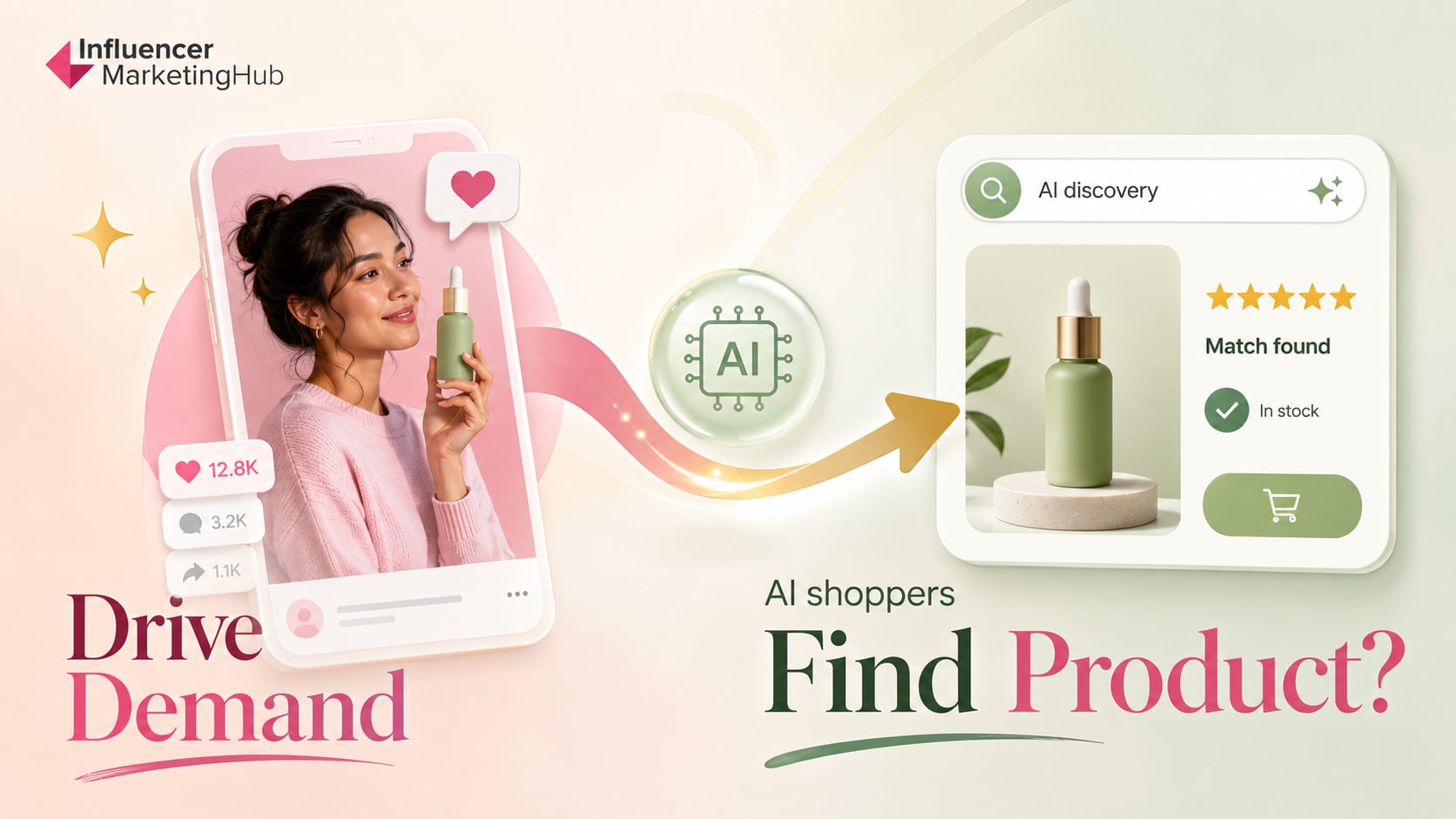
The modern retail landscape is witnessing a widening disconnect between the language of discovery and the language of transaction. As social commerce and generative artificial intelligence (AI) redefine the consumer journey, brands are discovering that their traditional product catalogs—built for internal logistics and legacy search engines—are failing to capture the demand generated by human-centric creator content. This friction often results in lost sales as shoppers move from a creator’s relatable recommendation to an AI shopping assistant that cannot find the product due to mismatched descriptions and missing attributes.
At the heart of this issue is a fundamental linguistic divide. Creators excel at providing context, describing products through the lens of utility and lifestyle. A travel influencer might praise a "compact carry-on that fits every overhead bin and features a dedicated laptop pocket," while the brand’s backend data identifies the same item as a "22-inch polycarbonate spinner" in the color "stone." When a consumer later asks an AI assistant like ChatGPT or Google Gemini for the "beige suitcase with a laptop pocket," the system may fail to surface the correct product because the catalog lacks the specific descriptors used by the creator and echoed by the audience.
The Shift Toward Human-Centric Discovery
Historically, e-commerce was driven by keyword matching. Consumers typed specific nouns into search bars, and retailers optimized pages for those high-volume terms. However, the rise of the creator economy has shifted the paradigm toward "preference-driven" shopping. Creators do the heavy lifting of building desire by answering practical questions: Does this jacket fit over a heavy sweater? Does this desk lamp create a glare during video calls? Does this moisturizer work well under makeup?
According to the Influencer Marketing Hub 2026 Benchmark Report, which surveyed over 600 marketing professionals, the industry has reached a tipping point where operational quality controls and AI-enabled scaling are now the primary concerns for brands. The report highlights that while creator-led storefronts have become a staple of social commerce, the underlying product data often remains static, failing to evolve alongside the conversations happening on social media.
The Chronology of a Lost Conversion
The failure of product data to mirror creator language typically follows a predictable timeline that illustrates the "leaky bucket" in modern digital marketing:
- The Spark: A creator posts a video highlighting a specific, non-obvious utility of a product (e.g., a "non-sporty" white sneaker that pairs well with formal dresses).
- The Engagement: The comments section fills with specific inquiries regarding sizing for wide feet, delivery times for upcoming trips, and compatibility with specific outfits.
- The Search: A segment of the audience, rather than clicking a direct affiliate link, turns to an AI shopping assistant days later, using the creator’s specific phrasing to find the item.
- The Disconnect: The AI assistant scans available merchant feeds. If the brand’s data is restricted to technical specifications (SKU numbers, dimensions, and proprietary color names), the AI may prioritize a competitor’s product that happens to have more descriptive, "human" metadata.
- The Abandonment: The shopper is presented with irrelevant results and abandons the search, or purchases a rival product that more closely matches their conversational query.
The Technical Infrastructure of AI Shopping
As AI assistants become the new gatekeepers of commerce, major technology providers are setting new standards for how product data must be structured. OpenAI has recently updated its merchant protocols, allowing brands to share comprehensive data feeds so their products can participate in ChatGPT’s integrated shopping experiences. These integrations rely on more than just price and availability; they require "useful specificity."
Similarly, Google’s Merchant Center has emphasized the importance of structured data. By utilizing Product structured data (Schema.org), brands can make their inventory eligible for rich results in search. This includes not just the basics, but review ratings, shipping details, and variant labels. However, the technical requirement goes beyond just filling out fields; it requires the data to be accurate and "fresh." Google’s documentation notes that correctly formatted data prevents disapprovals and ensures products are matched to relevant, long-tail queries.
The challenge for brands in 2026 is that AI does not just "read" a product page; it "understands" it through the context of the training data and the user’s intent. If a creator’s campaign introduces a new use case for a product—such as a microphone being "iPhone compatible" for vlogging—that information must be injected into the structured data fields immediately to ensure the AI recognizes the product’s relevance to those specific searches.
Bridging the Gap Between Creative and Catalog
The disconnect between marketing and merchandising is often an organizational one. In most corporate structures, the influencer marketing team operates independently of the e-commerce and data management teams. The "creative handoff" usually involves approving talking points and posting dates, but rarely involves updating the Product Information Management (PIM) system with the insights gained from the campaign.
Industry experts suggest that a "correction rate" metric should be established to measure how often product titles, descriptions, and attributes must be adjusted after a campaign launch. A high correction rate suggests that the brand is generating interest that the catalog is not equipped to capture.
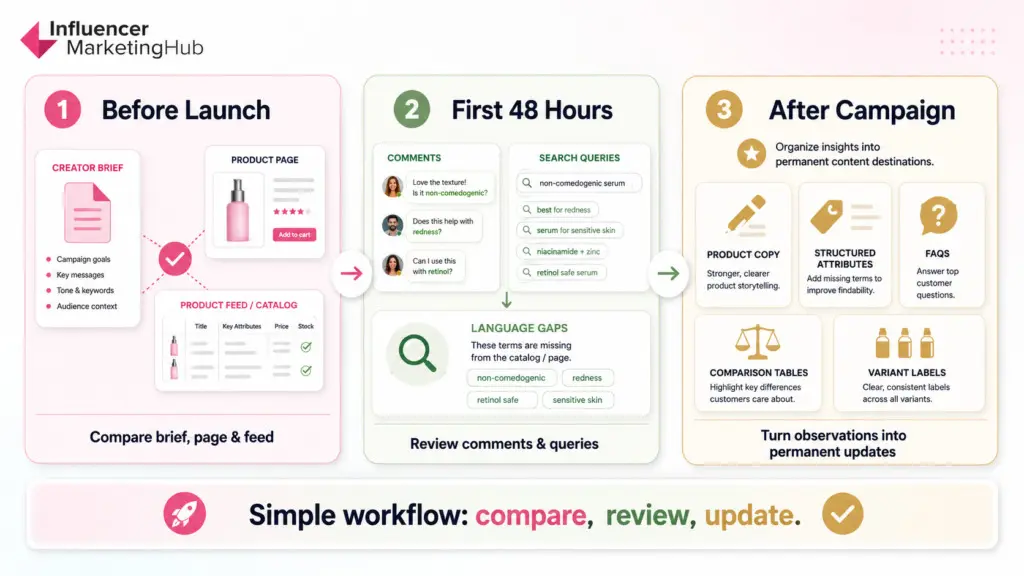
To address this, leading brands are adopting a more integrated workflow:
- Pre-Launch Alignment: Comparing the creator’s brief with the product feed to ensure key selling points (like a "laptop pocket") are present in the metadata.
- Real-Time Monitoring: Reviewing the first 48 hours of social media comments to identify "buying phrases" or unexpected questions that the current product page doesn’t answer.
- Post-Campaign Updates: Permanently integrating successful creator language into FAQs, comparison tables, and structured attributes.
Data-Driven Insights and Market Reactions
Data from recent e-commerce trends suggests that "conversational search" is growing at a rate that outpaces traditional search. Consumers are increasingly using natural language to describe their needs. For instance, a shopper is less likely to search for "women’s footwear category 184" and more likely to ask for "white sneakers that don’t look too sporty for a wedding."
In response, tech-forward retailers are moving toward "headless commerce" architectures. This allows them to decouple the frontend presentation from the backend data, making it easier to push real-time updates to various channels—social storefronts, marketplaces, and AI feeds—simultaneously. This ensures that if a creator’s video goes viral for a specific feature, the product data across the entire ecosystem can be updated within hours to reflect that newfound relevance.
Broader Implications for the Future of Retail
The shift toward aligning creator language with product data has profound implications for Search Engine Optimization (SEO). We are entering an era of AI Optimization (AIO), where the goal is not to "stuff" keywords, but to provide the most comprehensive and "useful" set of attributes possible.
The 2026 Influencer Marketing Hub report suggests that the brands that will win in the next three years are those that treat their product data as a living document. This means moving away from "approved at launch" copy and toward a dynamic system that absorbs customer and creator feedback.
Furthermore, this alignment serves as a form of "trust signaling." When an AI assistant provides a result that perfectly matches the nuances of a creator’s recommendation, it reinforces the consumer’s confidence in both the creator and the brand. Conversely, if the AI provides a generic or mismatched result, it creates friction that can damage the brand’s perceived reliability.
Conclusion and Strategic Takeaway
The era of "set it and forget it" product catalogs is over. As creators become the primary drivers of product discovery, their language must become the foundation of a brand’s data strategy. The disconnect between a human recommendation and a machine-readable catalog is a significant barrier to conversion that can no longer be ignored.
For brands looking to optimize their performance in 2026, the mandate is clear: bridge the silo between the creator marketing team and the data management team. By ensuring that the "buying phrases" used in social media are reflected in the structured data of the product feed, brands can ensure that the preference created by influencers successfully travels through AI assistants and results in a completed sale. The most successful brands will not necessarily be those with the largest marketing budgets, but those that maintain the most accurate, descriptive, and "human" product data across the digital ecosystem.