The Future of AI Infrastructure Navigating the Rising Tide of Data Center Moratoriums and Community Pushback

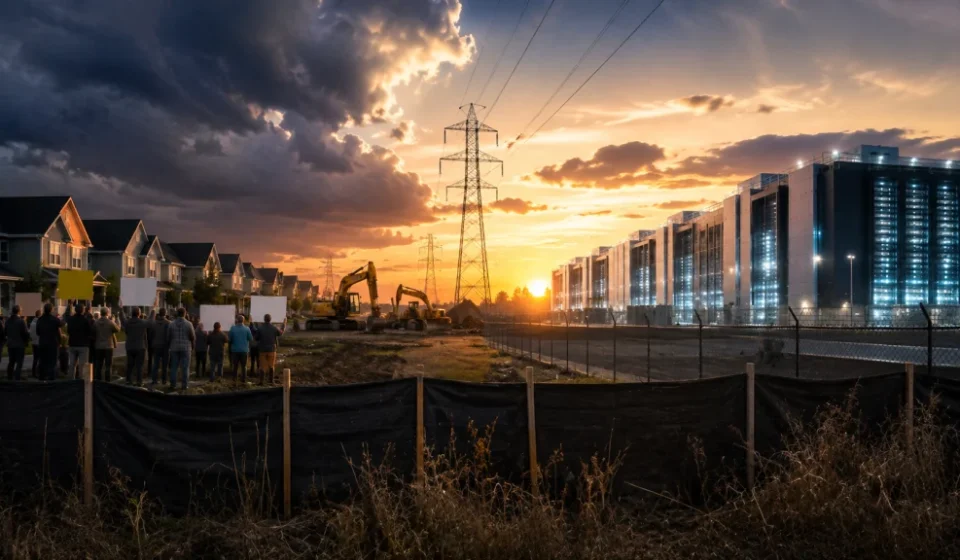
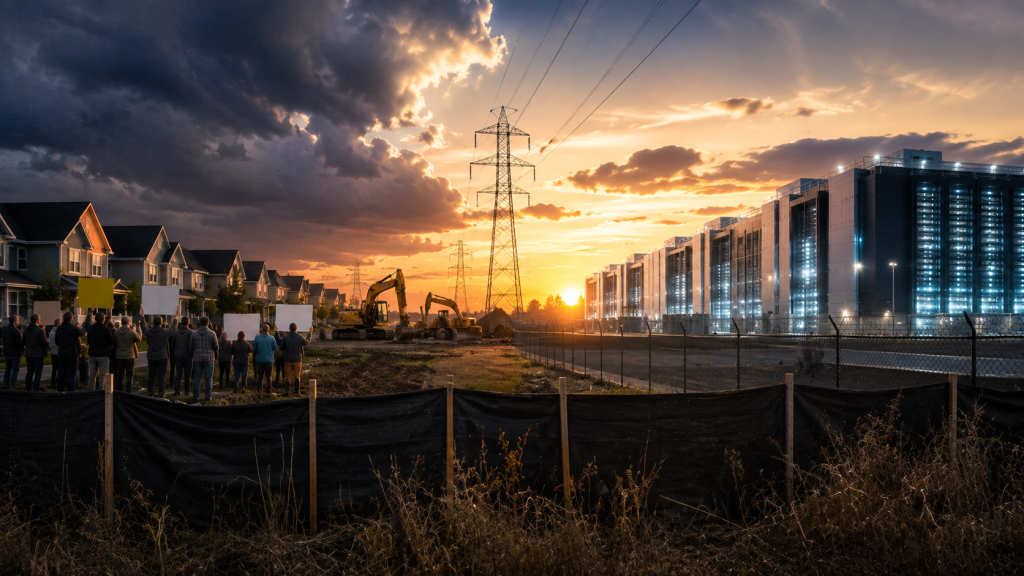
The rapid expansion of artificial intelligence and cloud computing has ignited a massive infrastructure boom across the United States, yet this growth is increasingly colliding with localized resistance. As developers race to build the data centers required to power the next generation of digital services, they are encountering a phenomenon reminiscent of the mid-20th-century "Freeway Revolts." From the suburbs of Northern Virginia to the tech hubs of the West Coast, local communities are voicing concerns over energy consumption, water usage, and noise pollution. While the demand for AI processing power remains at an all-time high, a growing number of municipal and state governments are implementing moratoriums to study the long-term environmental and economic impacts of these massive facilities.
Historical Context: The Precedent of the Freeway Revolts
To understand the current friction between national infrastructure goals and local community interests, analysts often look back to the late 1950s. Following the passage of the Federal Aid Highway Act of 1956, President Dwight D. Eisenhower launched a bold initiative to construct a 41,000-mile nationwide system of interstate highways. The project was framed as a necessity for national defense and economic modernization. However, as these massive transit arteries began carving through established urban neighborhoods, they met fierce opposition.
In San Francisco, the "Freeway Revolt" became a defining moment in urban planning history. Residents grew increasingly alarmed as proposals emerged to run elevated highways through iconic locations, including the Panhandle and Golden Gate Park. Throughout the early 1960s, citizens packed public meetings, organized petitions, and lobbied local officials to halt the projects. By 1966, the San Francisco Board of Supervisors famously rejected several major freeway segments by a narrow margin. While this local victory preserved the character of San Francisco, it did not halt the broader national expansion of the Interstate Highway System. Instead, the infrastructure was rerouted or adapted, a historical lesson that many industry experts believe will repeat itself in the current data center era.
The Scale of the Modern Data Center Boom
The current demand for data centers is driven by the unprecedented computational requirements of generative artificial intelligence and large language models (LLMs). According to Stanford University’s AI Index Report, the infrastructure required to support these technologies has led to a surge in construction. At the end of 2025, there were approximately 5,427 operational data centers in the United States. Current projections indicate that this number could nearly double in the coming decade, with plans already in place for an additional 3,969 facilities.
Recent data from June 2024 shows that data center construction spending rose 7% in a single month, reaching an annualized rate of $68.3 billion. This represents a staggering 46% increase compared to the same period in the previous year. The investment is not merely speculative; it is backed by a massive order backlog that industry analysts expect will persist through at least 2030. Despite this momentum, the sheer speed of development has outpaced the ability of local utility providers and regulatory bodies to adapt, leading to the current wave of policy pushback.
The Rise of Regulatory Moratoriums
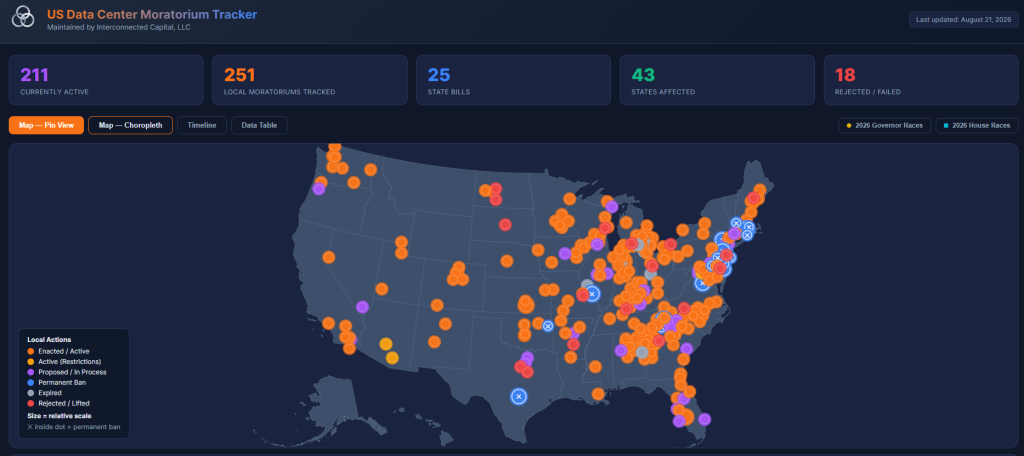
As of late 2024, more than 260 local moratoriums or restrictive zoning ordinances related to data centers have been tracked across the United States. These pauses in development are typically designed to give local governments time to update their master plans, assess the strain on power grids, and establish environmental standards for noise and water usage.
New York recently became the first state to implement a statewide moratorium on a specific class of data centers. The policy targets "hyperscale" facilities—those consuming 50 megawatts or more of power. Signed into effect by Governor Kathy Hochul, the one-year moratorium aims to ensure that all new construction adheres to consistent environmental standards. The state plans to conduct a comprehensive study on how these energy-intensive facilities impact New York’s ambitious climate goals. Despite the pause, Upstate New York remains a highly desirable location for the industry due to its abundant hydroelectric resources and proximity to Canadian power markets, suggesting that construction will likely resume once new regulatory frameworks are finalized.
Energy Constraints and the Texas Grid Challenge
The primary point of contention in most data center disputes is electricity. Modern AI chips, such as those produced by Nvidia, require significantly more power than traditional servers. This has placed an immense burden on regional power grids.
Texas serves as a primary example of the disconnect between project proposals and grid capacity. The Electric Reliability Council of Texas (ERCOT) has reported an unprecedented queue of interconnection requests. Currently, data center developers have requested more than 410 gigawatts of power to be added to the Texas grid. To put this in perspective, the entire state’s peak power demand currently hovers around 85 gigawatts. The queue is nearly five times the size of the existing grid’s total capacity.

While many of these filings are speculative—landowners and developers "holding a spot" in line—the sheer volume highlights the logistical hurdles facing the industry. Even if only a fraction of these projects move forward, they will require a massive overhaul of transmission lines and power generation facilities, costs that often trickle down to residential ratepayers, further fueling community opposition.
Environmental and Social Concerns: Water and Noise
Beyond electricity, data centers face criticism for their consumption of natural resources. High-performance computing generates extreme heat, requiring sophisticated cooling systems. Many facilities use evaporative cooling, which can consume millions of gallons of water per day. In drought-prone regions of the American West, this has become a flashpoint for local activists.
Furthermore, the noise generated by massive HVAC systems and backup diesel generators has led to quality-of-life complaints in residential areas. In Northern Virginia’s "Data Center Alley," residents have successfully lobbied for stricter noise ordinances and requirements that new facilities be built with sound-dampening architecture. These localized battles have forced developers to reconsider site selection, moving away from suburban neighborhoods toward more remote, rural locations where land is cheaper and industrial noise is less disruptive.
Supply Chain Delays and the Order Backlog
While political pushback is a significant factor in project delays, it is not the only obstacle. The industry is currently grappling with severe supply chain constraints. Essential components such as high-voltage transformers, power distribution units, and large-scale backup turbines currently have lead times ranging from 18 to 36 months.
Skilled labor is also in short supply. Building a modern data center requires specialized electrical and mechanical engineering expertise that is currently being stretched thin across multiple global projects. Industry analysts note that while headlines often focus on "canceled" projects, many of these are actually "deferred" due to the inability to secure the necessary hardware or labor to break ground. This supply-demand imbalance suggests that the boom is not ending, but rather entering a more prolonged, constrained phase of growth.
Financial Outlook and Global Investment Trends
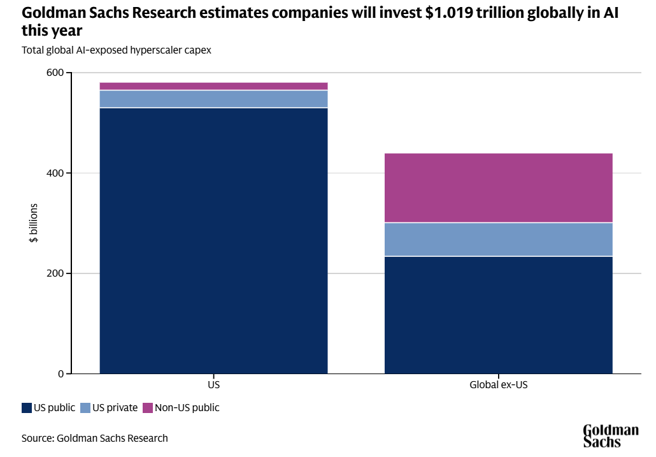
The financial stakes of the data center race are immense. Goldman Sachs recently forecasted that global AI-related investment will exceed $1 trillion by 2026. This capital is being deployed by "hyperscalers" like Microsoft, Alphabet, Meta, and Amazon, as well as specialized real estate investment trusts (REITs).
By 2030, cumulative spending on AI infrastructure and data centers is projected to reach between $5 trillion and $7.6 trillion. For investors, this represents a massive opportunity, but one that requires careful navigation. The focus is shifting from pure-play chip manufacturers to the broader ecosystem, including power management companies, cooling technology providers, and renewable energy developers.
Industry Adaptation and the Path Forward
In response to the growing resistance, the data center industry is beginning to pivot toward more sustainable and community-friendly practices. Developers are increasingly investing in "behind-the-meter" power solutions, such as small modular reactors (SMRs) or dedicated solar farms, to reduce their reliance on public grids. Additionally, newer facilities are utilizing closed-loop liquid cooling systems that drastically reduce water consumption.
There is also a trend toward geographic diversification. To avoid the regulatory hurdles and high costs of traditional hubs like Loudoun County, Virginia, or Santa Clara, California, developers are looking toward states like Indiana, Iowa, and Ohio. these regions often offer tax incentives and have more "breathing room" on their local grids.
Conclusion: A Shift, Not a Stop
The current pushback against data centers does not signal the end of the AI revolution, but rather its transition into a more mature and regulated phase. Much like the interstate highways of the 1960s, data centers have become a critical component of national infrastructure. While local communities will continue to demand—and receive—greater oversight and concessions, the fundamental economic and technological drivers behind the boom remain intact.
The "wall" that some investors fear is likely more of a speed bump. As state and local governments establish clearer guidelines, the uncertainty that currently plagues the development process is expected to diminish. For the foreseeable future, the challenge for the industry will not be a lack of demand, but the complex task of balancing the insatiable hunger for data with the finite resources and political realities of the physical world. The transition from speculative, rapid-fire construction to a more deliberate, environmentally conscious approach will likely define the next decade of American infrastructure development.