The Grim Reaper’s Unexpected Holiday: Unpacking the Romance and Mysteries of Death in Moonlight Peaks

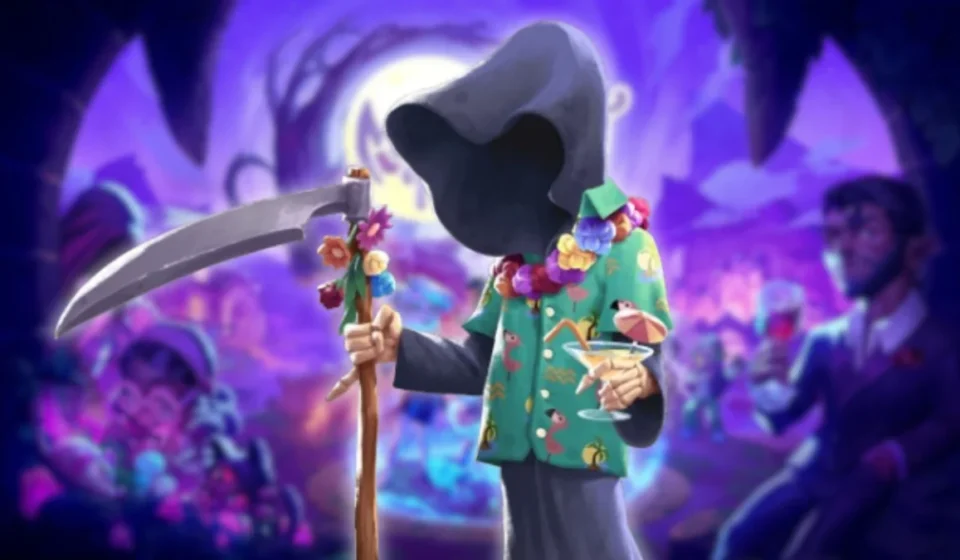
Moonlight Peaks, a town already steeped in supernatural intrigue, has become the unlikely vacation destination for a particularly significant cosmic entity: Death itself. While residents and visitors alike are accustomed to the presence of vampires, werewolves, and other fantastical beings, the arrival of the Grim Reaper, clad in a Hawaiian shirt and lei, has introduced an entirely new dimension to the town’s already vibrant tapestry of the unusual. This unexpected sojourn has not only provided a respite for the personification of mortality but has also opened up unprecedented romantic possibilities for the townsfolk, challenging conventional notions of courtship and eternal companionship.
The narrative surrounding Death’s presence in Moonlight Peaks begins not with a grim reaping, but with a surprising personal initiative. Early in the game’s storyline, Death, shedding its traditional somber persona for a more relaxed holiday demeanor, makes a direct approach to the player character. This initial encounter serves a dual purpose: it introduces a key narrative element and establishes a unique gameplay mechanic. Death informs the player of a local phenomenon – the scattering of one hundred "Soul Blobs" throughout the town. The quest to collect these ethereal remnants is not merely a side activity; it is intrinsically linked to Death’s personal journey and its burgeoning relationship with the player.
The Collector’s Quest: Soul Blobs and Temporal Control
The task of gathering the one hundred Soul Blobs is presented as a crucial undertaking. Upon successful completion of this collection, Death bestows a remarkable gift upon the player: an antique clock. This artifact is not merely decorative; it offers a tangible gameplay advantage, granting the player the ability to manipulate the passage of time within Moonlight Peaks, allowing for adjustments to the length of the night. This mechanic has significant implications for gameplay, influencing farming cycles, the timing of nocturnal events, and the schedules of other supernatural inhabitants. The integration of a core gameplay element with the personal narrative of a romanceable character, especially one as iconic as Death, underscores the innovative approach taken by the developers in crafting the Moonlight Peaks experience.
The significance of this "gift" extends beyond its practical application. It signifies a deepening of the bond between the player and Death, a tangible representation of progress in their developing relationship. The act of collecting the Soul Blobs, a task inherently related to the essence of life and spirit, becomes a shared endeavor, fostering a unique form of intimacy. The clock, therefore, can be interpreted as a symbol of shared control over destiny and time, a testament to the extraordinary connection being forged.
Locating the Lord of Shadows: A Permanent Fixture on Holiday
Following the initial introduction and the Soul Blob collection quest, Death establishes a more permanent presence in Moonlight Peaks. While the Grim Reaper’s traditional haunts are often associated with the liminal spaces between life and death, this particular incarnation has opted for a more grounded, albeit still spectral, residence. Players can frequently locate Death in the heart of the town, specifically by the water, within its designated home. The spectral figure is often visible through the front window, a haunting yet approachable presence. This visual cue serves as a constant reminder of Death’s integration into the town’s fabric, transitioning from a transient visitor to a somewhat settled resident, albeit one who may still be on vacation.
The choice of Moonlight Peaks as a holiday destination is particularly noteworthy. The town’s inherent supernatural atmosphere, populated by creatures of myth and legend, makes it a fitting backdrop for Death’s temporary retirement from its eternal duties. This setting allows for a unique juxtaposition of the ultimate harbinger of the end and the vibrant, often tumultuous, lives of its residents. The developers have carefully crafted this environment to accommodate such an unusual character, ensuring that Death’s presence feels organic within the game’s lore, even as it pushes the boundaries of conventional fantasy tropes.

Courting Eternity: The Unconventional Romance of Death
Perhaps the most talked-about aspect of Death’s presence in Moonlight Peaks is the unprecedented opportunity for romance. In a world populated by vampires, werewolves, and mermaids, the prospect of wooing the Grim Reaper stands out as the ultimate unconventional courtship. The game allows players to pursue a romantic relationship with Death, a journey that culminates in the potential for marriage once a significant level of affection, represented by eight hearts, has been achieved.
This narrative arc challenges societal norms and the very definition of love and companionship. The idea of spending eternity with the personification of death itself is a profound concept, inviting players to contemplate the nature of existence, mortality, and the enduring power of connection. The developers have clearly invested significant effort in developing Death’s character to make this romance plausible and compelling, moving beyond a mere gimmick to a deeply integrated aspect of the game’s narrative.
The process of building a romantic relationship with Death, much like with other romanceable characters, likely involves a series of interactions, gift-giving, and dialogue choices. The game’s mechanics are designed to reward players for understanding and catering to Death’s preferences, fostering a sense of genuine connection. The fact that Death, a being typically associated with finality, can experience and reciprocate love suggests a nuanced portrayal of the character, suggesting that even the ultimate end can be touched by the warmth of affection.
Gifts of Affection: Understanding Death’s Preferences
To successfully court Death, understanding its likes and dislikes is paramount. While the provided data does not list specific items Death "Loves," "Likes," or "Dislikes," this absence itself is a point of analysis. It suggests that perhaps Death’s affections are not swayed by material possessions in the same way as mortal beings. Alternatively, the "Loves" category might be reserved for actions or dialogue choices that demonstrate genuine understanding and acceptance of Death’s nature, rather than specific in-game items.
The "Likes" category would typically encompass items that resonate with Death’s role or perhaps its current holiday persona. For instance, items associated with reflection, time, or even elements that contrast with its usual somber duties (like tropical-themed gifts, given its current attire) could be considered. The "Dislikes" category would likely include items that are overly ostentatious, frivolous, or perhaps those that symbolize a denial of mortality or a fear of the inevitable. Without specific item listings, players are encouraged to engage with Death’s personality and dialogue to infer its preferences, adding a layer of depth to the relationship-building process.
This nuanced approach to gift-giving, if it indeed leans towards understanding rather than simple acquisition, elevates the romance beyond a typical fetch-quest. It encourages players to engage with Death on a more profound level, to truly listen and observe, and to build a relationship based on mutual understanding and acceptance.
The Unbirthday Enigma: A Being Beyond Conventional Timelines
A peculiar aspect of Death’s character, as revealed in the provided information, is the absence of a birthday. This detail is not merely a trivia point; it is a fundamental characteristic that reinforces Death’s existence beyond the conventional human lifecycle. Birthdays are markers of personal progression and the passage of time for mortal beings. For Death, an entity that presides over the end of these timelines, such a concept is inapplicable.
This lack of a birthday further emphasizes Death’s otherworldly nature. It is a being that exists in a different temporal plane, unbound by the biological and chronological constraints that govern the lives of mortals. For a potential romantic partner, this means accepting a being whose existence predates and will outlast any individual’s lifespan. The absence of a birthday, therefore, is not a deficit but a defining characteristic, highlighting the unique challenges and profound implications of pursuing a relationship with such an entity. It suggests that the "eternity" promised in such a union is not merely a metaphor but a literal reflection of Death’s own timeless existence.
The Persona of the Personification: Death on Vacation
The portrayal of Death in Moonlight Peaks is a significant departure from its traditional, often terrifying, depiction. The game presents a version of Death that is not only approachable but is actively seeking a break from its eternal responsibilities. This vacationing Grim Reaper is characterized by a visual dichotomy: the classic skeletal form, the flowing black robe, and the iconic scythe are juxtaposed with the decidedly more casual attire of a tropical shirt and a lei. This visual incongruity immediately signals a shift in the character’s persona, signaling a desire for relaxation and a departure from the grim realities of its job.
This relaxed demeanor extends to its social interactions. Death eschews the typical familial and societal structures associated with sentient beings. It possesses no surname, no clan, and no discernible family members. This solitary existence, while fitting for the personification of an ultimate, singular force, also makes the prospect of forming a personal connection all the more significant. The game’s narrative suggests that Death is open to accepting gifts and, more importantly, love, indicating a capacity for emotional connection that transcends its cosmic role.
The choice of Moonlight Peaks as a vacation spot is not arbitrary. The town, teeming with supernatural life and unusual occurrences, provides a familiar yet relaxed environment for Death to unwind. It is a place where its presence, while still extraordinary, might be more readily accepted or at least understood within the broader context of the town’s unique ecosystem. This choice underscores the developers’ intent to humanize, or perhaps more accurately, to personify, Death in a way that makes it relatable and even endearing.
Broader Implications for the Supernatural Genre
The introduction of Death as a romanceable character in Moonlight Peaks represents a significant evolution within the supernatural romance genre. Traditionally, these narratives focus on human protagonists falling for fantastical beings, often exploring themes of forbidden love, acceptance, and the blurring lines between worlds. Moonlight Peaks, however, takes this a step further by allowing players to pursue a relationship with the ultimate symbol of mortality.
This narrative choice has several implications:
- Re-evaluation of Mortality: By making Death a romantic interest, the game prompts players to reconsider their perception of mortality. Instead of viewing Death as an antagonist or an inevitable end, players are encouraged to see it as a potential partner, capable of affection and companionship. This reframes the concept of death not as an absolute negation but as a transition, and potentially, a shared journey.
- Expansion of Romance Tropes: The inclusion of Death pushes the boundaries of established romance tropes. It challenges the conventional understanding of what constitutes a suitable romantic partner, moving beyond the typical archetypes of brooding vampires or noble werewolves. This opens up new avenues for storytelling within the genre, allowing for even more diverse and unconventional relationships to be explored.
- Philosophical Engagement: The romance with Death can be interpreted as a philosophical exploration of life, love, and the acceptance of the inevitable. It invites players to contemplate the nature of eternity, the meaning of companionship in the face of ultimate finality, and the possibility of finding love in the most unexpected of places.
The success of this narrative arc hinges on the developers’ ability to balance the inherent gravitas of Death’s role with the lightheartedness required for a romanceable character in a game. The visual design, character dialogue, and gameplay mechanics must all work in concert to create a compelling and believable connection, ensuring that the romance feels earned and meaningful, rather than simply a novelty. The developers have, by all accounts, succeeded in creating a unique and memorable character that adds substantial depth and intrigue to the world of Moonlight Peaks.