
August 2026 witnessed a dynamic realignment within the mobile gaming publishing landscape, with established titans reinforcing their positions while several agile contenders made notable ascensions and others experienced shifts in momentum. This period of intense competition and evolving consumer preferences brought forth distinct leaders in both download volume and revenue generation, underscoring diverse strategies for market penetration and monetization. The monthly analysis, drawing data from industry sources like AppMagic, reveals both predictable dominance and surprising movements that collectively paint a comprehensive picture of the sector’s health and direction.
The Downloads Landscape: August’s Dominators in User Acquisition
The battle for user attention continued to intensify in August, with publishers employing varied strategies, primarily leaning into the hyper-casual and casual gaming segments to maximize reach. Miniclip, a long-standing powerhouse in the mobile gaming sphere, once again secured the apex position in downloads, registering an impressive 93.04 million downloads. This performance not only reaffirms its robust global distribution network but also its consistent ability to captivate a broad audience with accessible and engaging titles. Miniclip’s sustained lead often stems from a diverse portfolio that includes sports simulations, puzzle games, and popular casual experiences, ensuring a wide appeal across demographics.
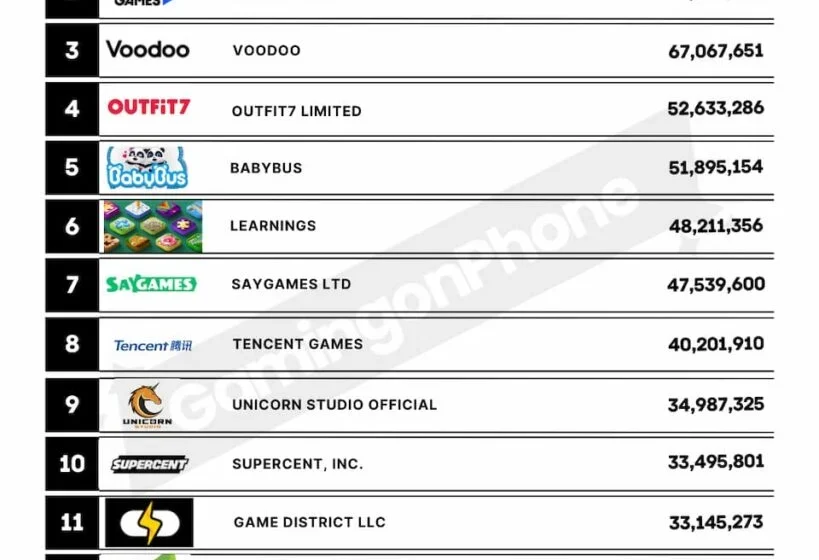
Immediately trailing Miniclip was Azur Games, solidifying its second-place standing with 72.66 million downloads. Azur Games, known for its prolific output of hyper-casual titles, demonstrates the enduring effectiveness of a high-volume, rapid-release strategy in the download charts. The segment relies on viral mechanics, short play sessions, and intuitive controls to quickly attract and cycle through users. VOODOO, another prominent player in the hyper-casual space, maintained a strong presence, securing third place with 67.07 million downloads. The consistent top-tier performance of these three publishers underscores the significant role of the hyper-casual genre in driving raw download numbers, often leveraging extensive advertising campaigns and trend-sensitive game development.
Further down the rankings, Outfit7, celebrated for its "Talking Tom and Friends" franchise, exhibited a notable climb into fourth place, garnering 52.63 million downloads. This ascent highlights the sustained appeal of character-driven, family-friendly content that resonates across age groups and maintains loyalty over time. Its upward trajectory moved it ahead of BabyBus, which secured fifth with 51.90 million downloads. BabyBus specializes in educational and entertainment apps for children, a niche that consistently generates high download volumes due to parental engagement and the constant influx of new young users.
The dynamic nature of the market was evident with Learnings experiencing a drop from fourth to sixth place, despite still recording a substantial 48.21 million downloads. Such shifts, even with strong numbers, indicate heightened competition and the continuous need for publishers to innovate and refresh their offerings. SayGames Ltd held its ground in seventh place with 47.54 million downloads, another testament to the hyper-casual model’s consistent performance.
One of the more surprising and significant movements within the download top ten was Unicorn Studio Official’s impressive leap to ninth place, achieving 34.99 million downloads. This rapid rise suggests a breakthrough title or a highly effective marketing campaign that allowed a relatively newer or less prominent entity to challenge established players. Unicorn Studio Official’s success serves as a reminder that the mobile gaming market, despite its maturity, still offers avenues for swift ascent for innovative or well-executed projects. Tencent Games, a global behemoth in both downloads and revenue, climbed to eighth with 40.20 million, demonstrating its continued expansion across various segments, though its download numbers are often dwarfed by its revenue figures, which are driven by high-monetization titles.
Rounding out the top ten was Supercent, Inc. with 33.50 million downloads, indicating a steady presence. The subsequent positions saw Game District LLC in 11th (33.15 million), IVYMOBILE in 12th (31.30 million), and CrazyLabs Ltd in 13th (28.53 million). These publishers, while not at the very top, represent the engine room of the mobile gaming market, consistently delivering a steady stream of new content. Garena International, a major player in competitive online gaming, moved into 14th place with 25.34 million downloads, often driven by its popular battle royale and multiplayer online battle arena (MOBA) titles. Century Games Pte. Ltd. completed the top 15 with 24.61 million, showcasing its ability to attract a significant user base even as it also features prominently in the revenue charts. Notably, Take-Two Interactive and Wildlife Studios, both fixtures in July’s top 15, exited the download rankings this month, underscoring the fierce competition and the transient nature of high download volumes.
The Revenue Arena: Monetization Masters and High-Value Engagement

While downloads reflect broad user acquisition, revenue figures paint a picture of engagement, monetization efficacy, and the value of specific gaming experiences. In August 2026, the revenue charts continued to be dominated by publishers specializing in games with deep engagement loops, strong social features, and sophisticated in-app purchase (IAP) mechanics.
Tencent Games, without surprise, reaffirmed its status as the undisputed king of mobile gaming revenue, generating an astounding $529.12 million. This figure not only highlights its massive market share but also its unparalleled ability to monetize its vast portfolio of titles, which includes some of the world’s most profitable mobile games across genres like RPGs, strategy, and MOBA. Tencent’s strategic investments and robust ecosystem continue to set the benchmark for financial performance in the industry.
Century Games Pte. Ltd. maintained a strong second position, pulling in $224.22 million. Its consistent high revenue is often attributed to its focus on strategy and role-playing games, which typically feature complex progression systems, strong community elements, and highly effective gacha mechanics or battle passes that encourage significant player spending. The publisher’s ability to sustain such high figures demonstrates a deep understanding of player psychology and long-term engagement strategies.
Dream Games exhibited a significant ascent in the revenue rankings, climbing from fourth to third place with $147.66 million. This upward movement is indicative of strong performance from its popular puzzle and casual games, which often combine appealing aesthetics with compelling narrative elements and well-designed monetization systems that encourage recurring purchases. Microfun Limited also moved up one position to fourth, generating $139.47 million, demonstrating steady growth and effective monetization of its titles.
Playrix, a consistent revenue generator known for its popular "match-3" and city-building hybrid games, slipped to fifth despite recording a robust $133.02 million. Its slight dip, despite impressive figures, highlights the aggressive competition at the top tiers of mobile gaming revenue, where even minor shifts in player spending or new game launches can impact rankings.
Take-Two Interactive, known for its console and PC gaming heritage but with a growing mobile presence, showed strong performance in the revenue charts, climbing from seventh to sixth with $115.65 million. This suggests that its mobile adaptations or original titles are successfully translating brand loyalty and deep gameplay into significant financial returns. Scopely, a publisher with a strong portfolio of licensed IP-based games and strategy titles, also rose to seventh place, generating $112.99 million, underscoring the power of popular franchises and sophisticated live-ops management.
NetEase Games, another Chinese gaming giant and a fierce competitor to Tencent, experienced a slight dip from sixth to eighth, though still commanding a substantial $111.66 million. NetEase’s revenue is largely driven by its strong lineup of RPGs and fantasy-themed games, particularly in Asian markets, which are known for their high average revenue per user (ARPU).
King, the progenitor of the Candy Crush phenomenon, made a notable jump from 11th to ninth, bringing in $106.99 million. This resurgence or sustained high performance for King illustrates the enduring appeal and incredible monetization power of evergreen casual titles, which maintain massive daily active user bases and consistent IAP revenue years after their initial launch. Roblox Corporation maintained its tenth position with $100.58 million, a testament to the metaverse platform’s unique blend of user-generated content, social interaction, and robust virtual economy that encourages significant spending on virtual items and experiences.
Further down the revenue list, KONAMI moved up to 11th with $97.41 million, often fueled by its sports titles and other popular franchises. Moon Active followed in 12th with $82.98 million, a strong performer in the casual and social casino segments. Cognosphere (HoYoverse), the creator of global sensations like Genshin Impact, held 13th with $67.61 million. HoYoverse’s presence highlights the immense revenue potential of high-production-value gacha RPGs that cultivate deeply loyal and highly spending player communities. Supercell, known for its enduring strategy and competitive multiplayer titles, climbed to 14th with $63.80 million, reinforcing the long-term value of well-designed, competitive games with strong clan mechanics.
Finally, Bandai Namco Entertainment entered the top 15 in August, generating $61.17 million and securing the final position. Its entry, often driven by popular anime and manga IP adaptations, indicates the continued strength of brand recognition in attracting and monetizing dedicated fanbases. Bandai Namco’s arrival pushed FUNFLY PTE. LTD. out of the previous month’s rankings, further emphasizing the constant flux at the high-stakes end of the mobile gaming market.

Broader Market Trends and Strategic Insights for August 2026
August 2026’s publisher rankings reveal several critical trends shaping the mobile gaming industry. The stark divergence between download leaders and revenue leaders is perhaps the most significant. Publishers like Miniclip, Azur Games, and VOODOO dominate downloads through high-volume, low-cost user acquisition strategies characteristic of hyper-casual games. These titles prioritize accessibility and virality, aiming for massive reach. In contrast, revenue leaders such as Tencent, Century Games, and HoYoverse focus on deeper, more complex games – RPGs, strategy titles, and social simulations – that foster long-term engagement and leverage sophisticated monetization models like gacha, battle passes, and subscription-like services. This bifurcation highlights two distinct but equally valid paths to success in the mobile market.
The consistent performance of family-friendly publishers like Outfit7 and BabyBus in the download charts underscores the evergreen demand for safe, entertaining, and often educational content for younger audiences. This niche, while not always topping revenue charts, provides a stable and continuous stream of new users. Meanwhile, the resilience of "evergreen" casual titles from King demonstrates that games with strong core loops and massive, dedicated player bases can continue to generate significant revenue years after their launch, often through continuous content updates and seasonal events.
The entry and exit of publishers from the top 15 in both categories also underscore the intense competition and the rapid pace of innovation. New entrants like Unicorn Studio Official can quickly gain traction with a successful title, while established players must constantly adapt to avoid being displaced. The global nature of mobile gaming means that publishers must also contend with regional preferences and varying monetization potentials, with Asian markets, for example, often showing higher ARPU for certain genres.
Looking Ahead: The Remainder of 2026
As the mobile gaming industry moves towards the final quarter of 2026, the trends observed in August are likely to persist and evolve. Publishers will continue to refine their user acquisition strategies amidst rising advertising costs, potentially leading to a greater emphasis on organic growth and community building. Monetization models will likely become even more sophisticated, with hybrid approaches combining IAPs, subscriptions, and perhaps even blockchain-integrated economies gaining traction.
The balance between hyper-casual’s broad appeal and mid-core/hardcore’s deep monetization will remain a critical strategic consideration. Publishers that can successfully bridge this gap, offering accessible entry points into deeper, more rewarding experiences, may find a new competitive edge. Furthermore, the increasing integration of social features and metaverse-like elements, exemplified by Roblox, suggests a future where games are not just played but lived in, offering persistent social environments that drive long-term engagement and spending.
The mobile gaming market, valued at hundreds of billions of dollars globally, continues to be a hotbed of innovation and intense competition. August 2026 serves as a compelling snapshot of this dynamic ecosystem, showcasing the varied paths to success and the constant evolution required to remain at the forefront. The continuous shifts in rankings, the emergence of new contenders, and the enduring strength of established giants all point to a sector that is as vibrant and unpredictable as ever.